
Recurring floods: A direct consequence of deforestation in the Western Ghats

Shivani
September 17, 2020

ghat4.JPG

The Western Ghats have been exposed to excessive human interference for past few years. Though a certain amount of forest was lent for agroforestry in this hot-spot of biological diversity, people have crossed the margin which resulted in irregular rains and floods in the region. In the past few years, south-west of India was prone to floods and landslides though the amount of rain received by these parts is relatively less.

According to environmental activist Dinesh Holla, “the shola grassland that grows in the hills of Western Ghats play a major role in holding the rainwater that flows down the hill. The roots of the grass hold the rainwater and this water is stored in the catchment area. Hence only a limited amount of rainwater joins the river. Since the shola forest is being cut down for different purposes like setting up the power plant, resorts, commercial crop plantation etc the water flows down the hill causing soil erosion and flooding as well. In 2018, Kerala and Madikeri faced major floods due to this.”

“Last year, several parts of Western Ghats suffered forest fire. This became an opportunity for estate owners to extend their land of agroforest. There are even instances where the estate owner sprayed chemicals on the grassland so that they catch fire during summer and they could occupy the reserved forest land. Also, the forest fire burns the seed that would germinate into another tree. Hence the reserved forest area is somehow devastated by the people. Though only certain parts of Western Ghats are allotted for development purpose, a large area of forest has been encroached.”

Shivananda Kalave, a water conversationalist, says, “There are   several endemic plants grown in Western Ghats. In order to make deforestation look convincing to the public, the industrialists claim it as compensatory deforestation. The suitable climate necessary for the growth of the endemic plants is only found in Western Ghats. Hence deforestation is still a damage with or without compensation.” 

“There are several plants in Western Ghats that boost our immunity but people decide to destroy forests under the pretext of development, employment and what not. What kind of unhealthy society are we building by destroying this forest which is beyond price?” he laments. 

In concern with floods, Karve says that the absorption rate of the forest in Western Ghats is 10- 12% rest of water flows down and joins the river. Since the highway has been constructed in between the forest, the water does not have a proper path to flow. Also, after immense clear cutting of the forest, the rate of absorption has declined to 4% which means the amount of rainwater that would be flowing to the river will be unendurable, resulting in floods.

The section 2 of the Forest (Conservation) Act of 1980 states that a prior approval is necessary from the central government before de-reserving the reserved forest. Several parts of Western Ghats also belong to the reserved forest. Also, according to the National Forest Policy 2016, climate change should be given importance in forest management and community management plans. The Ministry of Environment and Forest appointed the Western Ghats ecological expert panel under the chairmanship of Madhav Gadgil. The committee divided the area into three based on their ecological sensitivity. But the report faced great criticism as the people assumed it to be against farmers. Later the Kasturirangan committee was formed to examine the report of the Gadgil committee. However, this report favoured the corporates. As only 37% Western Ghats was considered an ecological sensitive zone and rest of the land is available for development projects. 

Nature has the power to generate as well as destroy. Even after facing the destruction caused by floods, humans have not learnt any lessons from the past. Clear cutting still takes place in Western Ghats, people still go there for road trips and throw plastic. This is just the beginning of karma to human society for the destruction we have caused. Destruction of nature will be nothing but us digging our own grave.

ghat1.JPG

ghat3.JPG


ghat2.jpg


Comments

Add new comment

  • Coastaldigest.com reserves the right to delete or block any comments.
  • Coastaldigset.com is not responsible for its readers’ comments.
  • Comments that are abusive, incendiary or irrelevant are strictly prohibited.
  • Please use a genuine email ID and provide your name to avoid reject.
News Network
December 2,2025

Mangaluru, Dec 2: Mangaluru International Airport responded to a medical emergency late on Monday night. Air India Express flight IX 522, travelling from Riyadh to Thiruvananthapuram, was diverted to Mangaluru Airport after a passenger in his late 30s experienced a medical emergency on board.

The Airport’s Operations Control Centre received an alert regarding the passenger’s health condition. The airport activated its emergency response protocol, mobilising the airport medical team and coordinating with stakeholders including CISF, immigration, and customs. 

Upon landing, airport medical personnel attended to the passenger, assessed his condition, and arranged to shift him to a local tertiary-care hospital for further treatment. The passenger’s relatives accompanied the passenger, who incidentally received necessary medical care on board, which helped stabilise the situation.

Following the handling of the emergency, the flight departed for Thiruvananthapuram at 2:05 am on Tuesday.

"We appreciate the cooperation of all parties involved, and this incident reaffirms our ongoing commitment to prioritising passenger safety and readiness to respond to unforeseen emergencies with professionalism and care," the Airport spokesperson said. 

Comments

Add new comment

  • Coastaldigest.com reserves the right to delete or block any comments.
  • Coastaldigset.com is not responsible for its readers’ comments.
  • Comments that are abusive, incendiary or irrelevant are strictly prohibited.
  • Please use a genuine email ID and provide your name to avoid reject.
News Network
December 2,2025

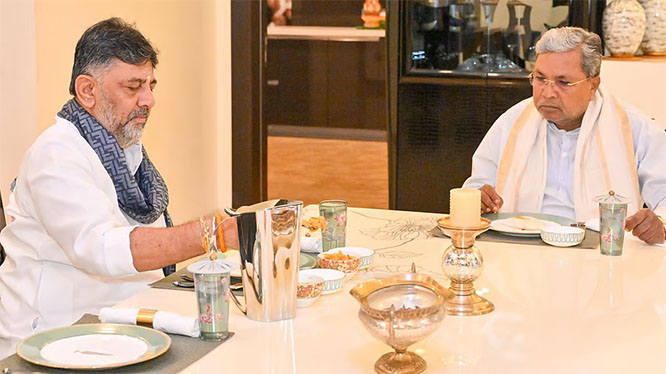
DKSsiddu.jpg

Bengaluru: 'Nati koli saaru' (country chicken curry) considered one of Chief Minister Siddaramaiah’s favourites along with steaming hot idlis was on the breakfast menu at Deputy CM D K Shivakumar’s residence on Tuesday, according to official sources.

The spread also included 'nati koli' fry, vada and pongal, among other items, they said.

In an apparent show of unity, Siddaramaiah visited Shivakumar’s residence for breakfast, just days after the two leaders shared a meal amid a simmering power tussle in the state Congress.

Siddaramaiah drove to the Deputy CM’s residence in Sadashivanagar, where he was received by Shivakumar and his brother D K Suresh, who is a former Congress MP.

Suresh and Kunigal MLA H D Ranganath, a relative of Shivakumar, joined them for breakfast, which featured a mix of vegetarian and non-vegetarian dishes.

Speaking to reporters later, Siddaramaiah said Shivakumar had invited him during his visit to the CM’s residence for breakfast on Saturday.

Asked about the difference between the two meals, the chief minister said, "At his (Shivakumar’s) house it was non-veg, while at my house it was veg. He is a vegetarian, I am a non-vegetarian. I had not prepared non-veg. I told DK to get chicken from the village as you won’t get the original in Bengaluru."

Shivakumar said he had initially invited Siddaramaiah to his residence, but the CM had suggested visiting his place first and reciprocating later. "It was a vegetarian breakfast at the CM’s house on Saturday," he noted.

"Today, I invited him (the CM) to my house. He enjoyed the breakfast, which had his Mysuru taste," Shivakumar added. At this point, Siddaramaiah remarked that Shivakumar’s wife is also from Mysuru.

Saturday’s breakfast at Siddaramaiah’s official residence, held as part of efforts by the Congress high command to ease tensions in the leadership dispute between the two, reportedly included idlis and sambar, according to official sources.

Comments

Add new comment

  • Coastaldigest.com reserves the right to delete or block any comments.
  • Coastaldigset.com is not responsible for its readers’ comments.
  • Comments that are abusive, incendiary or irrelevant are strictly prohibited.
  • Please use a genuine email ID and provide your name to avoid reject.
News Network
December 6,2025

pilot.jpg

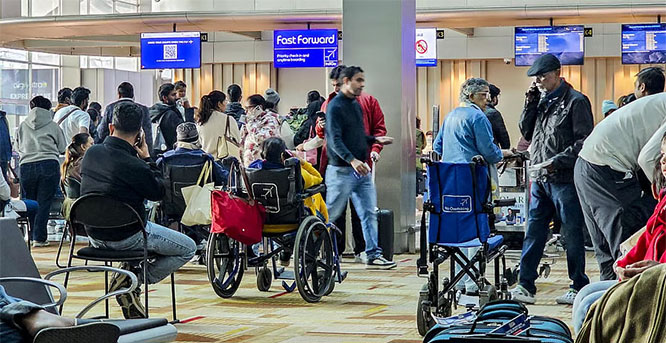
New Delhi: IndiGo, India’s largest airline, faced major operational turbulence this week after failing to prepare for new pilot-fatigue regulations issued by the Directorate General of Civil Aviation (DGCA). The stricter rules—designed to improve flight safety—took effect in phases through 2024, with the latest implementation on November 1. IndiGo has acknowledged that inadequate roster planning led to widespread cancellations and delays.

Below are the key DGCA rules that affected IndiGo’s operations:

1. Longer Mandatory Weekly Rest

Weekly rest for pilots has been increased from 36 hours to 48 hours.

The government says the extended break is essential to curb cumulative fatigue. This rule remains in force despite the current crisis.

2. Cap on Night Landings

Pilots can now perform only two night landings per week—a steep reduction from the earlier limit of six.

Night hours, defined as midnight to early morning, are considered the least alert period for pilots.

Given the disruptions, this rule has been temporarily relaxed for IndiGo until February 10.

3. Reduced Maximum Night Flight Duty

Flight duty that stretches into the night is now capped at 10 hours.

This measure has also been kept on hold for IndiGo until February 10 to stabilize operations.

4. Weekly Rest Cannot Be Replaced With Personal Leave

Airlines can no longer count a pilot’s personal leave as part of the mandatory 48-hour rest.

Pilots say this closes a loophole that previously reduced actual rest time.

Currently, all airlines are exempt from this rule to normalise travel.

5. Mandatory Fatigue Monitoring

Airlines must submit quarterly fatigue reports along with corrective actions to DGCA.

This system aims to create a transparent fatigue-tracking framework across the industry.

The DGCA has stressed that these rules were crafted to strengthen flight safety and align India with global fatigue-management standards. The temporary relaxations are expected to remain until February 2025, giving IndiGo time to stabilise its schedules and restore normal air travel.

Comments

Add new comment

  • Coastaldigest.com reserves the right to delete or block any comments.
  • Coastaldigset.com is not responsible for its readers’ comments.
  • Comments that are abusive, incendiary or irrelevant are strictly prohibited.
  • Please use a genuine email ID and provide your name to avoid reject.