

Is Secularism a threat to Traditions of India?

Ram Puniyani
March 18, 2021

India got independence from British colonial rule on 15th August 1947 after a long struggle which was inclusive and had plural dimensions. Foundation of Indian Constitution is Liberty, Equality, Fraternity and Justice. The values of secularism are deeply ingrained all through and particularly in Articles 14, 19, 22, and 25. It gives us freedom of religion, to practice, preach and propagate the same.

Not all Indians were for such plural values which respect diversity. The communal streams immediately attacked the constitution saying it does not reflect the glorious contribution of Indian past, the values given in holy tomes like Manu Smriti. Communal stream was critical of Constitution and did not accept the tricolor as our national flag. Nearly seven decades down the line those opposing Indian Constitution and its values are rearing their heads from last few decades. There are top leaders like the Prime minster Narendra Modi who on one side claim to be Hindu nationalists and on the other level for electoral purpose claim that “We are secular not because the word was added in our Constitution. Secularism is in our blood. We believe in Sarva Pantha Sambhava.”

There is yet another types of leaders like Yogi Adityanath, the Chief Minister of UP who detest this ideology out and out. Recently he stated that secularism was the “biggest threat” to the traditions of India getting recognition on the global stage.” At an earlier occasion he had stated that “The word "secular" is "the biggest lie", and suggested that the people who propagated it should apologize to the nation, a reference to the Congress party.”

Adityanath who has taken the oath on Indian Constitution has no qualms in denigrating one of its core values. He himself is the Mahant (Chief Priest) of Gorakhnath Math. He is saffron clad like few others in his party.

Let us see how secularism is a threat to traditions of India. India is inherently plural with rich diversity in religious traditions, languages, ethnicities, food habits, dressing pattern, ways of worship etc. In a way the Hindu religion, in whose pretext he is taking secularism to the task itself is so diverse; from the Brahmanical traditions of hierarchy to the Bhakti tradition talking of equality; there is a wide range. Has this diversity hampered the path to recognition of India on the global stage?

The rich contributions of India are recognized all over the World. The contributions of philosophers like Buddha are appreciated in large parts of the World, more particularly South East Asia. During freedom movement Mahatma Gandhi rose like a colossus and based on Indian tradition he propagated non Violence and Satyagriha (invocation to truth). These were the contribution which inspired many a great leaders in the World including Martin Luther King (Jr) and Nelson Mandela who followed his path to take their goals towards fruition. Indian philosophy influenced the global thinking in multiple ways.

Even global culture is diverse and learns from each other, the astronomical and mathematical contributions from India made their place in the global knowledge systems. Further the First Prime minster of India, Jawaharlal Nehru, gave the unique concept of ‘non alignment’, which was picked up by large sections of the World and many nations joined this unique movement at the peak of its success.

Contrary to what Adityanath is stating; it is precisely due to the secular path which we followed that we could achieve miraculous progress in first 5-6 decades of our republic in the areas of industrialization, education, irrigation, atomic and space research among others. As such we seem to have stagnated during last cople of decades as the path of secularism has been denigrated and mocked at. Lately the communal party is gloating that in last elections no body dared to utter this word!

There is also criticism that the introduction of this word in 1976 during emergency was uncalled for and so should be done away with. As such the whole constitution is seeped with the values of secularism. While at one level secularism says that state has no religion, Indian model of secularism respects all religions without being guided by it. Secularism is unique in another way that it respects those communities which are in minority and provides for affirmative, protective clauses for them. These are currently is being labeled as ‘appeasement of minorities’ and is being made a rallying point for electoral mobilization of majority community.

While Adityanath is lamenting against secular plural diverse values and propagates for Hindu Nation, the ideology of the ruling party, he is not alone in that. At the moment multiple articulations are being put forward. One Anant Kumar Hegde the Union minster bluntly stated that BJP is in power as it wants to change the constitution. One earlier Sarsanghchalak K. Sudarshan also put is forward by saying that Indian Constitution is based on Western values and so not suitable for our country. We should bring a Constitution based on Indian Holy books!

Religious nationalists all over the world abhor the secular-plural values they limit their power to impose their own values on society, to create a value system of hierarchy, the overt expression of which comes in the books like Manusmriti. The pre modern structural hierarchies of class, caste and gender are their ideal, be it the Talibans, Muslim Brotherhood (Egypt based communal organization) or those indulging in politics in the name of Buddhism in Sri Lanka and Myanmar.

The plight of Pakistan, where communal forces had been dominant, is there for all of us to see. Neither it could remain united as Islamic nation nor could it make headways in areas of science, education, health and industrialization.

The communal mindset needs to be overcome to focus on the progress of society in the areas of education, health, employment and nutrition rather than celebrating religious festivals at the expense of the state or taking up issues related to temple-mosque and put to margins the issues of marginalized sections of society.

Comments

Add new comment

  • Coastaldigest.com reserves the right to delete or block any comments.
  • Coastaldigset.com is not responsible for its readers’ comments.
  • Comments that are abusive, incendiary or irrelevant are strictly prohibited.
  • Please use a genuine email ID and provide your name to avoid reject.
News Network
December 6,2025

pilot.jpg

New Delhi: IndiGo, India’s largest airline, faced major operational turbulence this week after failing to prepare for new pilot-fatigue regulations issued by the Directorate General of Civil Aviation (DGCA). The stricter rules—designed to improve flight safety—took effect in phases through 2024, with the latest implementation on November 1. IndiGo has acknowledged that inadequate roster planning led to widespread cancellations and delays.

Below are the key DGCA rules that affected IndiGo’s operations:

1. Longer Mandatory Weekly Rest

Weekly rest for pilots has been increased from 36 hours to 48 hours.

The government says the extended break is essential to curb cumulative fatigue. This rule remains in force despite the current crisis.

2. Cap on Night Landings

Pilots can now perform only two night landings per week—a steep reduction from the earlier limit of six.

Night hours, defined as midnight to early morning, are considered the least alert period for pilots.

Given the disruptions, this rule has been temporarily relaxed for IndiGo until February 10.

3. Reduced Maximum Night Flight Duty

Flight duty that stretches into the night is now capped at 10 hours.

This measure has also been kept on hold for IndiGo until February 10 to stabilize operations.

4. Weekly Rest Cannot Be Replaced With Personal Leave

Airlines can no longer count a pilot’s personal leave as part of the mandatory 48-hour rest.

Pilots say this closes a loophole that previously reduced actual rest time.

Currently, all airlines are exempt from this rule to normalise travel.

5. Mandatory Fatigue Monitoring

Airlines must submit quarterly fatigue reports along with corrective actions to DGCA.

This system aims to create a transparent fatigue-tracking framework across the industry.

The DGCA has stressed that these rules were crafted to strengthen flight safety and align India with global fatigue-management standards. The temporary relaxations are expected to remain until February 2025, giving IndiGo time to stabilise its schedules and restore normal air travel.

Comments

Add new comment

  • Coastaldigest.com reserves the right to delete or block any comments.
  • Coastaldigset.com is not responsible for its readers’ comments.
  • Comments that are abusive, incendiary or irrelevant are strictly prohibited.
  • Please use a genuine email ID and provide your name to avoid reject.
News Network
December 4,2025

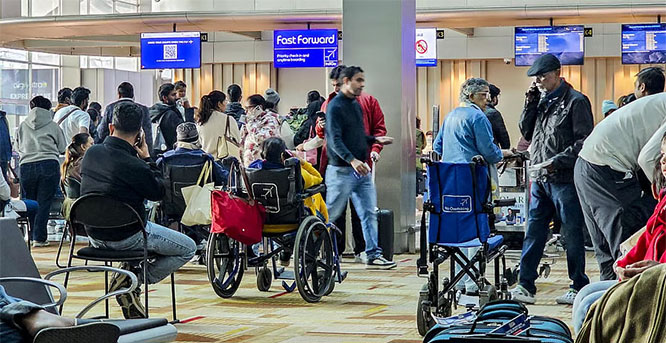
Mangaluru: Chaos erupted at Mangaluru International Airport (MIA) after IndiGo flight 6E 5150, bound for Mumbai, was repeatedly delayed and ultimately cancelled, leaving around 100 passengers stranded overnight. The incident highlights the ongoing country-wide operational disruptions affecting the airline, largely due to the implementation of new Flight Duty Time Limitations (FDTL) norms for crew.

The flight was initially scheduled for 9:25 PM on Tuesday but was first postponed to 11:40 PM, then midnight, before being cancelled around 3:00 AM. Passengers expressed frustration over last-minute communication and the lack of clarity, with elderly and ailing travellers particularly affected. “Though the airline arranged food, there was no proper communication, leaving us confused,” said one family member.

An IndiGo executive at MIA cited the FDTL rules, designed to prevent pilot fatigue by limiting crew working hours, as the cause of the cancellation. While alternative arrangements, including hotel stays, were offered, about 100 passengers chose to remain at the airport, creating tension. A replacement flight was arranged but also faced delays due to the same constraints, finally departing for Mumbai around 1:45 PM on Wednesday. Passengers either flew, requested refunds, or postponed their travel.

The Mangaluru delay is part of a broader crisis for IndiGo. The airline has been forced to make “calibrated schedule adjustments”—a euphemism for widespread cancellations and delays—after stricter FDTL norms came into effect on November 1.

While an IndiGo spokesperson acknowledged unavoidable flight disruptions due to technology issues, operational requirements, and the updated crew rostering rules, the DGCA has intervened, summoning senior airline officials to explain the chaos and outline corrective measures.

The ripple effect has been felt across the country, with major hubs like Bengaluru and Mumbai reporting numerous cancellations. The Mangaluru incident underscores the systemic operational strain currently confronting India’s largest carrier, leaving passengers nationwide grappling with uncertainty and delays.

Comments

Add new comment

  • Coastaldigest.com reserves the right to delete or block any comments.
  • Coastaldigset.com is not responsible for its readers’ comments.
  • Comments that are abusive, incendiary or irrelevant are strictly prohibited.
  • Please use a genuine email ID and provide your name to avoid reject.
coastaldigest.com news network
December 2,2025

karkala.jpg

Udupi, Dec 2: A wave of regional pride is sweeping through Udupi district as Shagun S Verma Hegde, a talented Class 9 student from Christ King English Medium High School, Karkala, has been named the captain of the Indian National Team for the Under-15 Girls’ Volleyball Championship.

Shagun holds the unique distinction of being the sole player from Karnataka selected to represent the country in the prestigious international tournament. The championship, organized by the School Games Federation, is scheduled to take place in Shangluo, China, from December 3 to 13, where Shagun will lead the national squad.

A Remarkable Journey to the Top

Shagun’s selection is a testament to her dedication and exceptional skill on the court. Her journey included several rigorous rounds of selection:

•    She was the only player from Udupi district to qualify for the state-level selection camp.

•    Out of eight players from Karnataka who advanced to the national selection camp in Pune, Maharashtra, Shagun was the only one to secure a place in the final national squad.

•    The national camp saw participation from approximately 200 players, which was shortlisted to 23. Shagun not only made the final cut but was also ranked as the second-best player overall, solidifying her leadership role.

Shagun, who is the daughter of Sandesh Verma and Shruthiraj of Kallotte, Karkala, has trained under experienced coaches Santosh D’Souza, Jeevan D’Silva, Jairaj Poojary, and Ramesh. Her selection as the team captain has brought profound honour to her family, school, the Udupi district, and the entire state of Karnataka.

Comments

Add new comment

  • Coastaldigest.com reserves the right to delete or block any comments.
  • Coastaldigset.com is not responsible for its readers’ comments.
  • Comments that are abusive, incendiary or irrelevant are strictly prohibited.
  • Please use a genuine email ID and provide your name to avoid reject.