

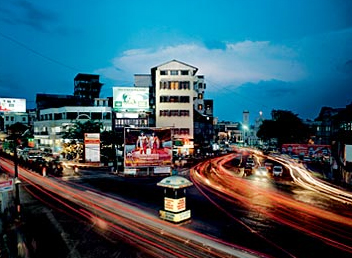
Bangalore ranked India's top business destination, Mangalore at 13th place

coastaldigest.com news network
October 23, 2013
New Delhi, Oct 23: Bangalore, known as India's silicon city, has been ranked as the country's top business destination, followed by Chennai, Mumbai and Pune in terms of infrastructure, human capital, city culture and basic quality of living, says a survey.
mangalore2

The list also includes Mangalore at 13th place based on based on factors such as human capital, energy, water, transport, housing, healthcare, climate, office space availability and city culture, which constitute the basic eco-socio-economic parameters critical in determining the growth of the city.

While Delhi does not figure on this list, Noida and Gurgaon from the National Capital Region have been ranked 17th and 19th respectively.

The survey, conducted by Global Initiative for Restructuring Environment and Management (GIREM) and real estate consultancy firm DTZ, also found that smaller cities like Indore (5th), Bhubaneswar (6th) and Coimbatore (7th) are competing with top metros in the race to be ideal business destinations.

The list includes a total of 21 top business destination in the country. Ahmedabad has been ranked 8th, followed by Nagpur at 9th and Kochi at the 10th place.

Commenting on the findings of the report, GIREM Chairman, Sankey Prasad, said that few of the top 21 business destinations in India are already established while others have the potential to emerge major business destinations.

“The ranking provides companies across industries and sectors with insights for future investment opportunities,” Prasad added.

“With the metros already bursting at their seams, it is important to have options that are fresh for investments and conducive for business operations,” DTZ Chief Executive, Anshul Jain, said.

Jain further noted that “in order to relieve the burden on the established metro cities, it becomes all the more important to encourage the Tier II cities to grow up to their potential so as to meet a twin objective of decongesting metros and nurturing talent in Tier II cities.”

The others in the list include Chandigarh at 11th place, followed by Hyderabad (12), Vadodara (14), Jaipur (15), Kozhikode (16), Kolkata (18), Navi Mumbai (20) and Visakhapatnam (21).

Comments

Add new comment

  • Coastaldigest.com reserves the right to delete or block any comments.
  • Coastaldigset.com is not responsible for its readers’ comments.
  • Comments that are abusive, incendiary or irrelevant are strictly prohibited.
  • Please use a genuine email ID and provide your name to avoid reject.
News Network
January 23,2026

Mangaluru: The Karnataka Government Polytechnic (KPT), Mangaluru, has achieved autonomous status from the All India Council for Technical Education (AICTE), becoming the first government polytechnic in the country to receive such recognition in its 78-year history. The status was granted by AICTE, New Delhi, and subsequently approved by the Karnataka Board of Technical Education in October last year.

Officials said the autonomy was conferred a few months ago. Until recently, AICTE extended autonomous status only to engineering colleges, excluding diploma institutions. However, with a renewed national focus on skill development, several government polytechnics across India have now been granted autonomy.

KPT, the second-largest polytechnic in Karnataka, was established in 1946 with four branches and has since expanded to offer eight diploma programmes, including computer science and polymer technology. The institution is spread across a 19-acre campus.

Ravindra M Keni, the first dean of the institution, told The Times of India that AICTE had proposed autonomous status for polytechnic institutions that are over 25 years old. “Many colleges applied. In the first round, 100 institutions were shortlisted, which was further narrowed down to 15 in the second round. We have already completed one semester after becoming an autonomous institution,” he said. He added that nearly 500 students are admitted annually across eight three-year diploma courses.

Explaining the factors that helped KPT secure autonomy, Keni said the institution has consistently recorded 100 per cent admissions and placements for its graduates. He also noted its strong performance in sports, with the college emerging champions for 12 consecutive years, along with active student participation in NCC and NSS activities.

Autonomous status allows KPT to design industry-oriented curricula, conduct examinations, prepare question papers, and manage academic documentation independently. The institution can also directly collaborate with industries and receive priority funding from AICTE or the Ministry of Education. While academic autonomy has been granted, financial control will continue to rest with the state government.

“There will be separate committees for examinations, question paper setting, boards of studies, and boards of examiners. The institution will now have the freedom to conduct admissions without government notifications and issue its own marks cards,” Keni said, adding that new academic initiatives would be planned after a year of functioning under the autonomous framework.

Comments

Add new comment

  • Coastaldigest.com reserves the right to delete or block any comments.
  • Coastaldigset.com is not responsible for its readers’ comments.
  • Comments that are abusive, incendiary or irrelevant are strictly prohibited.
  • Please use a genuine email ID and provide your name to avoid reject.
coastaldigest.com news network
January 10,2026

Mangaluru: In a strong pitch for redefining the economic future of coastal Karnataka, Deputy Chief Minister D K Shivakumar on Saturday lamented that the region’s vast natural wealth and tourism potential remain largely underutilised, forcing thousands of coastal youth to migrate outside the state and even abroad in search of opportunities.

Speaking in Mangaluru, Shivakumar said the coastal belt—stretching from Mangaluru to Karwar—continues to be one of Karnataka’s most scenic and resource-rich zones, yet local communities are not benefiting proportionately.

“Our beaches, backwaters, forests and culture are unmatched. But people from Mangaluru and other coastal districts continue to move out because we have not capitalised on what we already have,” he said.

Emphasising the talent of the younger generation, he noted that youth from coastal Karnataka are excelling in countries across the world. “They are brilliant, skilled and globally competitive. Our priority must be to create conditions where they can build their future here, not somewhere else. Our identity should shine on our own soil,” he asserted.

Shivakumar revealed that the state government has finalised a new tourism policy aimed at transforming Karnataka—particularly the coast—into a major tourism hub.

As part of the rollout, meetings will be held with investors, builders, tourism operators, entrepreneurs and local business communities.

“The government will extend full support to tourism development. Before implementing the policy, we will take inputs from stakeholders across Karnataka, especially from the coastal belt. Locals should be the prime beneficiaries of tourism growth,” he said.

He stressed that development must be driven by local capability, local enterprise and local initiative, ensuring that economic gains stay within the region rather than drifting outward.

Shivakumar added that Chief Minister Siddaramaiah is scheduled to visit later in the evening, urging those with concerns or suggestions regarding coastal tourism and youth opportunities to raise them directly during the visit.

Comments

Add new comment

  • Coastaldigest.com reserves the right to delete or block any comments.
  • Coastaldigset.com is not responsible for its readers’ comments.
  • Comments that are abusive, incendiary or irrelevant are strictly prohibited.
  • Please use a genuine email ID and provide your name to avoid reject.
News Network
January 14,2026

phone.jpg

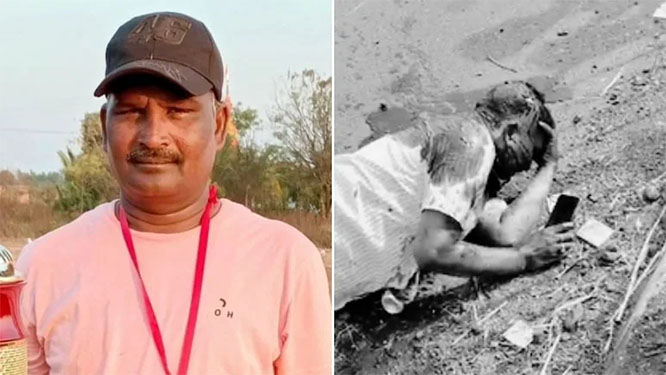
Bidar (Karnataka): A routine ride turned fatal when a nylon kite string slit the throat of a 48-year-old motorcyclist in Karnataka’s Bidar district, claiming his life in a chilling reminder of the deadly threat posed by banned kite-flying materials.

The victim, identified as Sanjukumar Hosamani, was riding near the Talamadagi Bridge when a taut kite string stretched across the road cut deep into his neck, causing profuse bleeding. Critically injured, Hosamani collapsed from his motorcycle but managed to place a final phone call to his daughter.

A disturbing video circulating on social media shows Hosamani drenched in blood, struggling to dial his daughter’s number as life ebbed away.

A passerby attempted to help by pressing a cloth against the wound to stop the bleeding. Locals said an ambulance was called immediately, but it arrived too late. Hosamani succumbed to his injuries before he could be taken to a hospital.

Family members have blamed the delay in emergency response for his death, alleging that timely medical assistance could have saved his life.

Following the incident, Hosamani’s relatives and local residents staged a protest at the accident spot, demanding strict action against the use of nylon kite strings and urgent improvements in emergency medical services.

Police have registered a case at Manna Ekhelli Police Station and said an investigation is underway.

Kite flying during Makar Sankranti is a long-standing tradition across many parts of India. While cotton strings coated with powdered glass were once common, they have increasingly been replaced by cheaper and more durable nylon strings. This durability, however, has proven lethal, as nylon can slice through skin with ease.

Commonly referred to as Chinese manjha, these strings pose a grave danger to two-wheeler riders, who often fail to notice the nearly invisible lines stretched across roads and flyovers.

The Karnataka incident is the latest in a series of such deaths reported across the country. Just this week, a 45-year-old man in Indore died after a kite string slit his throat. Delhi has witnessed multiple fatalities in recent years, including the deaths of a 22-year-old businessman in 2025, a biker in 2022, and a seven-year-old child in 2023.

Despite periodic raids and seizures by authorities, the recurring deaths underline serious gaps in enforcement, raising questions about whether current measures are sufficient to prevent further loss of life.

Comments

Add new comment

  • Coastaldigest.com reserves the right to delete or block any comments.
  • Coastaldigset.com is not responsible for its readers’ comments.
  • Comments that are abusive, incendiary or irrelevant are strictly prohibited.
  • Please use a genuine email ID and provide your name to avoid reject.