

Muslim population growth slows in India, still faster than others

August 26, 2015

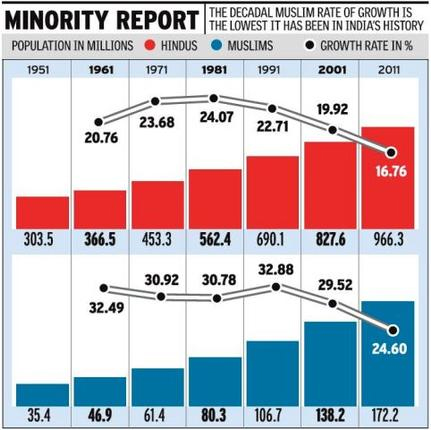
New Delhi, Aug 26: India’s Muslim population is growing slower than it had in the previous decades, and its growth rate has slowed more sharply than that of the Hindu population, the census on religious groups released by the Central government has revealed. However, the Muslim share in India’s population has grown faster than that of other religions between 2001 and 2011.

humanity

The decadal Muslim rate of growth is the lowest it has ever been in India’s history, as it is for all religions.

The Muslim population still grows at a faster rate than the Hindu population, but the gap between the two growth rates is narrowing fast.
census1

India in numbers

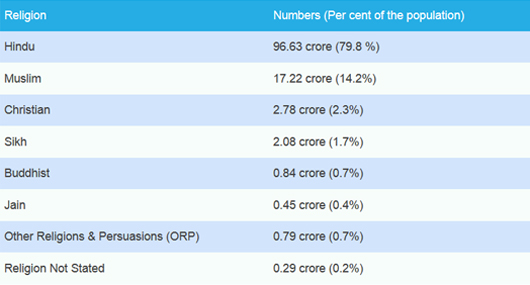
India now has 966.3 million Hindus, who make up 79.8 per cent of its population, and 172.2 million Muslims, who make up 14.23 per cent. Among the other minorities, Christians make up 2.3 per cent of the population and Sikhs 2.16 per cent.

The Registrar-General and Census Commissioner released the data on Population by Religious Communities of Census 2011 on Tuesday evening.

The distribution of data is of the total population by six major religious communities — Hindu, Muslim, Christian, Sikh, Buddhist and Jain — besides “Other religions and persuasions” and “Religion not stated”.

The data are released by sex and residence up to the levels of sub-districts and towns.

As has been the case since Independence, the rate of increase of the Muslim population is higher than that of the Hindu population as a result of higher Muslim fertility, higher child mortality among Hindus and a greater life expectancy among Muslims, demographers say. However, Muslim fertility rates in India are falling faster than among Hindus, Pew Research’s Future of World Religions report showed recently, and the Muslim community is expected to reach replacement levels of fertility by 2050.

Muslim sex ratio improves further
census2

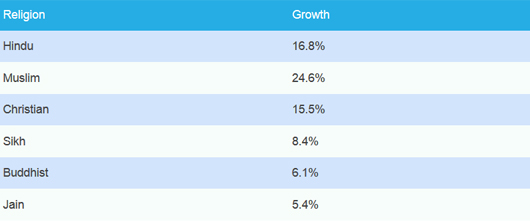
The data on Population by Religious Communities of Census 2011 show that between 2001 and 2011, Hindu population grew by 16.76 per cent, while that of Muslims by 24.6 per cent. The population of both communities grew faster during the previous decade, at 19.92 per cent and 29.52 per cent, respectively. As a long-term trend, say demographers, the communities’ growth rates are converging.

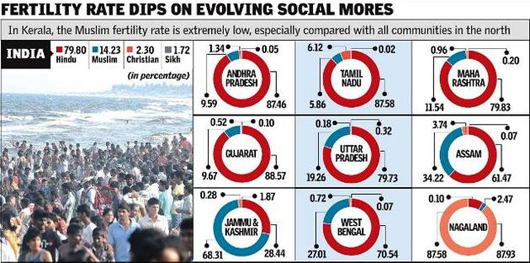
“This is completely along expected lines, and has been an ongoing process,” P. Arokiasamy, demographer and Professor at the International Institute of Population Sciences, Mumbai, told The Hindu. “With rising education and changing family expectations, declining fertility is an expected demographic phenomenon. It begins among better educated groups with better access to health care — as in India’s southern States — and then other groups catch up and converge,” Dr. Arokiasamy explained. In Kerala, for instance, the Muslim fertility rate (while higher than among the Hindus) is extremely low, especially compared with all communities in the northern States, he said.

The numbers show that the sex ratio among Muslims, already better than among Hindus, has further improved.

The sex ratio among Muslims now stands at 951 females for every 1,000 males, substantially better than 936 in 2001, while among Hindus, it is 939 females for every 1,000 males, a slight improvement over the 2001 value of 931. Assam remains the State with the largest Muslim population as a proportion (34.22 per cent) and saw the largest increase in the Muslim proportion between 2001 and 2011, followed by Uttarakhand and Kerala.
census3

Growth rate

The growth rate of population in the decade 2001-2011 was 17.7%. The growth rate of population of the different religious communities in the same period was:
census4

The Census data on religion comes after a significant delay; the 2001 Census data on religion was released in 2004 and the 2011 round results were expected in 2014. However, the numbers remained unreleased, even as a draft of the key data was selectively leaked earlier. The data comes in the backdrop of much fear-mongering over Muslims and their population, and RSS thinkers were quick to term the new data as proof of the end of Hindus, even while the numbers belie their claim.

Also Read: Hindu population declined; Muslims increased in India, reveals 2011 census

Comments

Add new comment

  • Coastaldigest.com reserves the right to delete or block any comments.
  • Coastaldigset.com is not responsible for its readers’ comments.
  • Comments that are abusive, incendiary or irrelevant are strictly prohibited.
  • Please use a genuine email ID and provide your name to avoid reject.
News Network
December 7,2025

Mangaluru, Dec 7: A 34-year-old fruit and vegetable trader in Mangaluru has reportedly lost ₹33.1 lakh after falling victim to an online investment scam run through a fake mobile app.

Police said the scam began in September, when the victim received a link on Facebook. Clicking it connected him to a WhatsApp number, where an unidentified person introduced a high-return investment scheme and instructed him to download an app.

To build trust, the fraudster asked him to invest ₹30,000 on September 24. The trader soon received ₹34,000 as “profit,” convincing him the scheme was genuine. Over the next two months, he transferred money in multiple instalments via Google Pay and IMPS to different scanner codes and bank accounts shared by the scammers. Between September 24 and December 3, he ended up sending a total of ₹33.1 lakh.

When he later requested a refund of his investment and promised returns, the scammers demanded additional payments, claiming he needed to pay a “service tax” first. Even after he paid a small amount, no money was returned, and the scammers continued pressuring him for more.

A case has been registered at the CEN Crime Police Station.

Comments

Add new comment

  • Coastaldigest.com reserves the right to delete or block any comments.
  • Coastaldigset.com is not responsible for its readers’ comments.
  • Comments that are abusive, incendiary or irrelevant are strictly prohibited.
  • Please use a genuine email ID and provide your name to avoid reject.
News Network
December 1,2025

hindutvaboy.jpg

Udupi, Dec 1: A horrific case of alleged rape has unfolded in Udupi, where a worker from a Hindutva organisation, previously arrested and released on bail for harassing a young woman, is now accused of waylaying and sexually assaulting her.

The arrested individual has been identified as Pradeep Poojary (26), a member of the Hindu Jagarana Vedike's Nairkode unit in Perdur.

Poojary had allegedly been relentlessly harassing the young woman, pressuring her to marry him. When she bravely stood up to him and refused his demands, she filed a formal complaint at the Hiriyadka police station. He was subsequently arrested in that initial harassment case but was later granted bail.

According to police reports, driven by the same malicious grudge, Poojary allegedly intercepted the woman again on November 29. While she was walking through a deserted area, the accused is claimed to have threatened her by grabbing her neck. When she again refused to marry him, he allegedly proceeded to rape her.

The survivor immediately informed her family about the traumatic assault. Following this, her parents lodged a complaint at the Udupi women’s police station.

Police arrested Poojary again and produced him before the court. He has since been remanded to judicial custody.

Comments

Add new comment

  • Coastaldigest.com reserves the right to delete or block any comments.
  • Coastaldigset.com is not responsible for its readers’ comments.
  • Comments that are abusive, incendiary or irrelevant are strictly prohibited.
  • Please use a genuine email ID and provide your name to avoid reject.
News Network
December 2,2025

Puttur: The long-cherished dream of a government medical college in Puttur has moved a decisive step closer to reality, with the Karnataka State Finance Department granting its official approval for the construction of a new 300-bed hospital.

Puttur MLA Ashok Kumar Rai announced the crucial development to reporters on Monday, confirming that the official communication from the finance department was issued on November 27. This 300-bed facility is intended to be the cornerstone for the establishment of the government medical college, a project announced in the state budget.

Fast-Track Implementation

The MLA outlined an aggressive timeline for the project:

•    A Detailed Project Report (DPR) for the hospital is expected to be ready within 45 days.

•    The tender process for the construction will be completed within two months.

Following the completion of the tender process, Chief Minister Siddaramaiah is scheduled to lay the foundation stone for the project.

"Setting up a medical college in Puttur is a historical decision by the Congress government in Karnataka," Rai stated. The project has an estimated budget allocation of Rs 1,000 crore for the medical college.

Focus on Medical Education Department

The MLA highlighted a key strategic move: requesting the government to implement the hospital construction through the Medical Education Department instead of the Health and Family Welfare Department. This is intended to streamline the entire process of establishing the full medical college, ensuring the facilities—including labs, operation theatres, and other necessary infrastructure—adhere to the strict guidelines set by the Medical Council of India (MCI). The proposed site for the project is in Bannur.

Rai also took the opportunity to address political criticism, stating that the government has fulfilled its promise despite "apprehensions" and "mocking and criticising" from opposition parties who had failed to take similar initiatives when they were in power. "Chief Minister Siddaramaiah has kept his word," he added.

Comments

Add new comment

  • Coastaldigest.com reserves the right to delete or block any comments.
  • Coastaldigset.com is not responsible for its readers’ comments.
  • Comments that are abusive, incendiary or irrelevant are strictly prohibited.
  • Please use a genuine email ID and provide your name to avoid reject.