
Urgency and Equity in South Asia's Environmental Justice Struggle against Climate Colonialism

Press Release
December 13, 2023

Dubai2.jpg

Dubai: The culmination of the Just Transition in South Asia press conference, which took place on December 11, 2023, at COP-28 in Dubai, has illuminated the pressing need for immediate action to confront the impending climate crisis. The event delivered a stark call for decisive decisions and collaborative endeavors by major economies to ensure an equitable and just transition in South Asia.

Key insights from the conference include a global south's call for urgent action, emphasizing concrete decisions to curb excessive emissions and meet the 1.5-degree goal by 2050, as outlined in the Paris Agreement. The conference underscored that 83% of the carbon budget has already been exhausted, leaving a precarious 50:50 chance of achieving the Paris Agreement goals by 2030.

Further, the Climate Risk Index revealed that six South Asian nations, including Bangladesh, India, Nepal, Pakistan, and Sri Lanka, are among the top 10 most vulnerable countries impacted by climate change. The region bore witness to the devastating impact of seven cyclones in 2023 alone, resulting in loss of lives, destruction of homes, and severe economic repercussions.

Hasan Mehedi from CLEAN (Coastal Livelihood and Environmental Action Network), Bangladesh, firmly stated, "The people of South Asia are bearing the brunt of climate change impacts, and their plea for urgent action is a call to the global community. The decisions we make today will determine the fate of vulnerable communities and the sustainability of our planet."

Recognizing the challenges faced by South Asian countries, representing a quarter of the global population and nearly a third of the world's poor, the conference shed light on the intricacies of energy poverty. The imperative to decarbonize the energy sector is acknowledged, yet challenges persist in meeting basic electricity needs and overcoming economic crises, particularly in Sri Lanka, Pakistan, and Bangladesh.

A positive development emerged with the signing of the Global Renewables and Energy Efficiency Pledge (GREEP) by 123 countries, including Bangladesh, Bhutan, and Maldives. However, concerns were voiced about the adequacy of the target, considering the escalating global electricity demand and the need for more ambitious goals to achieve a just transition by 2030.

The event underscored challenges such as the concentration of renewable energy technologies in specific countries, giving rise to a form of 'Climate Colonialism.' The dominance of large corporations in renewable energy projects, notably hydropower, raised serious environmental and human rights issues, with indigenous communities facing the imminent threat of displacement.

Hemantha Withanage from the Centre for Environmental Justice (CEJ), Sri Lanka, shared, "South Asian nations face a delicate balancing act: meeting the basic electricity needs of their citizens while navigating economic challenges. Big economies must acknowledge and support our transition efforts, ensuring a just and equitable pathway towards sustainability."

Opposition was against false solutions like hydrogen, ammonia, and carbon capture and storage (CCS) technologies. The conference emphasized the need for proven, affordable, and sustainable alternatives, rejecting the promotion of unproven technologies.

In the aftermath of the conference, key demands were outlined to address the climate crisis in South Asia. Organizers called for an ambitious target to generate at least 60% of global electricity demand from renewable sources, a cut-off date for using coal, gas, and petroleum in the power sector, cessation of financing for LNG as a transition fuel, and support for South Asian countries in building national renewable energy institutions. 

"The concentration of renewable energy technologies in specific countries is a form of 'Climate Colonialism.' We must shift focus towards community-owned decentralized systems to ensure not just environmental sustainability but also uphold the rights of local communities," says Vidya Dinker of Growthwatch, India,

Furthermore, the demands included financing for community-owned distributed renewable energy systems, ensuring local communities' human and environmental rights during the energy transition, and discontinuing the promotion of false solutions like hydrogen, ammonia, and CCS technologies.


Dubai.jpg

Comments

Add new comment

  • Coastaldigest.com reserves the right to delete or block any comments.
  • Coastaldigset.com is not responsible for its readers’ comments.
  • Comments that are abusive, incendiary or irrelevant are strictly prohibited.
  • Please use a genuine email ID and provide your name to avoid reject.
News Network
December 15,2025

Mangaluru, Dec 15: Educational institutions in Mangaluru that rely on the popular Mangala Stadium for their annual sports events are bracing for an inconvenience as the city's key sporting venue is set to close its gates for a significant upgrade. The stadium is expected to be unavailable for approximately two months starting from January 15, 2026.

The closure is necessitated by a proposed overhaul of the stadium's facilities, with a special focus on upgrading the synthetic track. Pradeep Dsouza, Assistant Director of the District of Youth Empowerment and Sports (DYES), Dakshina Kannada, confirmed the development.

"Experts have visited the stadium, conducted a thorough inspection, and have given the go-ahead for a complete makeover," Dsouza stated. "Funds have been allocated for the project, and we are currently awaiting the final green signal from state officials to commence the work. We anticipate that the work will likely begin in the second week of January. Consequently, we have stopped renting out the stadium to colleges and other organizations in preparation for the upgrade."

The timing presents a logistical challenge for colleges, as many schools have already concluded their sports meets.

"Colleges will now be organizing their events and will need to find alternative locations to host their sports meets," Dsouza added. He suggested a few potential venues, including the Dakshina Kannada police ground, University College grounds, Panambur grounds, Swaraj Maidan in Moodbidri, and the Mangalore University sports grounds in Konaje.

However, many institutions note that finding a comparable venue will be difficult. While the DK police ground and University College grounds are closer to the city center, they do not possess the extensive facilities and infrastructure offered by Mangala Stadium.

Dr. P Dayananda Pai - P Satisha Govt First Grade College, Carstreet, is one such institution dependent on the stadium. Principal Jayakar Bhandary expressed hope for a swift completion of the work. "We expect the work to be completed at the earliest. If not, we will be forced to look for other venues to host the sports day for our students," Bhandary said, highlighting the pressing need for the city's main sporting facility.

Comments

Add new comment

  • Coastaldigest.com reserves the right to delete or block any comments.
  • Coastaldigset.com is not responsible for its readers’ comments.
  • Comments that are abusive, incendiary or irrelevant are strictly prohibited.
  • Please use a genuine email ID and provide your name to avoid reject.
News Network
December 4,2025

Mangaluru: Chaos erupted at Mangaluru International Airport (MIA) after IndiGo flight 6E 5150, bound for Mumbai, was repeatedly delayed and ultimately cancelled, leaving around 100 passengers stranded overnight. The incident highlights the ongoing country-wide operational disruptions affecting the airline, largely due to the implementation of new Flight Duty Time Limitations (FDTL) norms for crew.

The flight was initially scheduled for 9:25 PM on Tuesday but was first postponed to 11:40 PM, then midnight, before being cancelled around 3:00 AM. Passengers expressed frustration over last-minute communication and the lack of clarity, with elderly and ailing travellers particularly affected. “Though the airline arranged food, there was no proper communication, leaving us confused,” said one family member.

An IndiGo executive at MIA cited the FDTL rules, designed to prevent pilot fatigue by limiting crew working hours, as the cause of the cancellation. While alternative arrangements, including hotel stays, were offered, about 100 passengers chose to remain at the airport, creating tension. A replacement flight was arranged but also faced delays due to the same constraints, finally departing for Mumbai around 1:45 PM on Wednesday. Passengers either flew, requested refunds, or postponed their travel.

The Mangaluru delay is part of a broader crisis for IndiGo. The airline has been forced to make “calibrated schedule adjustments”—a euphemism for widespread cancellations and delays—after stricter FDTL norms came into effect on November 1.

While an IndiGo spokesperson acknowledged unavoidable flight disruptions due to technology issues, operational requirements, and the updated crew rostering rules, the DGCA has intervened, summoning senior airline officials to explain the chaos and outline corrective measures.

The ripple effect has been felt across the country, with major hubs like Bengaluru and Mumbai reporting numerous cancellations. The Mangaluru incident underscores the systemic operational strain currently confronting India’s largest carrier, leaving passengers nationwide grappling with uncertainty and delays.

Comments

Add new comment

  • Coastaldigest.com reserves the right to delete or block any comments.
  • Coastaldigset.com is not responsible for its readers’ comments.
  • Comments that are abusive, incendiary or irrelevant are strictly prohibited.
  • Please use a genuine email ID and provide your name to avoid reject.
News Network
December 4,2025

indigoflight.jpg

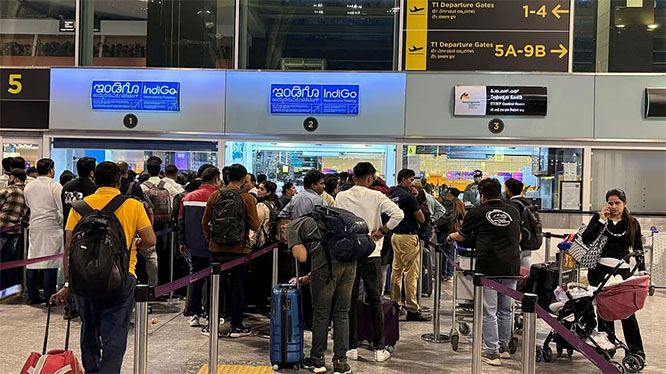
Domestic carrier IndiGo has cancelled over 180 flights from three major airports — Mumbai, Delhi and Bengaluru — on Thursday, December 4, as the airline struggles to secure the required crew to operate its flights in the wake of new flight-duty and rest-period norms for pilots.

While the number of cancellations at Mumbai airport stands at 86 (41 arrivals and 45 departures) for the day, at Bengaluru, 73 flights have been cancelled, including 41 arrivals, according to a PTI report that quoted sources.

"IndiGo cancelled over 180 flights on Thursday at three airports-Mumbai, Delhi and Bengaluru," the source told the news agency.

Besides, it had cancelled as many as 33 flights at Delhi airport for Thursday, the source said, adding, "The number of cancellations is expected to be higher by the end of the day."

The Gurugram-based airline's On-Time Performance (OTP) nosedived to 19.7 per cent at six key airports — Delhi, Mumbai, Chennai, Kolkata, Bengaluru and Hyderabad — on December 3, as it struggled to get the required crew to operate its services, down from almost half of December 2, when it was 35 per cent.

"IndiGo has been facing acute crew shortage since the implementation of the second phase of the FDTL (Flight Duty Time Limitations) norms, leading to cancellations and huge delays in its operations across the airports," a source had told PTI on Wednesday.

Chaos continued at several major airports for the third day on Thursday because of the cancellations.

A spokesperson for the Kempegowda International Airport (KIA) in Bengaluru said that 73 IndiGo flights had been cancelled on Thursday.

At least 150 flights were cancelled and dozens of others delayed on Wednesday, airport sources said, leaving thousands of travellers stranded, according to news agency Reuters.

The Directorate General of Civil Aviation (DGCA) has said it is investigating IndiGo flight disruptions and has asked the airline to submit the reasons for the current situation, as well as its plans to reduce flight cancellations and delays.

It may be mentioned here that the pilots' body, Federation of Indian Pilots (FIP), has alleged that IndiGo, despite getting a two-year preparatory window before the full implementation of new flight duty and rest period norms for cockpit crew, "inexplicably" adopted a "hiring freeze".

The FIP said it has urged the safety regulator, the DGCA, not to approve airlines' seasonal flight schedules unless they have adequate staff to operate their services "safely and reliably" in accordance with the New Flight Duty Time Limitations (FDTL) norms.

In a letter to the DGCA late on Wednesday, the FIP urged the DGCA to consider re-evaluating and reallocating slots to other airlines, which have the capacity to operate them without disruption during the peak holiday and fog season if IndiGo continues to "fail in delivering on its commitments to passengers due to its own avoidable staffing shortages."

Comments

Add new comment

  • Coastaldigest.com reserves the right to delete or block any comments.
  • Coastaldigset.com is not responsible for its readers’ comments.
  • Comments that are abusive, incendiary or irrelevant are strictly prohibited.
  • Please use a genuine email ID and provide your name to avoid reject.