

Yemen’s Houthi vows to expand operations against Israel-linked ships to Indian Ocean

News Network
March 15, 2024

yemen.jpg

The leader of Yemen’s Houthis has said that the Yemeni armed forces will continue their retaliatory operations against Israeli-affiliated commercial vessels, preventing the passage of the ships even through the Indian Ocean and through the Cape of Good Hope.  

About 34 Houthi fighters have been killed since the Yemeni armed forces began to attack shipping lanes in solidarity with the people of Palestine under attack in Gaza by Israel, Ansarullah leader Abdul Malik al-Houthi said in a televised speech on Thursday.

Yemeni forces have repeatedly launched drones and missiles against Israeli and Israel-bound ships since mid-November, saying they are acting in solidarity with Palestinians against Israel's war on Gaza.

Al-Houthi said 73 ships have been targeted in Yemeni operations in support of Gaza so far, adding rarely does any ship associated with the Israeli enemy pass through Bab al-Mandab.

“This week, support operations included 12 operations targeting ships and barges, executed with a total of 58 ballistic and cruise missiles and drones in the Red Sea, the Arabian Sea, and the Gulf of Aden,” he said.

“Our operations this time reached unprecedented ranges, with 3 operations reaching the Indian Ocean, by the grace of Allah,” he added. “The total number of targeted ships and barges reached 73.”

Al-Houthi said that the operations will continue as long as the aggression and siege on Gaza persist.

The United States and Britain began striking Yemen in January in order to dissuade the country from targeting Israeli ships which carry arms and logistics for the onslaught on the besieged Gaza Strip.

Al-Houthi said the Americans and the British have received “painful blows” from the Yemeni armed forces in retaliation.

The American-British “aggression will not affect the escalating course of our operations in terms of range, momentum, precision, and strength,” said Al-Houthi.  

“What can stop the Yemeni military’s maritime operations is only the cessation of aggression and siege on Gaza,” he noted.

The American stubbornness and escalation of aggression result in only one outcome: the expansion of the conflict, the widening of the circle of war and events, and the tension of the situation at the regional level in general, he stated.

He went on to say that the Yemeni armed forces will continue and effectively expand the range of the operations to reach areas and locations that the enemy never expected.

Al-Houthi said what insures the navigation security in the Red Sea is for any country not to participate in the Israeli aggression against Gaza.

He said the Americans and those who drag the United States towards the militarization of the Red Sea are the ones who undermine international navigation.

“By the grace of Allah and His assistance, we aim to prevent the passage of ships associated with the Israeli enemy even through the Indian Ocean and from South Africa towards the Cape of Good Hope,” he stated.

“For this important, advanced, and significant step, we have begun to implement our operations related to it through the Indian Ocean and from South Africa towards the Cape of Good Hope,” he said.

There is absolutely no choice for the American and the British but to stop the aggression on Gaza and stop starving the people in Gaza, he declared.

“Our human conscience, our religion, our morals, our dignity, our pride, our belonging to Islam, prohibit us from watching the oppression of Palestine or remaining silent about it,” said Houthi.

He added that the Yemeni military is in continuous development of capabilities and in constant expansion of the stance in its range, effectiveness, and impact.

“The American's actions this week, involving aerial bombings and naval shelling, amounted to 32 bombing raids and strikes, which, as usual, were unsuccessful,” he revealed.

“The impact of the American raids and bombings is negligible regarding our missile and drone capabilities and in terms of continuing operations effectively to counter it, and in preventing ships associated with the Israeli enemy,” he stated.

He concluded by saying that the Yemeni armed forces are continuously escalating, and increasing capabilities to attack enemy ships. “No matter what the Americans do, they will not be able to stop us from supporting the Palestinian people in Gaza.”

Yemenis have declared their open support for Palestine’s struggle against the Israeli occupation since the regime launched a devastating war on Gaza on October 7 after the territory’s Palestinian resistance movements carried out the surprise Operation Al-Aqsa Storm.

The Yemeni Armed Forces have said they won’t stop retaliatory strikes.

The maritime attacks have forced some of the world’s biggest shipping and oil companies to suspend transit through one of the world’s most important maritime trade routes.

Tankers are instead adding thousands of miles to international shipping routes by sailing around the continent of Africa rather than going through the Suez Canal.

Since the start of Israel's genocidal war following Operation al-Aqsa Storm by Gaza-based resistance movements on October 7, 2023, more than 31,000 Palestinians, including many women and children, have lost their lives.

The Israeli military offensive has left a trail of destruction in Gaza, leaving hospitals in ruins and displacing around half of its 2.4 million residents.

Israel has additionally enforced a comprehensive blockade on the coastal sliver, severing the supply of fuel, electricity, sustenance and water to the population residing there.

Comments

Add new comment

  • Coastaldigest.com reserves the right to delete or block any comments.
  • Coastaldigset.com is not responsible for its readers’ comments.
  • Comments that are abusive, incendiary or irrelevant are strictly prohibited.
  • Please use a genuine email ID and provide your name to avoid reject.
News Network
December 6,2025

pilot.jpg

New Delhi: IndiGo, India’s largest airline, faced major operational turbulence this week after failing to prepare for new pilot-fatigue regulations issued by the Directorate General of Civil Aviation (DGCA). The stricter rules—designed to improve flight safety—took effect in phases through 2024, with the latest implementation on November 1. IndiGo has acknowledged that inadequate roster planning led to widespread cancellations and delays.

Below are the key DGCA rules that affected IndiGo’s operations:

1. Longer Mandatory Weekly Rest

Weekly rest for pilots has been increased from 36 hours to 48 hours.

The government says the extended break is essential to curb cumulative fatigue. This rule remains in force despite the current crisis.

2. Cap on Night Landings

Pilots can now perform only two night landings per week—a steep reduction from the earlier limit of six.

Night hours, defined as midnight to early morning, are considered the least alert period for pilots.

Given the disruptions, this rule has been temporarily relaxed for IndiGo until February 10.

3. Reduced Maximum Night Flight Duty

Flight duty that stretches into the night is now capped at 10 hours.

This measure has also been kept on hold for IndiGo until February 10 to stabilize operations.

4. Weekly Rest Cannot Be Replaced With Personal Leave

Airlines can no longer count a pilot’s personal leave as part of the mandatory 48-hour rest.

Pilots say this closes a loophole that previously reduced actual rest time.

Currently, all airlines are exempt from this rule to normalise travel.

5. Mandatory Fatigue Monitoring

Airlines must submit quarterly fatigue reports along with corrective actions to DGCA.

This system aims to create a transparent fatigue-tracking framework across the industry.

The DGCA has stressed that these rules were crafted to strengthen flight safety and align India with global fatigue-management standards. The temporary relaxations are expected to remain until February 2025, giving IndiGo time to stabilise its schedules and restore normal air travel.

Comments

Add new comment

  • Coastaldigest.com reserves the right to delete or block any comments.
  • Coastaldigset.com is not responsible for its readers’ comments.
  • Comments that are abusive, incendiary or irrelevant are strictly prohibited.
  • Please use a genuine email ID and provide your name to avoid reject.
News Network
December 13,2025

New Delhi: School-going children are picking up drug and smoking habits and engaging in consumption of alcohol, with the average age of introduction to such harmful substances found to be around 13 years, suggesting a need for earlier interventions as early as primary school, a multi-city survey by AIIMS-Delhi said.

The findings also showed substance use increased in higher grades, with grade XI/XII students two times more likely to report use of substances when compared with grade VIII students. This emphasised the importance of continued prevention and intervention through middle and high school.

The study led by Dr Anju Dhawan of AIIMS's National Drug Dependence Treatment Centre, published in the National Medical Journal of India this month, looks at adolescent substance use across diverse regions.

The survey included 5,920 students from classes 8, 9, 11 and 12 in urban government, private and rural schools across 10 cities -- Bengaluru, Chandigarh, Delhi, Dibrugarh, Hyderabad, Imphal, Jammu, Lucknow, Mumbai, and Ranchi. The data were collected between May 2018 and June 2019.

The average age of initiation for any substance was 12.9 (2.8) years. It was lowest for inhalants (11.3 years) followed by heroin (12.3 years) and opioid pharmaceuticals (without prescription; 12.5 years).

Overall, 15.1 per cent of participants reported lifetime use, 10.3 per cent reported past year use, and 7.2 per cent reported use in the past month of any substance, the study found.

The most common substances used in the past year, after tobacco (4 per cent) and alcohol (3.8 per cent), were opioids (2.8 per cent), followed by cannabis (2 per cent) and inhalants (1.9 per cent). Use of non-prescribed pharmaceutical opioids was most common among opioid users (90.2 per cent).

On being asked, 'Do you think this substance is easily available for a person of your age' separately for each substance category, nearly half the students (46.3 per cent) endorsed that tobacco products and more than one-third of the students (36.5 per cent) agreed that a person of their age can easily procure alcohol products.

Similarly, for Bhang (21.9 per cent), ganja/charas (16.1 per cent), inhalants (15.2 per cent), sedatives (13.7 per cent), opium and heroin (10 per cent each), the students endorsed that these can be easily procured.

About 95 per cent of the children, irrespective of their grade, agreed with the statement that 'drug use is harmful'.

The rates of substance use (any) among boys were significantly higher than those of girls for substance use (ever), use in the past year and use in the past 30 days. Compared to grade VIII students, grade IX students were more likely, and grade XI/XII students were twice as likely to have used any substance (ever).

The likelihood of past-year use of any substance was also higher for grade IX students and for grade XI/XII students as compared to grade VIII students.

About 40 per cent of students mentioned that they had a family member who used tobacco or alcohol each. The use of cannabis (any product) and opioid (any product) by a family member was reported by 8.2 per cent and 3.9 per cent of students, respectively, while the use of other substances, such as inhalants/sedatives by family was 2-3 per cent, the study found.

A relatively smaller percentage of students reported use of tobacco or alcohol among peers as compared to among family members, while a higher percentage reported inhalants, sedatives, cannabis or opioid use among peers.

Children using substances (past year) compared to non-users reported significantly higher any substance use by their family members and peers.

There were 25.7 per cent students who replied 'yes' to the question 'conflicts/fights often occur in your family'. Most students also replied affirmatively to 'family members are aware of how their time is being spent' and 'damily members are aware of with whom they spend their time'.

Comments

Add new comment

  • Coastaldigest.com reserves the right to delete or block any comments.
  • Coastaldigset.com is not responsible for its readers’ comments.
  • Comments that are abusive, incendiary or irrelevant are strictly prohibited.
  • Please use a genuine email ID and provide your name to avoid reject.
News Network
December 4,2025

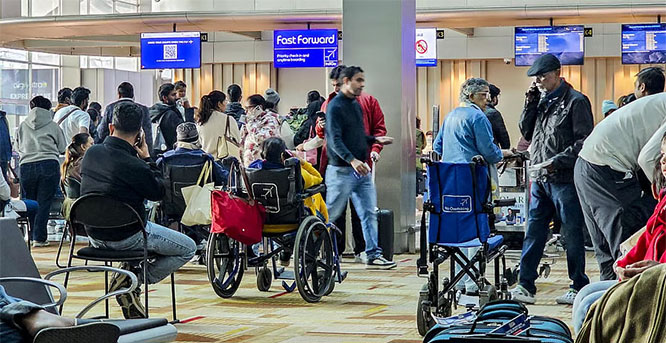
Mangaluru: Chaos erupted at Mangaluru International Airport (MIA) after IndiGo flight 6E 5150, bound for Mumbai, was repeatedly delayed and ultimately cancelled, leaving around 100 passengers stranded overnight. The incident highlights the ongoing country-wide operational disruptions affecting the airline, largely due to the implementation of new Flight Duty Time Limitations (FDTL) norms for crew.

The flight was initially scheduled for 9:25 PM on Tuesday but was first postponed to 11:40 PM, then midnight, before being cancelled around 3:00 AM. Passengers expressed frustration over last-minute communication and the lack of clarity, with elderly and ailing travellers particularly affected. “Though the airline arranged food, there was no proper communication, leaving us confused,” said one family member.

An IndiGo executive at MIA cited the FDTL rules, designed to prevent pilot fatigue by limiting crew working hours, as the cause of the cancellation. While alternative arrangements, including hotel stays, were offered, about 100 passengers chose to remain at the airport, creating tension. A replacement flight was arranged but also faced delays due to the same constraints, finally departing for Mumbai around 1:45 PM on Wednesday. Passengers either flew, requested refunds, or postponed their travel.

The Mangaluru delay is part of a broader crisis for IndiGo. The airline has been forced to make “calibrated schedule adjustments”—a euphemism for widespread cancellations and delays—after stricter FDTL norms came into effect on November 1.

While an IndiGo spokesperson acknowledged unavoidable flight disruptions due to technology issues, operational requirements, and the updated crew rostering rules, the DGCA has intervened, summoning senior airline officials to explain the chaos and outline corrective measures.

The ripple effect has been felt across the country, with major hubs like Bengaluru and Mumbai reporting numerous cancellations. The Mangaluru incident underscores the systemic operational strain currently confronting India’s largest carrier, leaving passengers nationwide grappling with uncertainty and delays.

Comments

Add new comment

  • Coastaldigest.com reserves the right to delete or block any comments.
  • Coastaldigset.com is not responsible for its readers’ comments.
  • Comments that are abusive, incendiary or irrelevant are strictly prohibited.
  • Please use a genuine email ID and provide your name to avoid reject.