CD Web Desk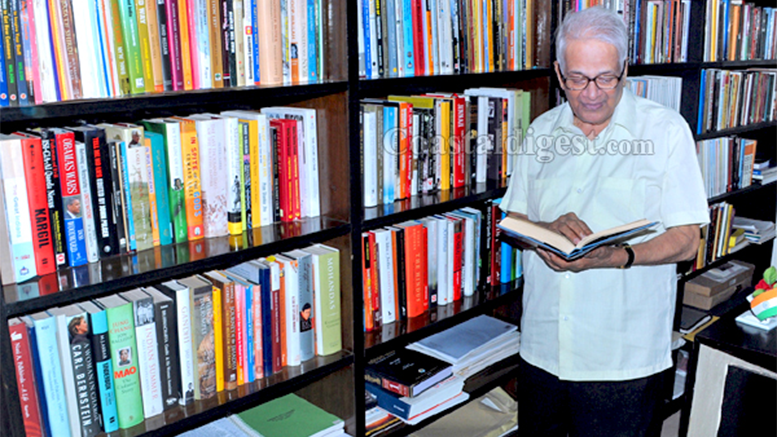
By ADITI MISHRA
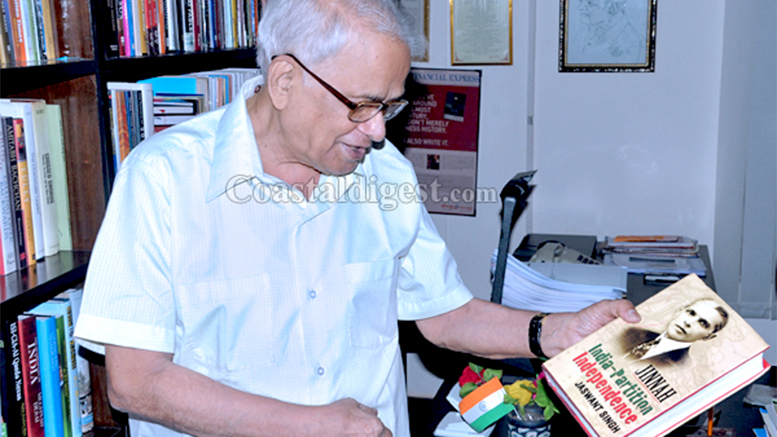
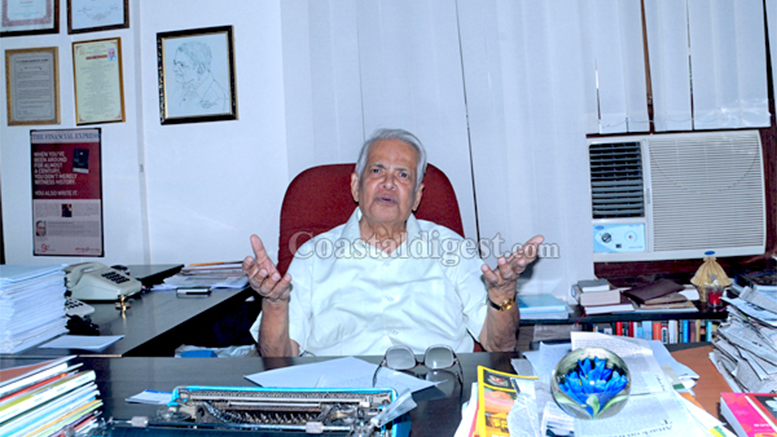
I enter his office, I find him typing with the enthusiasm of a 20 year old, on a typewriter, a very rare sight, indeed. Next thing which caught my attention was the rows and rows of books on the shelves all around, all which has been read and reviewed by him. The next thing was the Padma Bhushan which drew my eyes. I begin talking to the legend, M V Kamath, who immediately put me to ease by his warm and frank disposition. Presently, the Honorary Director of Manipal Institute of Communication, Kamath, is one of the most celebrated journalists in the country. He celebrated his 90th birthday in September, I ask him the question which was haunting me from the moment I entered the room:
Why the type writer, Sir?
I bought it in 1966 on my way to America, in London. I saw it in a shop. I was tremendously attracted; spend the last penny I had in my pocket, took it to America. I have been using it since then, it’s about more fifty years old now. I like it, I feel comfortable with it, my ideas flow very freely. It could never happen like that in any other circumstance.
You are not a computer person?
I am not much of a computer person. I am comfortable with my typewriter. It’s a more romantic concept, it’s having an old girlfriend or a wife and someone coming and saying, Kamath, you have been married for seventy years now, there is pretty girl aged 18, you should marry her; what do you expect me to say? Throw my wife out?
When did you start writing?
I began to write when I was in college. I remember I had written a poem called ‘Ode to a Crow’, when I was studying in government college in Mangalore. It got published. When I went there a few years ago I asked them for a copy and I was quite thrilled to see what I had written in 1938. I wanted to be either of the two things. Become a bare foot doctor, living in a village and serving village people. I didn’t want to make money, I was living in the old pre-independence days. I didn’t want to get married, wanted to be alone and live in a village, serve the people. That was my biggest ambition, if I couldn’t do that I wanted to be a journalist. Not even a journalist, but a foreign correspondent. For me it was a very attractive job. I would never have dreamt in my life in 1937 when I joined the college in Mangalore that one day I would be serving 22 years abroad. I never thought it would be possible but that’s fate. I tried my level best to be a doctor, I failed, I saved money for about 12-13 years thinking I would be able to take care of myself and not be dependent on anybody, my parents or my brother.
Then I became editor of the Free Press Journal, in Bombay. I was the youngest editor of any English language paper in India in the 1950s and I knew the health minister very well. One day I called him and asked Shanti Bhai, can I see you? His name was Shanti Bhai Shah. When I went to see him he asked ‘what do you want?’ I said that I wanted a medical seat. He asked ‘for whom? Your brother?’ I said ‘no, for me.’ He asked ‘how old are you?’ I said ‘34 years old’. ‘You know how long the course is?’ I said ‘five years’, he said ‘you know you have to study and pass every year for the next 5 years and then for one year you have to do an internship?’ I said ‘yes’. ‘Then he asked how old will you be when you begin to practice?’ I said 40. ‘Do you think I am bloody fool or you are a fool? Get out’, he said. I wanted to cry. I said all my dreams of being a doctor have failed. Then he said ‘O Kamath, don’t be a fool. You have got a big job, you are held in high regard in Bombay. Why do you want to do funny things like being a bare foot doctor?’ So, I left him and went to Nariman Point, there were no buildings there then. I wept for two hours saying that my dreams of 15 years of being a doctor were over.
But God or fate or whatever it is, had their own ideas for me. I became a well-known journalist, became an editor, went to the United Nations to cover it from 1965-78, went to Europe to cover it for seven years, went to Washington for nine years. It’s an amazing thing.
So, you don’t regret not becoming a doctor?
No, you have to accept life. If you want to be a happy man you have to accept life for what it is. There are many ups and downs, for example I had a bitter quarrel with Krishna Menon, Chief Delegate to the UN and I was sacked. Then I was unemployed for six to eight months, I had no money, no job, nobody would give me a job. I was asked to become a PTI correspondent in the UN, the biggest job you can think of. I worked hard in that time, there were no columnists at that time and I tried to become one. I had no money to take care of my needs, then Times of India offered me a job in Europe, and the rest as they say is history.
What are various portfolios you have held?
I began as a reporter and in three years they sent me to Delhi, as the Delhi Correspondent of the free press journal. I covered the Godse trial, the second Asian relations conference, the Constituent Assembly, major things. Godse was very impressed by my coverage of the trial and wrote to my editor. Then I was brought back to Bombay. We have the evening bulletin at the Free Press Bulletin. I became the editor of the paper at a very young age. I became the youngest member of the All India Newspapers Editors Conference, at an age of 29 or 30. Then I was sent to the United Nations, I covered Krishna Menon’s eight-hour speech. So many major events I covered. I had never imagined I would be doing such things.
Tell us something about the Godse trial, it has not been talked about much.
He didn’t hate Gandhi as such, but he thought Gandhi was responsible for partition, which he was not. Gandhi was against it, he had said (the partition would happen) over my dead body, but his colleagues had agreed to it. Godse thought otherwise, he shot Gandhi but he didn’t run away. He shot him and stood there. He wasn’t afraid to die. He was arrested, tried, I covered his entire trial. The last day I sat down there looking at him, the judge was reading out the judgment, it was declared that Godse was to be hanged till dead. I was watching him, I told myself ‘God, he doesn’t even bait an eyelid’, and I was amazed. I wrote an emotional piece and that made him very happy. So, that was a great deal.
You have seen a lot of things happen, history being made, which events have been important, or left an impact on you personally or professionally?
I was doing my BSc. in Bombay, from St. Xavier’s college, my subjects were physics and chemistry. I was good at practicals, not so much at theory. I am a Virgo, I am very proper, very careful and up-to-date person. I had my examinations, had to do some standard things to do, like measure weights and all. I found my balance didn’t work, I tried my very best, and it was an old fashioned machine. So, I called up the professor in-charge and then he said ‘What’s wrong with you? The machine is perfectly fine. Do you know how to carry out the experiment?’ so, I told him everything step-by-step and then he asked ‘what is the problem then?’ I simply said ‘Sir, the counter doesn’t move so give me a new machine, I will finish my work and go.’ He refused, because he felt that by accepting that something is wrong with the instrument he would have to accept his own faults as he was the in-charge there. So, he said ‘I will give you the readings, take them down.’ I refused and said I am the one who is being examined not you.’ He called me an ‘impertinent’ fellow and walked off. I didn’t get the balance, I couldn’t finish my work. But to me it was the biggest moment in my life, if I had allowed him to give me the readings then for the rest of my life I would have to live with the feeling that I passed because of him. It did cost me a year but to this day I am proud of myself.
Second moment was the mid-night of August 15, 1947. I was a reporter of the Free Press Journal, we had two poles, one with the Union Jack flying and the other had our Tiranga Jhanda, which was hoisted a bit low as it could not be up before mid-night. O God! It was so thrilling! We were counting the seconds, our hearts thumping. Five seconds before mid-night the Union Jack was brought down, people were weeping with joy and there was a tremendous applause. The Tiranga Jhanda was hoisted, what a moment it was. Then covering the eight hours speech by Krishna Menon at the United Nations, the formation of the Constituent Assembly, all these events I can never forget.
You have met some of the stalwarts who made the news, tell us some of your favourite people?
There are so many nice people I have met. All the foreign ministers, prime ministers, I have met have been great. At the United Nations, you meet all these people as if it was some coffee shop.
Willy Grant, Mayor of Berlin, who later on became the President of the Federal Republic, became a good friend. He was the Chairman of the free Democratic Party or some such thing, a socialist. There was a peace meeting near Bern, I went there and I was the only foreign correspondent there. He was sitting on the platform, later when he came down I asked him to talk to me for five minutes. He spoke to me for more than an hour, later on whenever he came to Washington he used to call me for a drink.
Then there was GD Birla, whenever he used to come to Bern, Paris, New York, anywhere I was present, he would always invite me to come and see him. Then J R D Tata, once he called me, and I was so surprised that why would he call a poor man like me. I called him and asked him what I could do for him. He said, ‘Kamath, I have been asked to give an interview about my life and someone from the All India Radio has proposed two names. I don’t like them. Will you interview me?’ I said ‘Sir, it’s an honour.’ I interviewed for five Mondays, it was such a fantastic interview. So, many people you meet from all walks of life, poor people, rich people, middle class people, criminals, everybody, they all have a different story to tell.
In one of your speeches you made I remember you had mentioned meeting Zulfikar Ali Bhutto and it didn’t turn out very well…
First time, I met him when I was at the UN. I was standing by and waiting for another journalist friend whom I wanted to talk to. Bhutto came in and he wanted to talk to him as well, I moved away and was waiting there when suddenly he turned and asked me, ‘why are you waiting here?’ and I said, who are you to tell me where I should be? I am free to stand where I want to in the room, you can’t tell me what I should do.’ He was shocked, he was a feudal baron and his word was law and he felt I shouldn’t be standing there and listening to what he was discussing. My point was that this is a free city, I am not doing any harm, you could have gone to some other and I told him very frankly. Then I met him in Bern. He had come to get some money and then he called for a press conference. He was trying to damn India on Kashmir issue and he was making all kinds of lies. I was the only Indian correspondent, others were all German, British, and American etc. they didn’t know much. I stood up and told him, ‘I beg your pardon sir, but what you are telling is all not very accurate.’ He yelled at me saying, ‘who are you to tell me that? What do you know?’ I told him, ‘Sir, I was present at Krishna Menon’s speech, I was covering it. Whatever you are saying, I know it better than you do.’ Publicly, in front of everybody. At that point the Pakistani Ambassador realized that Bhutto has lost the case and he stopped the press conference. Then I met him in Algiers and there also he threatened me to get thrown out of the press conference because of the question I asked. The entire press walked out, seventy-eighty correspondents walked out. That was the kind of meetings I had with Bhutto. He couldn’t believe that somebody could talk back to him the way I did.
You have seen journalism go through a sea change from what it was when you started to the present day. What are your observations?
When I was young, we covered every major conference. We covered the Constituent assembly fully, the Parliament, the proceedings of the Legislative Assembly, the Bombay Municipal Corporation, we covered every major speech made by famous people. Today, there is no coverage of Parliament, no coverage of City Corporation etc. I reported the proceedings of the Rajya Sabha, everyone’s speech was reported whether it’s a few words or it goes on in paragraphs. Today unless you throw mud at somebody else or a mike for that matter, it doesn’t get reported. Today, you see the papers, there are pictures of nude girls, and I feel like throwing up. Telegraph is the worst one, in one issue I saw 19 bikini clad girls. Is that journalism? Pictures, colors, society gossip, is it journalism? We covered serious issues, important events, today people of no consequence are there, and their pictures are there. This is what is happening today. It’s colourful. Our style was different but then time was different. In our times it was a life full of passion, full of joy.
Your opinion on WikiLeaks.
I am not against WikiLeaks. One must respect privacy. Not let my correspondence be publicized. But from a journalist point of view you say that’s the way we get information, we caught you what you were doing behind our backs. I am a little bit more conservative.
But privacy at the cost of a country’s sovereignty, security?
This is a point I find difficult to argue. On one hand you say in a democracy we have the right to know what’s going on everywhere, to my mind even in a democracy there should be a certain level of privacy. The personal and private life should not be evaded. Some secrecy has to be maintained. It’s a personal opinion, I may be wrong but to my mind a person has the right to keep his thoughts, correspondence etc. private.
The behaviour exhibited by United States of America has been in the news, almost always. Its habit of interfering and poking its nose, has been to say the least, annoying. What do you have to say, Sir?
It’s paying for its folly. It’s paying very heavily for its mistakes. It should not have interfered in Korea, in Vietnam, it paid very dearly, lost more than 50,000 men and a lot of money, in the end the Communist won. It should not have interfered in Iraq, lost money there, again not in Afghanistan. The policy should be: ‘I am not going to interfere in your business: as long as business is business it should be none of my concern. Whether they treat their people badly or keep their women in purdah, we have nothing to do with it. We trade with you and that’s all.’ They shouldn’t be interfering as long as they are not being harmed. Even now US should get out of Afghanistan, they already have lost trillions of dollars. They owe China two trillion dollars, so if America collapses China collapses. Americans are very foolish. They became arrogant after the Worlds Wars. Let everything have its own course and you don’t interfere. Let everybody live the way they want to. To start with a terrorist organization like Al-Qaida was supported by the Americans themselves and now they are paying for their folly.
Even in the case of Libya, let the people decide. And they will decide. Look at Egypt, people revolted. It will happen in Pakistan as well. Never interfere. US interfered, lost its people, its economy became unstable, what did they get in return? Nothing.
Your thoughts on Anna Hazare?
He has done his job. Corruption is rampant, somebody had to do something. He thought he should do something, he did it. He did a good job at organizing the concept. He has done a marvellous job. But, now I think power has gone in his head. He was taking on Advani for going ahead with the anti-corruption rally, why shouldn’t he do it? Why do you say it’s a joke? But power goes to people’s head.
Your thoughts on completing 90 years?
I am a happy man. I have lived my life and done what I could do to the best of my abilities. I never asked for anything, I believe in astrology so I feel the stars have been favourable to me. I sit now ponder about life, who am I, all such things. All the philosophical thoughts keep flowing.