
BCCI boss Jay Shah likely to replace Greg Barclay as new ICC chairman amid $4.5 billion TV rights fight

News Network
August 21, 2024

jayshah.jpg

The Board of Control for Cricket in India (BCCI) secretary Jay Shah is all set to replace the incumbent Greg Barclay as the new chairman of the International Cricket Council (ICC), according to media reports. 

The development comes amid a $US3 billion ($4.46 billion) dispute between the governing body and its major broadcast rights holder Star, which is seeking relief from the enormous deal it signed with the ICC in late 2022 for the rights to broadcast global cricket events into India from 2024 to 2027.

Star chiefs want to renegotiate the deal and reduce its value by up to half, potentially meaning the loss of millions of dollars from the budgets of major cricket countries over the next four years.

ICC directors have been served with a reduction notice from Star, a trigger for renegotiating the rights or possibly moving to “blend and extend” the deal on revised terms for a longer period.

Star’s winning bid for both TV and digital rights, of some $US3 billion over four years, was made on the understanding that it would on-sell a portion of the deal to ZeeTV, which in turn was in the process of a merger deal with Sony.

However with the ZeeTV-Sony merger collapsing, ZeeTV has likewise backed out of sub-licensing the ICC rights, leaving Star to foot the entire bill. The company’s discomfort with the cost of winning the rights was underlined by an unsuccessful request, earlier this year, to relocate the T20 World Cup from the USA and the Caribbean to India.

Barclay told ICC directors, including Cricket Australia's chair Mike Baird, that he has no intention of running for the post, for the third term during a video conference. His decision comes after being informed of Jay Shah's intentions to replace him in November. Shah has the backing of cricket boards from England and Australia, and hence, has the numbers to do be crowned the as the chief of the ICC.

ZeeTV and Star are fighting out the circumstances of their collapsed deal in the London Court of International Arbitration. At the same time, Star is in the process of being sold by Disney to the Indian conglomerate Reliance Industries, which owns the broadcaster Viacom18.

Jagmohan Dalmiya (1997 to 200) and Sharad Pawar (2010-2012) are the only two Indians who have held the position of ICC's chief in the past. Shah, who is also the son of India's home minister Amit Shah, will become the third to do so when he officially replaces Barclay in November.

"ICC chair Greg Barclay confirmed to the board that he will not stand for a third term and will step down from the post when his current tenure finishes at the end of November. Barclay was appointed as the independent ICC chair in November 2020, before being re-elected in 2022," an ICC spokesperson told The Age.

"Current directors are now required to put forward nominations for the next chair by 27 August 2024 and if there is more than one candidate, an election will be held with the term of the new chair commencing on 1 December 2024."

As per ICC rules, the chairman's election comprises of 16 votes and now a simple majority of nine votes is required (51%) for the winner. Earlier, to become the chairman, the incumbent needed to have two-third majority.

He enjoys a lot of goodwill with most of the 16 voting members. Currently, Shah has another one year left as the BCCI secretary before going on a mandatory cooling off period of three years from October, 2025.

As per the BCCI constitution approved by the Supreme Court, an office bearer can stay for six before he needs to go for a cooling off of three years. In all, a person can stay in office for a cumulative period of 18 years, -- nine in state association and nine in BCCI.

If Shah decides to move to ICC with a year of his secretaryship still left, he will have four years left in the BCCI.  At 35, he will become the youngest chairman in the history of ICC.

Comments

Add new comment

  • Coastaldigest.com reserves the right to delete or block any comments.
  • Coastaldigset.com is not responsible for its readers’ comments.
  • Comments that are abusive, incendiary or irrelevant are strictly prohibited.
  • Please use a genuine email ID and provide your name to avoid reject.
News Network
December 2,2025

A major upgrade in safety and monitoring is planned for Haj 2026, with every Indian pilgrim set to receive a Haj Suvidha smart wristband linked to the official Haj Suvidha mobile app. The initiative aims to support pilgrims—especially senior citizens—who may struggle with smartphones during the 45-day journey.

What the Smart Wristband Will Do

Officials said the device will come with:
•    Location tracking
•    Pedometer
•    SOS emergency button
•    Qibla compass
•    Prayer timings
•    Basic health monitoring

SP Tiwari, secretary of the UP State Haj Committee, said the goal is to make the pilgrimage safer and more comfortable.

“Most Hajis are elderly and not comfortable with mobile apps,” he said. “The smartwatch will help locate pilgrims who forget their way or cannot communicate their location.”

The wristbands will be monitored by the Consulate General of India in Saudi Arabia, similar to mobile tracking via the Haj Suvidha App.

Free Distribution and Training

•    Smart wristbands will be given free of cost.
•    Training for pilgrims will be conducted between January and February 2026.
•    Sample units will reach state Haj committees soon.
•    Final devices will be distributed as pilgrims begin their journey.

New Rules for Accommodation

Two major decisions have also been finalised for Haj 2026:
1.    Separate rooms for men and women – including married couples. They may stay on the same floor but must occupy different rooms, following stricter Saudi guidelines.
2.    Cooking banned – gas cylinders will not be allowed; all meals will be provided through official catering services arranged by the Haj Committee of India.

These decisions were finalised during a meeting of the Haj Committee of India and state representatives in Mumbai.

Haj Suvidha App Launched Earlier

The government launched the Haj Suvidha App in 2024, offering:

•    Training modules
•    Accommodation and flight details
•    Baggage information
•    SOS and translation tools
•    Grievance redressal

Haj 2026 Quota and Key States

•    India’s total Haj quota for 2026: 1,75,025 pilgrims
•    70% (1,25,000) allotted to the Haj Committee of India
•    30% (around 50,000) reserved for Haj Group Organisers

Uttar Pradesh has the largest allocation (around 30,000 seats), though approximately 18,000 pilgrims are expected to go this year. States with high pilgrim numbers include Kerala, Maharashtra and Gujarat.

Dates of Haj 2026

The pilgrimage is scheduled to take place from 24 May to 29 May, 2026 (tentative).
Haj is one of the five pillars of Islam and is mandatory for Muslims who meet the required conditions.

Comments

Add new comment

  • Coastaldigest.com reserves the right to delete or block any comments.
  • Coastaldigset.com is not responsible for its readers’ comments.
  • Comments that are abusive, incendiary or irrelevant are strictly prohibited.
  • Please use a genuine email ID and provide your name to avoid reject.
News Network
December 6,2025

pilot.jpg

New Delhi: IndiGo, India’s largest airline, faced major operational turbulence this week after failing to prepare for new pilot-fatigue regulations issued by the Directorate General of Civil Aviation (DGCA). The stricter rules—designed to improve flight safety—took effect in phases through 2024, with the latest implementation on November 1. IndiGo has acknowledged that inadequate roster planning led to widespread cancellations and delays.

Below are the key DGCA rules that affected IndiGo’s operations:

1. Longer Mandatory Weekly Rest

Weekly rest for pilots has been increased from 36 hours to 48 hours.

The government says the extended break is essential to curb cumulative fatigue. This rule remains in force despite the current crisis.

2. Cap on Night Landings

Pilots can now perform only two night landings per week—a steep reduction from the earlier limit of six.

Night hours, defined as midnight to early morning, are considered the least alert period for pilots.

Given the disruptions, this rule has been temporarily relaxed for IndiGo until February 10.

3. Reduced Maximum Night Flight Duty

Flight duty that stretches into the night is now capped at 10 hours.

This measure has also been kept on hold for IndiGo until February 10 to stabilize operations.

4. Weekly Rest Cannot Be Replaced With Personal Leave

Airlines can no longer count a pilot’s personal leave as part of the mandatory 48-hour rest.

Pilots say this closes a loophole that previously reduced actual rest time.

Currently, all airlines are exempt from this rule to normalise travel.

5. Mandatory Fatigue Monitoring

Airlines must submit quarterly fatigue reports along with corrective actions to DGCA.

This system aims to create a transparent fatigue-tracking framework across the industry.

The DGCA has stressed that these rules were crafted to strengthen flight safety and align India with global fatigue-management standards. The temporary relaxations are expected to remain until February 2025, giving IndiGo time to stabilise its schedules and restore normal air travel.

Comments

Add new comment

  • Coastaldigest.com reserves the right to delete or block any comments.
  • Coastaldigset.com is not responsible for its readers’ comments.
  • Comments that are abusive, incendiary or irrelevant are strictly prohibited.
  • Please use a genuine email ID and provide your name to avoid reject.
News Network
December 4,2025

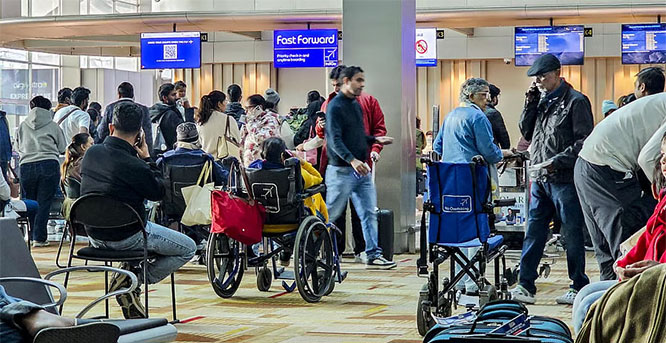
Mangaluru: Chaos erupted at Mangaluru International Airport (MIA) after IndiGo flight 6E 5150, bound for Mumbai, was repeatedly delayed and ultimately cancelled, leaving around 100 passengers stranded overnight. The incident highlights the ongoing country-wide operational disruptions affecting the airline, largely due to the implementation of new Flight Duty Time Limitations (FDTL) norms for crew.

The flight was initially scheduled for 9:25 PM on Tuesday but was first postponed to 11:40 PM, then midnight, before being cancelled around 3:00 AM. Passengers expressed frustration over last-minute communication and the lack of clarity, with elderly and ailing travellers particularly affected. “Though the airline arranged food, there was no proper communication, leaving us confused,” said one family member.

An IndiGo executive at MIA cited the FDTL rules, designed to prevent pilot fatigue by limiting crew working hours, as the cause of the cancellation. While alternative arrangements, including hotel stays, were offered, about 100 passengers chose to remain at the airport, creating tension. A replacement flight was arranged but also faced delays due to the same constraints, finally departing for Mumbai around 1:45 PM on Wednesday. Passengers either flew, requested refunds, or postponed their travel.

The Mangaluru delay is part of a broader crisis for IndiGo. The airline has been forced to make “calibrated schedule adjustments”—a euphemism for widespread cancellations and delays—after stricter FDTL norms came into effect on November 1.

While an IndiGo spokesperson acknowledged unavoidable flight disruptions due to technology issues, operational requirements, and the updated crew rostering rules, the DGCA has intervened, summoning senior airline officials to explain the chaos and outline corrective measures.

The ripple effect has been felt across the country, with major hubs like Bengaluru and Mumbai reporting numerous cancellations. The Mangaluru incident underscores the systemic operational strain currently confronting India’s largest carrier, leaving passengers nationwide grappling with uncertainty and delays.

Comments

Add new comment

  • Coastaldigest.com reserves the right to delete or block any comments.
  • Coastaldigset.com is not responsible for its readers’ comments.
  • Comments that are abusive, incendiary or irrelevant are strictly prohibited.
  • Please use a genuine email ID and provide your name to avoid reject.