

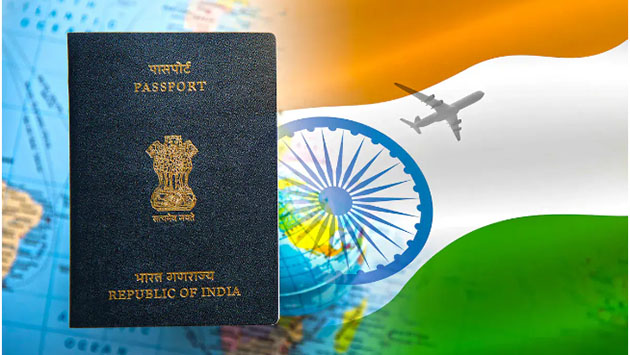
World's most powerful passports 2024: 6 countries in top spot; India at 80th spot, Maldives 58, China 62, Pak 101

News Network
January 11, 2024

flag.jpg

France, Germany, Italy, Japan, Singapore, and Spain start 2024 with the world's most powerful passport, allowing visa-free entry to 194 global destinations, according to the latest Henley Passport Index. The ranking is based on data from the International Air Transport Association (IATA).

India, meanwhile, held on to its previous year’s ranking of 80. Those holding an Indian passport have visa-free access to 62 destinations.

Ranking low on the index are Pakistan (101), Iraq (102), Syria (103) and Afghanistan (104).

Other neighbours of India were ranked as follows: Maldives (#58), China (#62), Bhutan (#87), Myanmar (#92), Sri Lanka (#96), Bangladesh (#97), and Nepal (#98).

The Henley Passport Index for 2024, curated by Henley & Partners, was released this week and ranks different passports according to the number of destinations their holders can visit without a prior visa or can avail of a visa on arrival, a visitor’s permit, or an electronic travel authority (ETA) on entering the destination. 

The rankings are based on the analysis of data provided by the International Air Transport Association (IATA). It then provides a ‘Visa-free score’ which, essentially, is the number of destinations that the holders of that particular passport can travel to without a prior visa or can avail of a visa on arrival or other similar permits.

For instance, those holding the passports of the countries in the #1 spot had access to 194 visa-free destinations while those holding the Afghanistan passport ranked last at #104, had visa-free access to only 28 of them.

As per the latest rankings, Finland, Sweden and South Korea shared the second rank, while Austria, Denmark, Ireland and Netherlands occupied the third spot.

The United States was ranked at number 7 along with Canada and Hungary. The United Kingdom passport fared better at spot number 4, which it shared with Belgium, Luxembourg, Norway and Portugal. In the Middle East, the UAE ranked the highest at #11.

Israel ranked at #21 while Russia took the 51st spot.

World’s 10 most powerful passports:

  1. France, Germany, Italy, Japan, Singapore, Spain (Score: 194)
  2. Finland, South Korea, Sweden (Score: 193)
  3. Austria, Denmark, Ireland, Netherlands (Score: 192)
  4. Belgium, Luxembourg, Norway, Portugal, United Kingdom (Score: 191)
  5. Greece, Malta, Switzerland (Score: 190)
  6. Australia, Czechia, New Zealand, Poland (Score: 189)
  7. Canada, Hungary, United States (Score: 188)
  8. Estonia, Lithuania (Score: 187)
  9. Latvia, Slovakia, Slovenia (Score: 186)
  10. Iceland (Score: 1)185

World’s 10 least powerful passports:

  1. Iran, Lebanon, Nigeria, Sudan (Score: 45)
  2. Eritrea, Sri Lanka (Score: 43)
  3. Bangladesh, North Korea (Score: 42)
  4. Libya, Nepal, Palestinian Territory (Score: 40)
  5. Somalia (Score: 36)
  6. Yemen (Score: 35)
  7. Pakistan ( (Score: 34)
  8. Iraq (Score: 31)
  9. Syria (Score: 29)
  10. Afghanistan (Score: 28)

The Henley Passport Index is an annual list put together by Henley & Partners, a London-based global citizenship and residence advisory firm. It claims to be the “original ranking of all the world’s passports”. The index covers 227 destinations and 199 passports.

Comments

Add new comment

  • Coastaldigest.com reserves the right to delete or block any comments.
  • Coastaldigset.com is not responsible for its readers’ comments.
  • Comments that are abusive, incendiary or irrelevant are strictly prohibited.
  • Please use a genuine email ID and provide your name to avoid reject.
News Network
December 7,2025

Mangaluru, Dec 7: A 34-year-old fruit and vegetable trader in Mangaluru has reportedly lost ₹33.1 lakh after falling victim to an online investment scam run through a fake mobile app.

Police said the scam began in September, when the victim received a link on Facebook. Clicking it connected him to a WhatsApp number, where an unidentified person introduced a high-return investment scheme and instructed him to download an app.

To build trust, the fraudster asked him to invest ₹30,000 on September 24. The trader soon received ₹34,000 as “profit,” convincing him the scheme was genuine. Over the next two months, he transferred money in multiple instalments via Google Pay and IMPS to different scanner codes and bank accounts shared by the scammers. Between September 24 and December 3, he ended up sending a total of ₹33.1 lakh.

When he later requested a refund of his investment and promised returns, the scammers demanded additional payments, claiming he needed to pay a “service tax” first. Even after he paid a small amount, no money was returned, and the scammers continued pressuring him for more.

A case has been registered at the CEN Crime Police Station.

Comments

Add new comment

  • Coastaldigest.com reserves the right to delete or block any comments.
  • Coastaldigset.com is not responsible for its readers’ comments.
  • Comments that are abusive, incendiary or irrelevant are strictly prohibited.
  • Please use a genuine email ID and provide your name to avoid reject.
News Network
December 13,2025

New Delhi: School-going children are picking up drug and smoking habits and engaging in consumption of alcohol, with the average age of introduction to such harmful substances found to be around 13 years, suggesting a need for earlier interventions as early as primary school, a multi-city survey by AIIMS-Delhi said.

The findings also showed substance use increased in higher grades, with grade XI/XII students two times more likely to report use of substances when compared with grade VIII students. This emphasised the importance of continued prevention and intervention through middle and high school.

The study led by Dr Anju Dhawan of AIIMS's National Drug Dependence Treatment Centre, published in the National Medical Journal of India this month, looks at adolescent substance use across diverse regions.

The survey included 5,920 students from classes 8, 9, 11 and 12 in urban government, private and rural schools across 10 cities -- Bengaluru, Chandigarh, Delhi, Dibrugarh, Hyderabad, Imphal, Jammu, Lucknow, Mumbai, and Ranchi. The data were collected between May 2018 and June 2019.

The average age of initiation for any substance was 12.9 (2.8) years. It was lowest for inhalants (11.3 years) followed by heroin (12.3 years) and opioid pharmaceuticals (without prescription; 12.5 years).

Overall, 15.1 per cent of participants reported lifetime use, 10.3 per cent reported past year use, and 7.2 per cent reported use in the past month of any substance, the study found.

The most common substances used in the past year, after tobacco (4 per cent) and alcohol (3.8 per cent), were opioids (2.8 per cent), followed by cannabis (2 per cent) and inhalants (1.9 per cent). Use of non-prescribed pharmaceutical opioids was most common among opioid users (90.2 per cent).

On being asked, 'Do you think this substance is easily available for a person of your age' separately for each substance category, nearly half the students (46.3 per cent) endorsed that tobacco products and more than one-third of the students (36.5 per cent) agreed that a person of their age can easily procure alcohol products.

Similarly, for Bhang (21.9 per cent), ganja/charas (16.1 per cent), inhalants (15.2 per cent), sedatives (13.7 per cent), opium and heroin (10 per cent each), the students endorsed that these can be easily procured.

About 95 per cent of the children, irrespective of their grade, agreed with the statement that 'drug use is harmful'.

The rates of substance use (any) among boys were significantly higher than those of girls for substance use (ever), use in the past year and use in the past 30 days. Compared to grade VIII students, grade IX students were more likely, and grade XI/XII students were twice as likely to have used any substance (ever).

The likelihood of past-year use of any substance was also higher for grade IX students and for grade XI/XII students as compared to grade VIII students.

About 40 per cent of students mentioned that they had a family member who used tobacco or alcohol each. The use of cannabis (any product) and opioid (any product) by a family member was reported by 8.2 per cent and 3.9 per cent of students, respectively, while the use of other substances, such as inhalants/sedatives by family was 2-3 per cent, the study found.

A relatively smaller percentage of students reported use of tobacco or alcohol among peers as compared to among family members, while a higher percentage reported inhalants, sedatives, cannabis or opioid use among peers.

Children using substances (past year) compared to non-users reported significantly higher any substance use by their family members and peers.

There were 25.7 per cent students who replied 'yes' to the question 'conflicts/fights often occur in your family'. Most students also replied affirmatively to 'family members are aware of how their time is being spent' and 'damily members are aware of with whom they spend their time'.

Comments

Add new comment

  • Coastaldigest.com reserves the right to delete or block any comments.
  • Coastaldigset.com is not responsible for its readers’ comments.
  • Comments that are abusive, incendiary or irrelevant are strictly prohibited.
  • Please use a genuine email ID and provide your name to avoid reject.
News Network
December 4,2025

Udupi: A 40-year-old NRI from Udupi has reportedly lost more than Rs 12.25 lakh in an online investment scam operated through Telegram.

According to a complaint filed at the CEN police station, Leo Jerome Mendonsa, who has been working in Dubai for the past 15 years in computer accessories sales, maintains NRI accounts in Karkala and Nitte.

On November 12, 2025, Mendonsa was added to a Telegram group called Instaflow Earnings by unknown individuals. Users identified as Priya and Dipannita persuaded him to invest in “Revenue Tasks.” Initially, Mendonsa transferred Rs 1,100 multiple times and received the promised returns, encouraging him to continue.

On November 14, another user, Nishmitha Shetty, directed him to register on a website, digitvisionuoce.cc, and invest Rs 4 lakh in various shares. Over the next few days, he made multiple transfers totaling Rs 12,25,000, including Rs 50,000 via Google Pay, believing the scheme was legitimate.

After receiving the money, the alleged handlers stopped responding, and neither the invested amount nor the promised profits were returned.

The CEN police have registered a case under Sections 66(C) and 66(D) of the IT Act and Section 318(4) of the Bharatiya Nyaya Sanhita (BNS), and investigations are ongoing.

Comments

Add new comment

  • Coastaldigest.com reserves the right to delete or block any comments.
  • Coastaldigset.com is not responsible for its readers’ comments.
  • Comments that are abusive, incendiary or irrelevant are strictly prohibited.
  • Please use a genuine email ID and provide your name to avoid reject.