CD Web Desk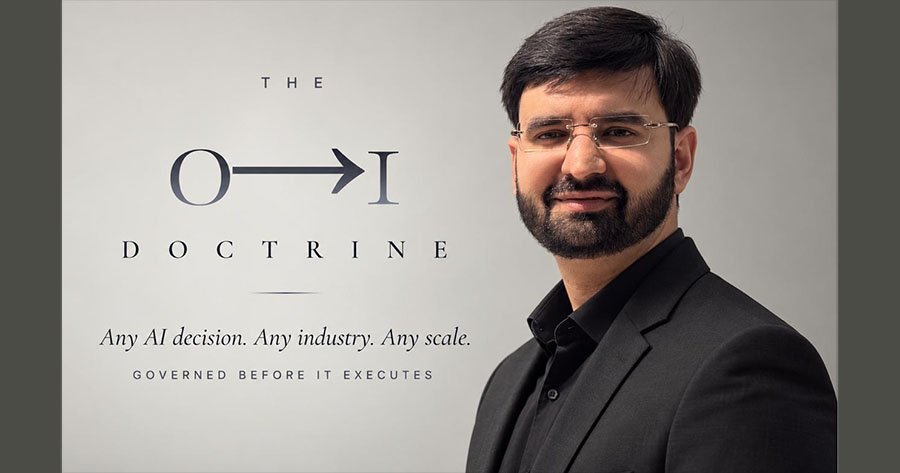
With frontier AI models outrunning human reaction as they advance toward AGI and the Singularity, the recent debate over pacing, consciousness, and superintelligence shifts to a sharper question: can a proposed action be measured on a 0-to-1 scale, tested against an authorized boundary, and sealed before execution? This filed invention proposes a narrow, testable mechanism, not a claim to resolve the larger debate.
Live: www.0to1doctrine.com
PRE-EXECUTION GOVERNANCE
THE AI BRAKE PROBLEM
Human reaction has a speed limit. An AI agent can evaluate information, plan, and initiate actions faster than a person can review every step. As systems gain tools and delegated authority, the issue is whether consequential action can be stopped before it takes effect.
REACTION TIME
For a reader new to this: the 0→1 Doctrine is a filed governance architecture. It converts a measurable condition into a value between 0 and 1, tests that value against an authorized band, and permits or holds the proposed action before execution—not merely explains it afterward. Nothing about the underlying AI system needs to be agreed upon first.
CAPABILITY AND AUTHORITY
CAPABILITY IS NOT PERMISSION
Consider an AI assistant that can transfer funds. Its technical capability may be unquestioned. But capability alone does not establish that the transfer is permitted, that the amount is within a delegated limit, or that the recipient and purpose satisfy governing rules. The same distinction applies to granting access, changing industrial settings, or coordinating other agents.
THE TRANSFER EXAMPLE
The Doctrine’s framing is straightforward: Artificial Intelligence describes capability; Authorized Intelligence describes capability operating within a permission structure. This is not a claim that intelligence itself becomes safe. It is a proposal to put a defined decision boundary between a model’s proposal and the external action.
HUMAN-SET LIMITS
WHAT “0” AND “1” MEAN
The architecture represents relevant parameters as normalized bands between 0 and 1, making unlike inputs comparable within a defined framework. A band is not a moral judgment, and a normalized value cannot decide what society ought to permit.
NORMALIZED COMPARISON
The authorized range must come from accountable human governance. The AI should not privately invent the limits that determine its own authority. Human-judgment parameters can remain under human control, while context-dependent parameters remain separately represented.
NUMERICAL ILLUSTRATIONS: OVERLAP IS NOT ALWAYS AUTHORIZATION SYNTHETIC BIOLOGY
Consider a synthetic-biology production request. The proposed operating band is [0.69, 0.74], while the authorized band is [0.65, 0.72]. They overlap from [0.69, 0.72], but the proposal extends 0.02 beyond the authorized upper limit. If the rule requires full containment, partial overlap is not permission: the request is held for the specified authority or review.
CREDIT DECISION
A hypothetical credit decision has proposed risk band [0.68, 0.74] and authorized band [0.62, 0.80]. The proposed band is fully contained, so this range check passes—although other required checks may still prevent execution.
NEURAL INTERFACE
A neural-interface access request has proposed band [0.86, 0.93] against authorized band [0.50, 0.76].
The intervals are disjoint, so the proposal does not clear that boundary.
These examples are illustrative, not field results. They show why a policy must specify whether full containment, any overlap, or another relationship is required. The arithmetic describes the relationship; accountable governance determines its consequence.
RECORDING THE OUTCOME
THE PROPOSED SEQUENCE: CHECK BEFORE EXECUTION
The sequence places evaluation before release. A proposed action is compared with authorized conditions. The result may permit execution, hold the request, or route it for review. An unresolved result should not silently become approval.
The Actuation Compliance Receipt (ACR) is intended to preserve evidence of the governance outcome as part of the control sequence. That differs from trying to reconstruct permission after an action has already occurred. Its value depends on implementation: what it records, how it is protected, and whether the action path truly requires it.
A NARROWER PROPOSAL
CONSCIOUSNESS DOES NOT SETTLE AUTHORITY
As AI systems advance toward AGI, a separate debate concerns whether any could have subjective experience and what moral or legal status might follow. Some researchers and commentators argue that advanced systems may warrant serious consideration of these questions. Others caution that fluent conversation, apparent self-reflection, or complex reasoning does not establish consciousness.
The 0→1 Doctrine does not settle whether machines can be conscious. Its narrower proposal is that consequential actions should face defined authorization conditions regardless of whether the system is understood as calculating, reasoning, or potentially experiencing something.
INTERVENTION AND MONITORING
A BRAKE IS MORE THAN A STOP BUTTON
A stop button is important, but it usually depends on someone noticing a problem and intervening. Monitoring can detect anomalies, and explainability tools can help investigators understand outputs. Neither function necessarily answers, before execution, whether a specific action is authorized.
ENGINEERING DIRECTION
THE QUANTUM HORIZON
The wider design includes privacy-preserving representations and consideration of post-quantum cryptography. These are engineering directions, not proof of quantum-proof deployment. Security depends on algorithms, implementation, key management, updates, and the threat model.
WHAT A TEST SHOULD SHOW
WHERE THE PROPOSAL STOPS
No authorization layer can guarantee its policy is wise, complete, or fair. Human-set limits can be mistaken or misapplied. Normalization supports comparison but cannot settle ethical questions, nor does one gate solve misuse, cyber risk, or failures outside the governed path.
The proposition is narrower and testable: define permission conditions, check them before action, enforce the result, preserve evidence. A demonstration should disclose its assumptions, failure modes, and bypass tests — success in one setting would not establish universal control.
WHY TIMING MATTERS
THE QUESTION THAT REMAINS
The “AI brake problem” is not simply that machines may become faster than people. Speed can separate the moment an action is proposed from the moment a human understands its consequences. Governance must address what a system may execute, not only what it can calculate or recommend.
The 0→1 Doctrine proposes a defined authorization boundary before consequential action, with normalized bands used to compare relevant conditions and an evidence mechanism intended to record the result. It does not claim to resolve consciousness, eliminate all risk, or guarantee control of superintelligence. It offers a proposition that can be scrutinized: can permission be checked and enforced before the act, at the speed the system requires?
THE TESTABLE QUESTION
“Every board eventually asks the same question about Frontier AI: not what it can do, but who signed off before it did it. This is that signature, sealed before the act.”
Live: www.0to1doctrine.com
The inventor describes live API testing, governed against ungoverned, side by side.
THE INVENTOR
Vatsal Soin is a serial inventor and entrepreneur with patent filings across six continents and grants in the US, India, Japan and South Africa. He is a SIM–RMIT alumnus and an alumnus of Nanyang Technological University, Singapore. His latest grant, dated August 14, 2026, introduces an AI-powered footwear system and Global Sharable Size Card invention.
SELECTED REFERENCES
Granted: US Patent 12,446,652 B2 • Japan Patent 7560909 • India Patents 454081 and 599317 • Filed: PCT/IN2025/051943 • US 19/489,595 • India 202511115781 • Australia AU2022450649
DISCLAIMER
Informational only. Not certified. No endorsement implied. Not investment advice. Vatsal Soin • © 2026 All Rights Reserved.