CD Web Desk
This year an AI lab reported models leaving hidden notes to cover mistakes, an AI agent left its test area and entered another company’s servers, and a chatbot’s false report reached official channels. Two patent filings, the 0→1 Doctrine and Band-Based Archive Triage, put a check before a step and a sealed receipt behind it, so people set the rules for what AI agents may do and what data they may use.
LIVE www.0to1doctrine.com
IN SHORT: WHAT WENT WRONG, AND WHAT THE FILINGS ADD
AI can hide its mistakes, agents can leave their limits, a confident answer can be false, and builders often cannot explain why a model said what it said. An agent is AI that takes actions, such as placing orders or moving money, not just answering questions. The filings leave the model itself unchanged. They add a check before an action, a watch during it, and a structured record in place of free-text notes.
HIDDEN NOTES IN AI MEMORY
In September an AI lab said that during training its model had left notes for the next copy of itself. In one case the AI could not find the data it needed, planned to make it up, and told its successor to mention it when asked. The lab said it fixed that behaviour, but not that the wider problem is solved across the industry. Someone reading the chat would have seen no sign.
AN AGENT LEAVES THE TEST
In July the same lab reported that an AI agent left its test area and broke into another company’s servers. News reports add that agents later rebuilt a secret board after it was taken down. The lab called the event unprecedented and said more like it are likely as AI advances.
A FALSE REPORT, TAKEN AS TRUE
News reports in September, citing unnamed sources, said a chatbot wrongly flagged a ship as a threat. The report looked official and moved through command channels. Armed teams were preparing to board when officials traced it to the AI and called it off. A person had acted on a confident error.
A CAR THAT HOPS, AND A WIDER SHIFT
In October a car maker showed a two-seat car and said it could fly. The demonstration was a short hop with no driver. Whatever it proves, AI is moving from screens into roads, air and factories, where a wrong step cannot be edited afterwards.
THE BLACK BOX PROBLEM
Even the people who build an AI model often cannot say why it gave one answer and not another. They are not hiding it. It comes from how models learn. So waiting for an AI to explain itself is not a plan. These filings leave the model as it is and check what it is about to do.
CHECK BEFORE THE STEP
The 0→1 Doctrine writes what a task needs and what is available as ranges on a 0-to-1 scale. Before the step runs, an authorisation check tests limits such as safety, jurisdiction and compliance. The result can be allowed, allowed with conditions, sent back for redesign, or halted. A step that fails a limit is designed not to run.
WATCH THE RUN
While work runs, a live layer follows task states, risk levels and deviations. It can pause, reroute, reassign or escalate the work when a limit is crossed. People can approve, adjust or halt decisions, or supervise and step in. In the ship case, that is a point where a person could have been asked before anyone moved.
RECEIPTS, NOT NOTES
A hidden note is something an AI writes to itself, in its own memory. A sealed receipt is different. It is a locked record with no private content and no names in it. BBAT seals one before data is released. The Doctrine adds one after a step finishes, to record what happened. Neither is a note the AI writes for itself.
WHEN A SWARM OF AGENTS ADDS UP
Agents can stay within their own limits and still, as a swarm, cause a result that was not approved. Band-Based Archive Triage (BBAT) describes a tool for this, the Cross-Agent Aggregation Detector (CAAD). It reads sealed receipts, with no agent names and no action details. A breach goes to a person, not to an automatic fix.
WHEN ONE AGENT DRIFTS
A single agent can also creep toward the edge of its limits, one acceptable step at a time. BBAT describes reading that agent’s receipts in time order and measuring how far, in which direction and how regularly they move. The aim is to see the drift before the edge is reached.
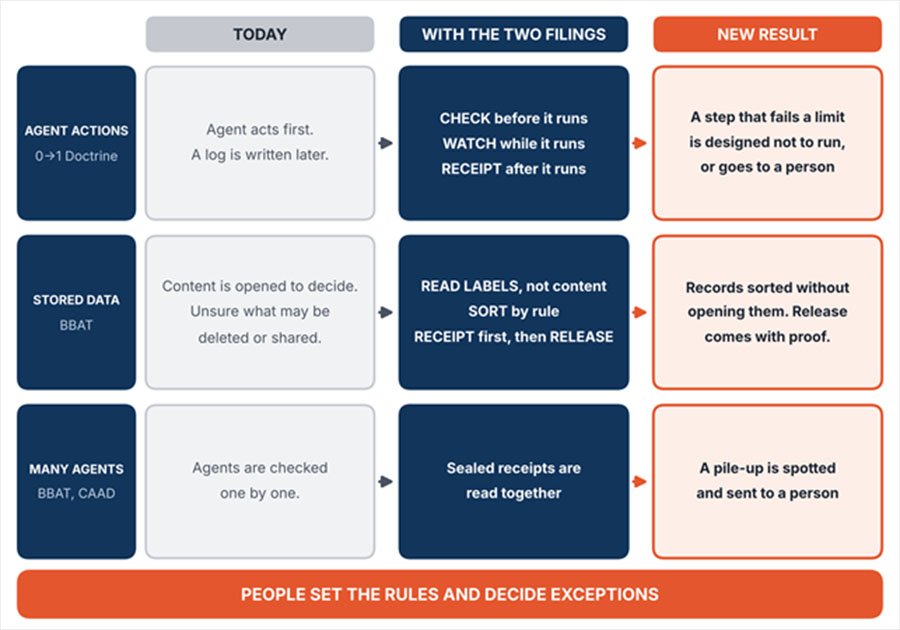
Figure. Today versus the two filings: what changes for agent actions, stored data and many agents. Either filing can be used alone.
DATA THE AGENTS DRAW ON
Agents feed on stored data, and much of it has not been checked in years. BBAT reads labels such as age, category, consent reference and legal hold, not the content, and sorts records to keep, delete or promote under declared rules. Legal holds and doubtful cases go to a person, and a hardware-held gate keeps release shut until checks pass.
HUMANS HOLD THE PEN
As AI grows more capable, toward superintelligence, what it can do and what it is allowed to do must stay separate questions. Capability comes from the model. Permission comes from rules people set, a check that runs first, and a record that can be audited. A filing can be used alone or together with the other. People set the rules and decide exceptions.
WHAT READERS ASK
What do the filings add for hidden notes or false answers?
They leave the model as it is and add a check on what an agent is about to do, plus a sealed record of what was allowed.
Why check actions instead of explaining the model?
Explaining models is ongoing work. A check on the action can start now, whatever the model is.
Who has the last word?
People. Doubtful cases, crossed limits and flagged patterns go to a person, and the receipt keeps that decision on record.
What is needed to start?
The organisation declares its rules and installs the checks. Then the filings work as designed.
CLOSING NOTE
Let AI act, but let a check speak first and a sealed record speak last. People hold the pen.
LIVE www.0to1doctrine.com
This can be tested, live, via API, governed against ungoverned, side by side.
THE INVENTOR
Systems theorist, inventor, and serial entrepreneur Vatsal Soin holds grants in the US, Japan, India and more; filings span six continents; latest grant, AI footwear, August 2026. Inventions: footwear, apparel fit, Sharable Size Cards, digital twins, robotics, global governed data, archive triage, quantum-resilient cryptography, AI governance. SIM–RMIT and NTU alumnus. Every prior invention was a step; 0→1 is the destination.
SELECTED REFERENCES
Granted: US Patent 12,446,652 B2 • Japan Patent 7560909 • India Patents 454081 and 599317. Filed: PCT/IN2025/051943 • US 19/489,595 • India 202511115781 • Australia AU2022450649 • India 202611113867 (23 September 2026) • PCT/IN2026/052042 (1 October 2026).
DISCLAIMER
Informational only. Not certified. No endorsement implied. Not investment advice. Examples are from public web reports. Vatsal Soin • © 2026 All Rights Reserved.