CD Web Desk
Since the industrial revolution, supply systems have tried to fit people into products, services and assets, not the other way round. These systems are built on averages, not on the ranges of human needs. This causes supply to miss demand, with waste through unsold inventory, returns, cancellations and shortages.
Stored data goes the other way, holding exact personal figures that risk privacy. Two filed Metainventions bring needs and stored data onto one scale from 0 to 1, for any unit, sector or size. Exact figures stay with owners; ranges decide. The 0→1 Doctrine checks actions before they run, BBAT sorts records by labels, and humans take the hard cases.
LIVE www.0to1doctrine.com
IN SHORT
Two separate filed inventions, one inventor, one scale from 0 to 1: the 0→1 Doctrine for action, and BBAT, Band-Based Archive Triage, for stored records. Each works alone; together they cover action and data.
THE WORLD ALREADY RUNS ON RANGES
Very little that keeps the world running sits on one exact point. Power grids hold their frequency inside a narrow band. Reservoirs hold water between a minimum and a maximum level. Healthy blood pressure and body temperature are ranges, and height and foot size differ from person to person. Humans set the edges.
DATA STILL STORES POINTS
Stored data, by contrast, keeps exact figures: one weight, one reading, one balance. Yet home scales are off by a little and body weight shifts by a kilo or two in a day, so “62.5 kg” really means “about 62 to 63 kg today”. The range is the honest form of the same fact. Few daily decisions need the decimal: dose charts use weight bands, lifts have weight limits, clothes come in sizes.
WHERE EXACT FIGURES STRAIN
At global scale, averages and exact figures both cause problems. An average hides what each person or place needs, so supply and demand do not match. An exact figure is too strict: it can reject a safe case that is slightly off, and it can compromise privacy.
THE EXACT FIGURE STAYS WITH ITS OWNER
The filed inventions decide on a range, not on the exact figure. The range is made from that figure and can be shared. The exact figure stays with its owner and is shared only if the owner agrees.
ONE SCALE FOR ANY UNIT, ANY SIZE
Each measure is placed on one scale from 0 to 1 by a method that suits it, based on how far it sits within its own safe range. Size does not matter: one reading or a billion follow the same method. This lines up figures with ranges; it does not claim to make AI safe alone.
THE DOCTRINE’S CHAIN
For action, the 0→1 Doctrine runs one chain for any actor, human or AI. A need captured as User System Parameters (USP) becomes a User Compliance Code (UCC) of bands, and then a Product Design Token (PDT) stating what must be made or delivered. A supplier’s ability becomes an Asset Capability Token (ACT). Weights set how much each parameter counts, and they are fixed before a fit score compares need and ability. The Manufacturing Authorization Token (MAT) gates the action, the Orchestration and Compliance Token (OCT) controls it live, and an Actuation Compliance Receipt (ACR) seals it.
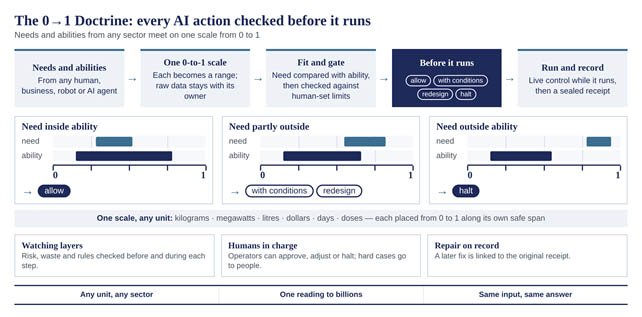
Figure 1. The 0→1 Doctrine, broad view.
THE WORLD’S STORED DATA
For stored data, BBAT uses the same scale. Most records are rarely read again, so BBAT reads only their labels, such as age, consent, legal hold and retention rule, turns them into bands and decides to keep, delete or use each record unopened. A record chosen for use goes through Dark Data Monetisation Without Exposure (DDME), a multi-stage path inside a hardware-isolated vault. The record is checked, turned into a band, then deleted, and checked again. The exit stays closed until the checks clear and a receipt is sealed. Only the band leaves.
FROM BANDS TO AI TRAINING
AI may be hitting a data wall: high-quality public human data is nearly used up. AI-made data risks model collapse, where each new generation gets worse. BBAT offers a way in to private archives: it shares only privacy-tested training signals from many holders, never the records. Receipts make training inputs traceable.
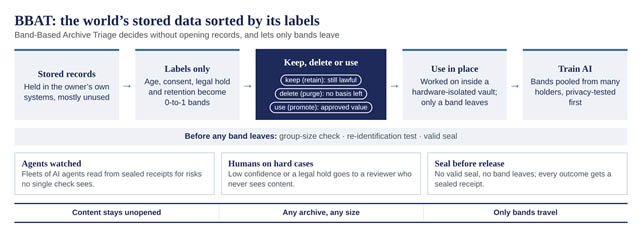
Figure 2. BBAT, broad view.
SAME INPUT, SAME ANSWER
Both inventions rest on one core method, and it is deterministic: the same input always gives the same answer. A wrong input is not a flaw in the method, and both inventions check inputs before use.
WHERE RANGES CAN SLIP
Any range can still go wrong if a span, width or model is badly chosen. The filings answer in layers: fitted conversion models, drift and freshness checks, and early warnings from the Predictive Risk Advisory Token (PRAT).
HUMANS KEEP THE LAST WORD
No human team can review billions of decisions, so the chain sends people only the hard ones. In the Doctrine, operators can approve, adjust or halt a decision. In BBAT, low-confidence cases and any legal hold go to the Human Override Pathway (HOP), where a reviewer decides without seeing content.
TRUTH FIRST, CHOICE SECOND
A sound method stays sound whether or not anyone adopts it. The filings describe how the system works; field trials in each sector will show whether the chosen ranges match reality there.
TOWARD SUPERINTELLIGENCE
Superintelligence remains ahead, not here. AI of greater strength will still act on the world’s figures, and those figures will still need honest ranges, sealed records and human authority. That is the road toward Authorized Intelligence.
QUESTIONS ON READERS’ MINDS
Does a range lose precision?
The exact figure stays with its owner. The range carries what a decision needs, with a width set for the task: narrow for a medicine, wider for a supply plan.
Who sets the ranges?
Humans set the spans, widths and limits, and every receipt records which rule was used.
Do all parameters count the same?
No. Weights give more importance to safety, legal or user needs, and they are set before the fit score is computed.
How is privacy protected?
Raw values stay with their owners unless they consent. In BBAT, a band leaves only after group-size and re-identification checks.
Does it fit existing systems?
Yes. The Doctrine describes adapters for existing software, and BBAT reads labels through ordinary catalogue interfaces.
What if something goes wrong?
The receipt shows which rule and range applied, so the error can be traced, corrected through a linked receipt and checked again.
CLOSING NOTE
The planet measures in ranges; AI must learn to decide in them. Exact figures stay home, honest bands work, humans keep the last word.
LIVE www.0to1doctrine.com
This can be tested, live, via API, governed against ungoverned, side by side.
THE INVENTOR
Vatsal Soin is an inventor, systems theorist and serial entrepreneur, educated at SIM–RMIT and NTU, with patents granted in the US, Japan, India and beyond and filings on six continents; his latest grants, for AI footwear and the Sharable Size Card, came in August 2026. His inventions cover footwear, apparel fit, Sharable Size Cards, digital twins, robotics, global governed data, archive triage, quantum-resilient cryptography and AI governance. Each earlier invention led to 0→1.
SELECTED REFERENCES
Granted: US Patent 12,446,652 B2 • Japan Patent 7560909 • India Patents 454081 and 599317. Filed: PCT/IN2025/051943 • US 19/489,595 • India 202511115781 • Australia AU2022450649 • India 202611113867 (23 September 2026) • PCT/IN2026/052042 (1 October 2026).
DISCLAIMER
Informational only. Not certified. No endorsement implied. Not investment advice. Examples are illustrative, not field results. Vatsal Soin • © 2026 All Rights Reserved.