CD Web Desk
AI is moving from chat to agents, swarms and machines. Each needs a check before it acts and a way into the systems already in use. The 0→1 Doctrine is designed to check each AI action on one scale before it runs. Band-Based Archive Triage (BBAT) is designed to sort stored data by its labels and hold its release behind secure hardware. Each works alone or together.
LIVE www.0to1doctrine.com
IN SHORT: HARD GATE, SOFT REACH
Hard gate: an action or a data release waits for a check. Soft reach: the check connects to systems already in use. One scale: the Doctrine places values from machines, code and rules on a scale from 0 to 1 so they can be compared. Both inventions are filed. Short forms used here have their full forms in the demo and PCT filings.
AI LEAVES THE SCREEN
AI is no longer only answering questions. Agents book, buy and write code. Swarms of them split tasks. Machines move through factories and warehouses. Each action touches two layers at once. The first is hardware: sensors, devices and chips. The second is software: records, rules and the older systems a business already runs. So a check before AI acts should look at both: the limits of the machine and the rules in the software.
ONE SCALE FOR EVERY UNIT
The 0→1 Doctrine is designed to place any measurable value, whatever its unit, on a scale from 0 to 1 and compare what is needed with what is allowed. A force limit from a machine, a cost limit from a contract and a legal limit from a region can then be read side by side. If they do not match, the action can be changed, rerouted, held or halted before it runs.
THE HARD GATE
A gate is a point where work waits for a check. The Doctrine is designed so an action does not proceed until the check is passed. It can run as software, firmware, hardware or a mix, on classical computers, AI accelerators and quantum-resilient platforms.
In BBAT, hardware is part of the design itself. When records are put to use, the work runs inside a secure hardware environment. The exit for data is held shut by a hardware control. It opens only after a hardware-backed proof that the source records inside were deleted is verified.
THE SOFT REACH
Safety plans often stall because they ask organisations to replace systems they cannot afford to replace. The Doctrine is designed to turn its results into signals that older business, factory and control systems can read, through adapter layers, so those systems stay in place. BBAT is designed to connect through a metadata interface, so an archive need not be moved before it is sorted.
DATA STAYS AT HOME
Where configured, the Doctrine computes on the device or site that holds the data, takes a bounded signal from it and deletes the temporary working copy. Only the signal is shared. The original record stays with its lawful holder and is not erased.
BBAT: SORT BY LABEL, RELEASE BY PROOF
BBAT is designed to read only the labels on a record, such as age, category, last use, purpose, legal hold and jurisdiction, and route it to keep, delete, use or a person. Records that need judgment, such as those under legal hold, go to an authorised reviewer who decides without seeing the content. Where records are worth using, a group can be reduced to one bounded band inside the secure environment. Only that band is released, with a sealed receipt.
AGENTS AND SWARMS
The Doctrine describes a coordination bus for human agents, software agents and robotic systems. Its Orchestration and Compliance Token (OCT) is designed to pause, reroute, reassign or escalate work while it runs. Every governed action ends in an Actuation Compliance Receipt (ACR), a sealed record of what was checked. An authorised auditor can check that receipt later without repeating the work.
ONE EXAMPLE, FROM ORDER TO RECEIPT
Example, illustrative only: a software agent passes a rush order to a fleet of warehouse robots. The Doctrine reads each robot’s load and battery limits, the order’s deadline and the site’s safety rules on the same scale. One robot is close to its limit, so the task is rerouted to another. The older stock system receives the result through an adapter, and a sealed receipt records the decision. Nothing in the old system was replaced.
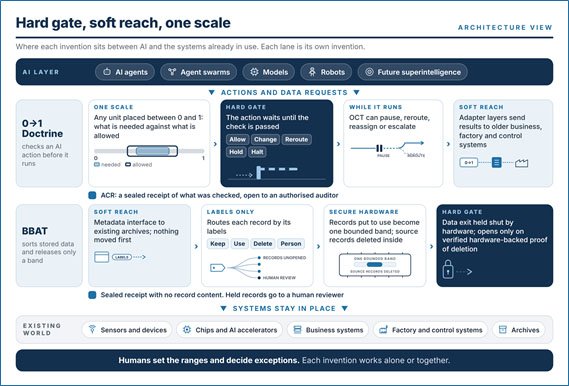
Figure. Where each invention sits between AI and existing systems. Each lane is its own invention.
HUMANS STAY IN CHARGE
Humans set the ranges. In the Doctrine, people can approve, adjust or halt decisions, and can step in when safety or compliance limits call for it. In BBAT, a Human Override Pathway lets a reviewer decide on held records. Routine cases can be handled by the checks, so expert time goes to the cases that need it.
WHAT AN ORGANISATION DOES
People add no new steps. An organisation connects its existing software once, sets its ranges, and the inventions work from there. Each invention has its own filing and works alone. Used together, they cover AI actions and stored data.
TOWARD SUPERINTELLIGENCE
Superintelligence does not exist today, and nothing here claims to solve it. Whatever form it takes, it is likely to run on chips and be written in code. Both inventions are designed to give any such system the same two things: a gate that waits for a check and a way to work with what already exists.
WHAT TO KEEP IN MIND
The text describes design aims drawn from the filings. Each invention is designed to work within limits that humans set. Adoption needs a one-time connection and configuration, after which routine checks can run on their own.
QUESTIONS ON READERS’ MINDS
Does it need special chips?
Not for the Doctrine, which can run in software, firmware or hardware. BBAT’s secure release uses an isolated hardware environment.
What if there is no network?
The Doctrine’s filing describes offline tokens by QR, SMS, voice or paper, reconciled when a connection returns.
Where does the data go?
It stays with its holder. Only a bounded signal or band is shared.
Do we need to change our AI?
The inventions are designed to sit beside the AI already in use.
What if something is missing?
The Doctrine is designed to catch missing prerequisites and send the job back for redesign or another supplier.
Why start with a check?
A check before the action can reduce the work of correcting it afterwards.
CLOSING NOTE
Intelligence will live in silicon and speak in code. Let the gate be hard, the reach be soft, and every measure meet on one scale.
LIVE www.0to1doctrine.com
This can be tested, live, via API, governed against ungoverned, side by side.
THE INVENTOR
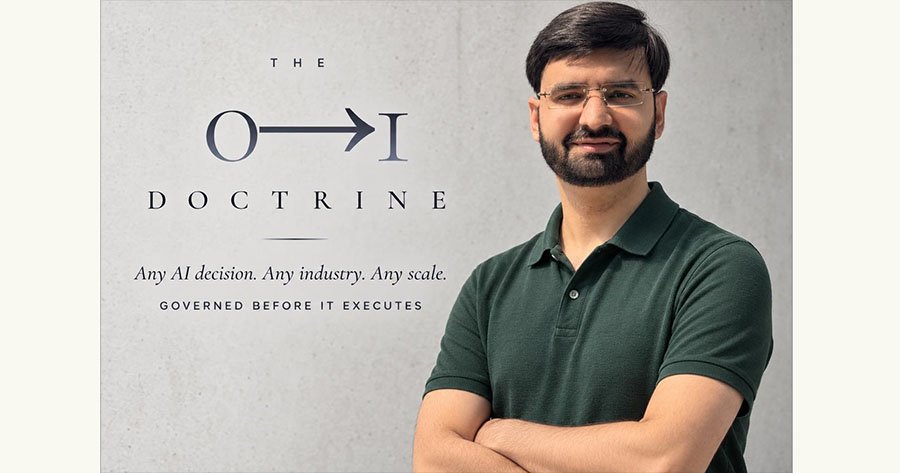
Systems theorist, inventor, and serial entrepreneur Vatsal Soin holds grants in the US, Japan, India and more; filings span six continents; latest grant, AI footwear, August 2026. Inventions: footwear, apparel fit, Sharable Size Cards, digital twins, robotics, global governed data, archive triage, quantum-resilient cryptography, AI governance. SIM–RMIT and NTU alumnus. Every prior invention was a step; 0→1 is the destination.
SELECTED REFERENCES
Granted: US Patent 12,446,652 B2 • Japan Patent 7560909 • India Patents 454081 and 599317. Filed: PCT/IN2025/051943 • US 19/489,595 • India 202511115781 • Australia AU2022450649 • India 202611113867 (23 September 2026) • PCT/IN2026/052042 (1 October 2026).
DISCLAIMER
Informational only. Not certified. No endorsement implied. Not investment advice. Examples are illustrative, not field results. Vatsal Soin • © 2026 All Rights Reserved.