CD Web Desk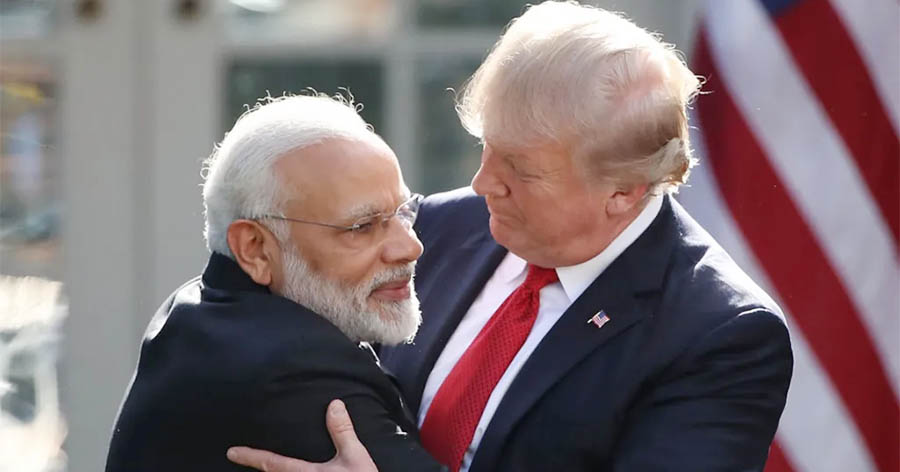
U.S. President Donald Trump on Friday confirmed that there would be no changes to the parameters of the U.S.-India trade deal announced on February 2, even after the U.S. Supreme Court’s ruling that his “reciprocal tariffs” were unlawful.
Addressing a press conference soon after the judgment, Mr. Trump criticised the Justices who ruled against the tariffs and said he would explore alternative legal routes to impose duties. The Court held that the President had exceeded his authority under the International Emergency Economic Powers Act (IEEPA), the legal basis used for the reciprocal tariffs unveiled on April 2, 2025.
“Nothing changes. They’ll be paying tariffs, and we will not be paying tariffs,” Mr. Trump said when asked about the status of the agreement with India.
Calling Prime Minister Narendra Modi a “great gentleman”, Mr. Trump added that the revised arrangement marked a reversal of earlier trade dynamics, alleging that India had previously taken advantage of the United States.
“So we made a deal with India, and it’s a fair deal now, and we are not paying tariffs to them, and they are paying tariffs. We didn’t flip,” he said.
Under the agreed framework, the general tariff rate on Indian goods entering the U.S. is set to fall from 50% — which included a 25% “penalty” component linked to India’s energy trade with Russia — to 18%.
Mr. Trump also said he would sign into law a broad 10% “global tariff” under Section 122 of the U.S. Trade Act of 1974, expected to take effect within three days. Such tariffs can remain in force for a maximum of 150 days. He further indicated that Section 232 tariffs imposed on national security grounds, such as on steel and aluminium, and Section 301 tariffs related to alleged unfair trade practices would continue, adding that new 301 probes were being initiated. However, the precise legal basis for the full 18% tariff rate on India remains unclear.
When asked about ties with India, Mr. Trump described the relationship as “fantastic” and said his personal rapport with Mr. Modi was “great”. He also reiterated his claim that India had scaled back purchases of Russian oil at Washington’s request and again asserted that he had “largely” stopped the India-Pakistan conflict in May 2025 by threatening steep tariffs on both countries.
‘India pulled way back from Russia at my request’: Trump
Mr. Trump’s remarks on the ceasefire and India’s energy imports — subjects that have drawn political sensitivity in India — featured prominently in his comments.
“India pulled out of Russia. You know, India was getting its oil from Russia, right? And they pulled way back at my request, because we want to settle that horrible war where 25,000 people are dying every month,” he said.
“I also stopped the war between India and Pakistan,” he added, claiming that multiple aircraft were shot down and suggesting the conflict risked escalating into a nuclear confrontation.
“I said, look, you’re going to fight, that’s fine, but you’re not going to do business with the United States, and you’re going to pay a 200% tariff. Each country,” he said, asserting that the warning pushed both sides toward peace.
Mr. Trump did not directly respond to a question on whether he plans to visit India for the upcoming Quad Summit, involving India, the U.S., Japan and Australia, which had been deferred last year.
During the press conference, Mr. Trump also lashed out at several Justices who opposed the tariffs, using terms such as “fools”, “lapdogs” and “unpatriotic”, while praising dissenting members of the bench, including Justice Brett Kavanaugh, whom he described as a “genius” and said he was “very proud of”.