CD Web Desk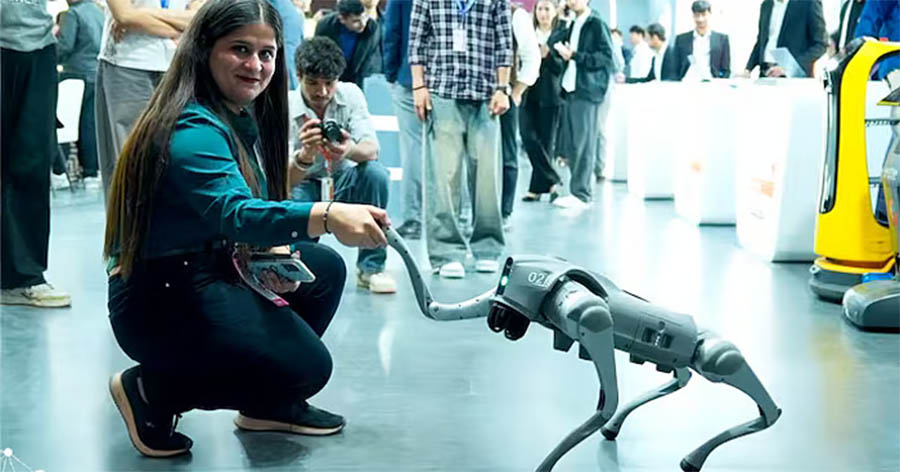
New Delhi: A demonstration at the AI Impact Summit in the capital has sparked controversy after a viral video showed Galgotias University presenting a robotic dog at its stall — prompting allegations that the machine was being passed off as an in-house innovation.
The Greater Noida-based institution later clarified that the quadruped robot was purchased from a Chinese robotics company and is being used strictly as a teaching and research tool.
In the widely shared clip, university representatives are seen introducing the robotic dog to visitors, saying it regularly “walks around the campus.” They explained that the robot could perform multiple tasks, including surveillance, as it is capable of accessing narrow or difficult-to-reach spaces and capturing images.
As the video gained traction online, criticism mounted on social media. Some commentators accused the university of projecting the imported robot as part of a larger AI investment showcase reportedly valued at over Rs 350 crore. Several users questioned the authenticity of the presentation, with posts mocking what they described as inflated claims on a global platform.
The controversy deepened after claims surfaced that the off-the-shelf robot — identified by some users as the Unitree Go2 model, typically priced between Rs 2–3 lakh — had been presented under the name ‘Orion’ during the summit demonstration.
University Clarification
In response, the university issued a statement stressing that it had never claimed to have built the robotic dog.
“The recently acquired Robodog from Unitree is part of our effort to provide hands-on exposure to students. It is not merely a display unit but a practical learning platform. Our students are experimenting with it, testing its capabilities, and enhancing their understanding of robotics and AI,” the statement read.
The university further clarified that while the robot itself was not developed in-house, the institution’s focus remains on equipping students with the skills to design and manufacture such technologies in the future.
The episode has since triggered a broader conversation online about transparency, academic integrity and the representation of technological capabilities at high-profile industry events.