CD Web Desk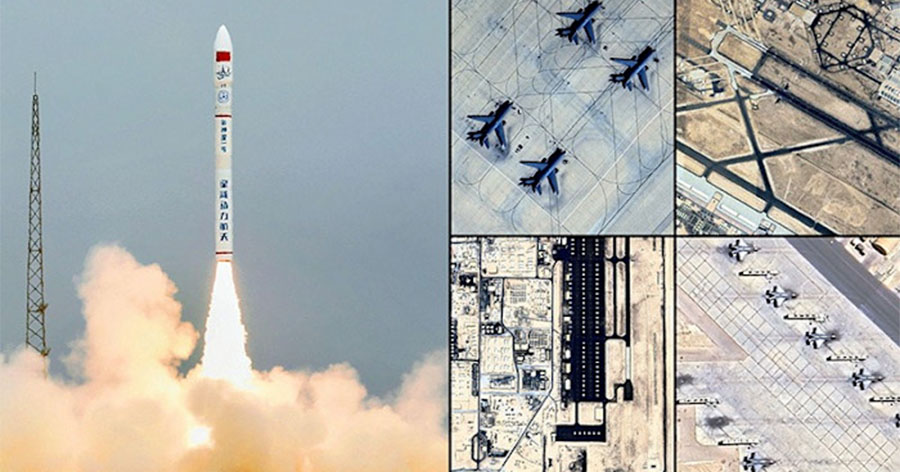
A Chinese-built satellite may have significantly enhanced Iran’s ability to carry out precise missile and drone strikes on US military bases across the Gulf, according to a report by Financial Times.
The report says Iran’s Islamic Revolutionary Guard Corps (IRGC) Aerospace Force acquired an advanced Earth-observation satellite, known as TEE-01B, from China in late 2024 in a deal worth about $36.6 million. The system, paid for in Chinese currency, reportedly provided high-resolution imagery and detailed tracking data.
Real-Time Surveillance Advantage
Using time-stamped coordinates, satellite images and orbital tracking, Iranian commanders were able to closely monitor US military installations before and after launching strikes in March. Key sites under surveillance reportedly included:
• Prince Sultan Air Base in Saudi Arabia
• Muwaffaq Salti Air Base in Jordan
• Areas near the US Fifth Fleet headquarters in Bahrain
• Erbil airport in Iraq
Logs cited in the report indicate repeated monitoring of Prince Sultan Air Base between March 13 and 15—around the same time US President Donald Trump confirmed that American aircraft at the base had been hit.
Beyond the Gulf
The satellite’s reach extended well beyond immediate conflict zones. Iranian monitoring reportedly included US-linked facilities such as Camp Lemonnier in Djibouti, bases in Kuwait, and Duqm port in Oman—suggesting a wide surveillance net across the region.
A Major Technological Boost
The TEE-01B satellite is capable of capturing images at roughly half-metre resolution, a sharp improvement over Iran’s earlier systems, such as Noor-3, which had a resolution of about five metres. This leap in clarity likely enabled far more accurate targeting.
The satellite was developed by Earth Eye, a private Chinese firm with links to institutions associated with the People’s Liberation Army (PLA). Supporting software and ground systems were reportedly provided by another Chinese company with ties to China’s military aerospace sector.
Wider Pattern of Support
The findings add to growing reports that Beijing may have quietly supported Iran’s military capabilities. Previous reports have suggested China supplied air defence systems and other equipment to help Tehran rebuild after recent conflicts.
However, China has consistently denied providing military assistance to Iran. Speaking to Fox News, President Trump said Chinese leader Xi Jinping had assured him that Beijing was not arming Tehran.
Strategic Implications
If confirmed, the use of a Chinese satellite would mark a significant shift in the balance of intelligence capabilities in the region. Access to high-quality surveillance data—once a key US advantage—may now be enabling rivals like Iran to carry out more precise and coordinated attacks.
The development also underscores how space-based technology is increasingly shaping modern warfare, extending influence far beyond national borders.