CD Web Desk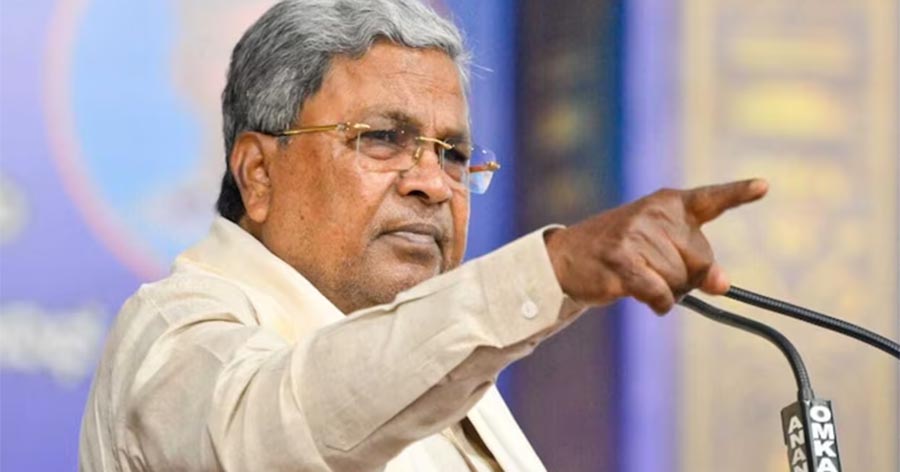
Bengaluru: Siddaramaiah may have stepped away from the chief minister’s office, but the political constituency that helped define his career remains firmly within his sights.
The veteran Congress leader’s appearance at a major Backward Classes convention in Bengaluru on Sunday offered a glimpse of his emerging role in Karnataka politics after his tenure as chief minister. Rather than retreating into the background, Siddaramaiah appears to be reasserting himself as one of the Congress’s principal voices on the concerns of minorities, backward classes and Dalits — the social coalition popularly identified as Ahinda.
Held at Palace Grounds, the convention provided a sizeable platform for Siddaramaiah, who was felicitated for completing eight years as chief minister across his two terms — 2013-18 and 2023-26.
The gathering was nowhere near the scale of the 75th-birthday celebrations popularly known as ‘Siddaramotsava’ in Davanagere in 2022, nor did it carry the same political significance as the Jana Kalyana Samavesha held in Hassan in 2024. Yet, its importance lay elsewhere: it demonstrated that Siddaramaiah continues to command considerable political visibility among the communities that have traditionally formed the core of his support base.
A political identity built around Ahinda
For decades, Siddaramaiah has cultivated an image as Karnataka’s most prominent OBC leader, while positioning the Congress as a broad social coalition capable of bringing together backward classes, Dalits and minorities.
His renewed activity comes at a politically significant moment for the Congress. With D K Shivakumar at the helm of the government, the party faces the challenge of balancing two different but potentially complementary social equations.
Shivakumar’s political strength is closely associated with the influential Vokkaliga community, particularly in southern Karnataka. Siddaramaiah, meanwhile, has long represented a different strand of Congress politics — one centred on OBCs, Dalits, minorities and other socially disadvantaged groups.
The two political currents could prove crucial to the Congress as it looks beyond the present government and towards the next Assembly election.
The BJP, for its part, has been making sustained efforts to expand its influence among OBC and SC/ST communities. That makes retaining the Congress’s traditional advantage among these groups an important electoral priority.
Why Siddaramaiah’s voice still matters
Siddaramaiah’s decision to remain politically active also stands in contrast to the manner in which another veteran Karnataka leader, B S Yediyurappa, left the chief minister’s office in 2021.
Yediyurappa’s departure had triggered considerable discussion within the BJP and was followed by speculation that sections of the Lingayat electorate felt alienated by the manner of his exit. The Congress later benefited from a shift in support among some sections of the community during the 2023 Assembly election.
Siddaramaiah’s post-chief-ministerial phase is unfolding differently. His continued public engagement allows the Congress to retain a prominent political figure who can directly speak to communities that constitute a substantial part of its electoral coalition.
His recent intervention on the question of internal reservation among Scheduled Castes is another indication that he intends to remain engaged with contentious social and political issues. Speaking at a seminar on August 25, Siddaramaiah backed internal reservation and expressed confidence that Chief Minister D K Shivakumar would address the concerns involved.
Looking beyond Karnataka
There could also be a national dimension to Siddaramaiah’s renewed political engagement.
Political analyst Harish Ramaswamy described him as one of the most prominent advocates of OBC politics in the Congress camp since the era of former prime minister V P Singh.
Siddaramaiah’s political relevance may therefore extend beyond Karnataka. His experience in building an electoral coalition around backward classes could be valuable to the Congress as it seeks to strengthen its OBC outreach in other parts of the country.
With elections approaching in states such as Uttar Pradesh and Punjab, the party could potentially draw on Siddaramaiah’s political experience and public image as part of its broader social mobilisation strategy.
There is also a more personal political calculation involved.
Ramaswamy believes Siddaramaiah’s continued activism could partly be linked to securing a political future for his son, Yathindra Siddaramaiah. Keeping himself politically relevant would allow the former chief minister to retain influence within the party while helping create space for the next generation of his political family.
The 2028 question
For the Congress, however, Siddaramaiah’s return to active Ahinda mobilisation may be about more than one leader’s ambitions.
The party will have to manage an increasingly complex social equation in Karnataka: Shivakumar’s Vokkaliga appeal, Siddaramaiah’s OBC credentials, the Congress’s traditional minority support and its efforts to retain Dalit and tribal voters.
Whether these constituencies can remain under one political umbrella will be one of the central questions facing the party before the 2028 Assembly election.
Siddaramaiah’s latest public appearance suggests that he has no intention of leaving that battle to others.
The former chief minister may no longer occupy the state’s top executive post, but his political constituency remains too important — and his own political ambitions too alive — for him to disappear from Karnataka’s electoral landscape.