CD Web Desk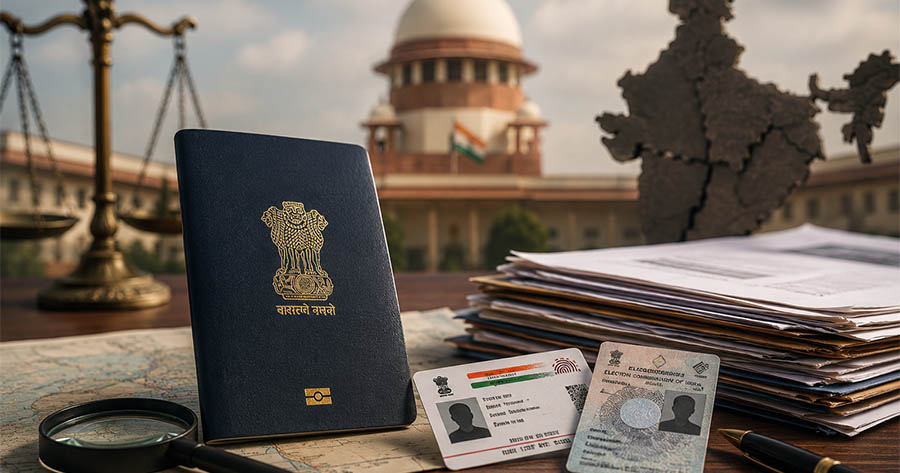
The Ministry of External Affairs’ recent clarification that an Indian passport is primarily a travel document and not conclusive proof of citizenship has triggered confusion and concern among many citizens.
For decades, Indians have viewed a passport as one of the strongest documents issued by the government. Obtaining one requires submission of multiple records, police verification, and scrutiny by authorities. It is accepted worldwide as proof that the holder is an Indian national. Naturally, many people were surprised to hear that it is not considered definitive proof of citizenship under Indian law.
The clarification has revived an important debate: if a passport does not conclusively establish citizenship, what document does?
The answer lies in the distinction between nationality, identity and citizenship under India’s legal framework.
A passport is undoubtedly one of the country’s most trusted official documents. It enables international travel, allows foreign governments to identify the holder as an Indian national, and serves as the basis for diplomatic and consular assistance abroad. Immigration authorities across the world rely on Indian passports while granting visas and permitting entry.
Yet Indian law treats a passport differently from a citizenship certificate.
Under the Passports Act, authorities must satisfy themselves that an applicant is entitled to receive a passport before issuing one. However, the law also provides limited circumstances in which travel documents may be issued in the public interest to individuals who are not Indian citizens. As a result, a passport cannot be regarded as absolute legal proof of citizenship in every situation.
This legal distinction may appear technical, but its practical implications are significant.
Many Indians assume that possession of a passport automatically settles questions relating to citizenship. The government’s clarification suggests otherwise. If citizenship is challenged in a legal or administrative proceeding, authorities may seek additional evidence beyond the passport itself.
The issue becomes even more complex because India does not issue a universal citizenship card to all its citizens.
Instead, citizenship is determined under the Citizenship Act, 1955. The law recognizes citizenship through birth, descent, registration, naturalisation and certain other legal processes. Establishing citizenship often requires examining a person’s date of birth, place of birth, parental status and supporting records.
For millions of Indians, citizenship is therefore established not through a single document but through a collection of records accumulated over a lifetime.
These may include birth certificates, school records, family lineage documents, parents’ citizenship records and other government-issued documents. Individuals who acquire citizenship through naturalisation or registration receive formal citizenship certificates, but most Indians born in the country do not possess such a standalone certificate.
This reality raises an important concern.
Many citizens may not have preserved old records, especially those born decades ago when birth registration was less common in parts of the country. Others may find it difficult to trace parental documents or family records. In such cases, uncertainty over what constitutes sufficient proof can create anxiety and confusion.
The debate also extends beyond passports. Courts have repeatedly clarified that Aadhaar is a proof of identity and residence, not citizenship. Similarly, voter ID cards are primarily electoral documents. While only citizens are legally entitled to vote, a voter card by itself may not conclusively settle a citizenship dispute.
As a result, some of the documents that citizens rely upon most frequently are not treated as final proof of citizenship when legal questions arise.
That does not make these documents meaningless. Passports remain essential for international travel. Aadhaar plays a crucial role in accessing services and verifying identity. Voter IDs enable democratic participation. Each document serves an important purpose within its respective legal framework.
However, the recent controversy highlights a broader challenge: many citizens are unaware of the difference between identity documents and citizenship evidence.
In an era when governments around the world are investing heavily in digital governance and streamlined public services, citizens expect clarity regarding their legal status and documentation. Questions about citizenship are not merely legal technicalities; they affect people’s sense of security, belonging and confidence in public institutions.
The government’s clarification may be legally accurate, but it has also exposed a gap in public understanding. For many Indians, the discussion serves as a reminder of the importance of preserving birth records, family documents and other historical records that may one day be needed to establish citizenship.
Ultimately, the controversy is not about passports alone. It is about a larger question that concerns every citizen: in a country where no single document conclusively proves citizenship for most people, how can ordinary Indians be assured that their legal status is clear, secure and beyond doubt?