CD Web Desk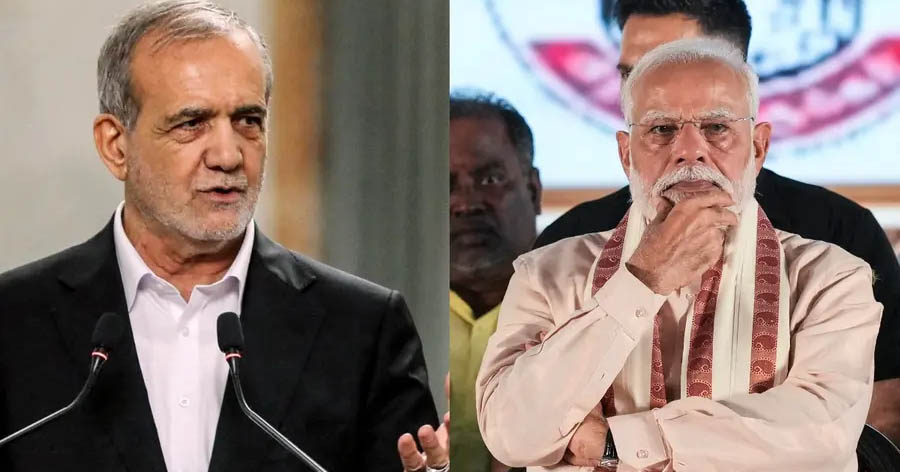
Iranian President Masoud Pezeshkian has said that Iran is not seeking war but is exercising its right to self-defence in response to what he described as U.S.–Israeli aggression.
Mr. Pezeshkian made the remarks during a telephone conversation with Prime Minister Narendra Modi on Thursday, as U.S. and Israeli airstrikes on Iranian targets continued following attacks that began on February 28.
According to the Iranian President, Tehran “did not start the war and does not seek its continuation”. However, he said Iran was targeting U.S. bases in the region that it considers to be the source of the attacks, citing its right to self-defence.
Mr. Pezeshkian thanked the Indian government and people for their expressions of sympathy and said Iran regards India as a friend and an important economic partner. He also praised India’s “balanced and constructive” approach in international affairs and its efforts to reduce tensions.
He said the strikes occurred at a time when Iran was engaged in negotiations with Washington and pursuing diplomatic efforts to resolve outstanding issues. The attacks, he said, were a violation of international law and humanitarian norms.
The Iranian President said the strikes resulted in the assassination of the Leader of the Islamic Revolution, Ali Khamenei, along with senior military commanders. He also said that 168 schoolchildren were killed in an attack on a school in the southern Iranian city of Minab.
He described Israel’s actions as “state terrorism” and called for justice for those killed.
Despite the attacks on Iranian infrastructure, Mr. Pezeshkian said Tehran remained committed to expanding cooperation with India and other countries, including through platforms such as BRICS and the Shanghai Cooperation Organization. He also called for a greater role for BRICS in promoting regional stability.
Mr. Modi, according to the Iranian side, expressed concern over the escalating tensions in West Asia and reaffirmed India’s ties with Iran. He said India would support diplomatic efforts and emphasised that further escalation would not benefit any party.
The Prime Minister also expressed regret that the conflict had escalated during the holy month of Ramadan and expressed hope that the Persian New Year, Nowruz, would bring peace and stability to the region.
Separately, Iranian Foreign Minister Abbas Araghchi spoke with India’s External Affairs Minister Subrahmanyam Jaishankar on Friday to discuss regional and international developments.
During the conversation, Mr. Araghchi briefed his Indian counterpart on what Iran described as the consequences of the recent attacks and their impact on regional and global security. He reiterated Iran’s determination to exercise what he termed its legitimate right of self-defence.
Mr. Araghchi also called on international and regional organisations to condemn the military action against Iran.
Mr. Jaishankar, for his part, said India was ready to expand bilateral and multilateral cooperation in regional and international forums and stressed the need to strengthen long-term stability and security in the region.