CD Web Desk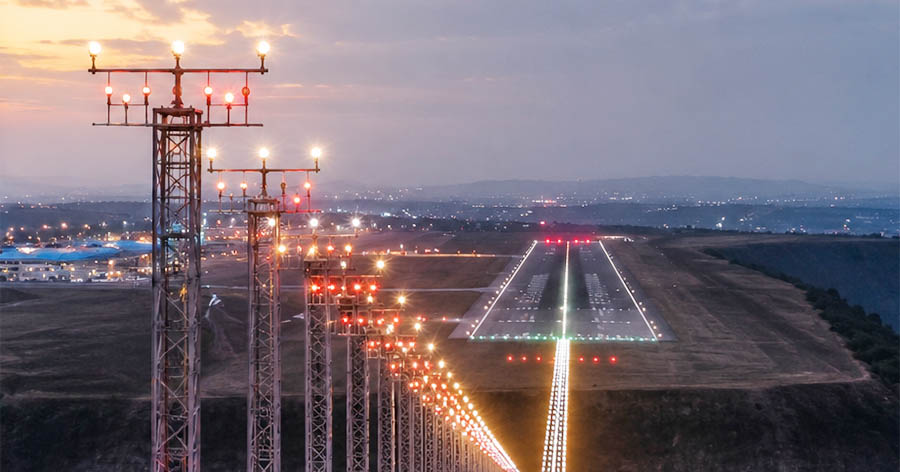
At Mangaluru International Airport, a new chapter in runway safety has quietly begun—not with fanfare, but with light.
Following approval from the Directorate General of Civil Aviation (DGCA), the airport has introduced a Precision Approach Lighting (PAL) Category-I system for Runway 24, a development that significantly upgrades how aircraft are guided during landing, especially in low-visibility conditions. For an airport built on a tabletop terrain—where runways sit dramatically above surrounding landscape—this enhancement is more than technical refinement; it is an added layer of assurance in one of aviation’s more demanding environments.
Rather than serving as a headline achievement in itself, the commissioning of the system translates into something more practical: clearer visual guidance for pilots during the most critical final moments of descent. In rain, fog, or haze, when visibility often becomes unpredictable along the coastal belt, the lighting system helps aircraft align more precisely with the runway centreline, supporting steadier and more controlled approaches.
What makes the installation particularly distinctive is its engineering scale. The approach lighting extends nearly 900 metres from the runway threshold, mounted on specially designed lattice towers, many of which rise higher than the Qutub Minar. The system includes 17 such structures, each equipped with barrettes of four lights and a central sequential-flashing light designed to draw a pilot’s attention forward along the landing path. These barrettes can also be lowered for maintenance, combining scale with operational practicality.
The airport has also integrated an Airfield Lighting Intelligent Management System (ALIMS), enabling centralised monitoring and control of the lighting network. This allows for more efficient management of runway lighting operations and quicker response to technical requirements.
According to airport officials, the system places Mangaluru among a very small group of airports globally—and only the second in Asia—to deploy such an advanced configuration. Throughout its installation, the project reportedly maintained a zero-accident record, reflecting the controlled execution of a complex engineering task.
The impact of the system is expected to be most visible not in daily routines, but in moments of challenge. Better visual cues during approach can reduce pilot workload, improve landing stability, and minimise the likelihood of go-arounds or diversions. For an airport whose topography already demands heightened operational care, these improvements contribute directly to smoother and more reliable traffic flow.
The PAL system also fits into a broader set of ongoing upgrades at the airport, including improvements to runway lighting and airside safety infrastructure. Together, these developments reflect a long-term effort to strengthen operational resilience at one of India’s most geographically distinctive airports.
As a spokesperson for the airport noted, the introduction of the system reflects a continuing commitment to adopting advanced technologies that enhance aviation safety and passenger confidence—quiet improvements that work, quite literally, in the background of every safe landing.