CD Web Desk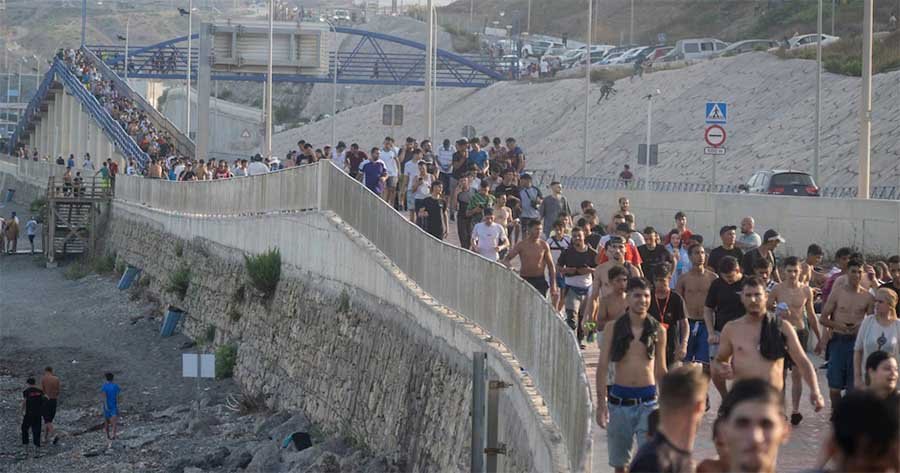
Madrid, July 31: Spain is grappling with an unprecedented migration crisis after nearly 49,000 migrants entered the North African enclave of Ceuta from neighbouring Morocco within 24 hours, according to the Spanish Interior Ministry.
The sudden influx overwhelmed border authorities in the tiny Spanish territory, which has a population of about 84,000. Migrants crossed both by sea and on foot, with videos showing thousands swimming to the coast and others entering through the Tarajal land border. At least 18 people were reported dead during the crossings.
The Spanish government has deployed the military to assist security forces and restore order in the enclave. Prime Minister Pedro Sánchez is also expected to visit Ceuta, pledging to restore normalcy as quickly as possible.
Spain’s Interior Ministry said Moroccan authorities have stepped up cooperation by preventing further crossings and agreed to work with Madrid to facilitate the return of migrants who entered the territory illegally.
The mass arrival has reignited debate over migration policy across Europe, with concerns that migrants granted legal status in Spain could eventually move freely within the Schengen Area, which allows passport-free travel across 29 European countries.
Italian Prime Minister Giorgia Meloni described the situation as a threat to European border security and called for stronger measures to curb illegal migration.
“The images coming from Ceuta demonstrate once again that uncontrolled illegal immigration poses a concrete threat to the security of Europe’s borders,” Meloni said.
France also announced tighter checks along its border with Spain. French Interior Minister Laurent Nuñez said additional border personnel had been deployed in response to the developments in Ceuta.
The latest surge follows a ruling by Spain’s Supreme Court that migrants intercepted at sea while attempting to reach Ceuta or the nearby enclave of Melilla cannot be immediately returned under the country’s fast-track “hot returns” policy. The ruling applies only to sea arrivals, while summary returns remain permissible for certain land-border crossings.
Ceuta and Melilla are Spain’s two autonomous enclaves on the North African coast and the only European Union territories sharing a land border with Africa. Their location has long made them focal points for irregular migration into Europe.
Analysts say the sudden movement of such a large number of people would have been difficult without at least the knowledge of Moroccan authorities. The migration surge also comes amid reports of diplomatic tensions between Spain and Morocco over Madrid’s growing ties with Algeria.
The latest influx is being described as one of the largest single-day migrant arrivals ever recorded in the European Union, placing renewed pressure on Spain’s border management and raising concerns across Europe over migration and security.