CD Web Desk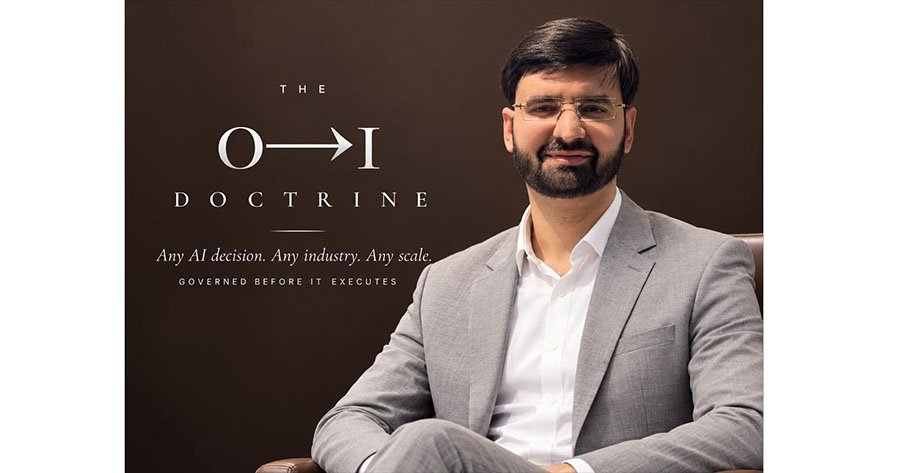
Two separate inventions share one family of sealed receipts. Vatsal Soin’s BBAT filings, on September 23 and October 1, 2026, govern stored data; the older 0→1 Doctrine filing governs how AI decides and acts. Each works alone and can add value to the other. Together they could set off a ripple effect, from one file to a company, a sector and the world’s data.
LIVE www.0to1doctrine.com
TWO DOORS, ONE BUILDING
Picture two doors in one building. The first opens onto live decisions. A system weighs a person’s needs against what is on offer, under written rules, and seals a receipt. A person handles the hard cases. That is the 0→1 Doctrine, the earlier filing, which guards every decision before it happens.
THE DOOR TO THE CELLAR
The second door leads to the cellar, where years of old files sit. BBAT, Band-Based Archive Triage, sorts each file by its label alone. MICA, the Metadata Inconsistency Check Module, holds back any file with a wrong label. A person, through HOP, the Human Override Pathway, settles unclear cases and legal holds.
WIPE, THEN SHARE
A sealed machine, called a Trusted Execution Environment or TEE, writes a short summary as a band, a range between a low mark and a high mark. DBS, Delete-Before-Share, wipes the original first. For the highest risk, a Hardware Attestation Certificate, or HAC, proves it. Only then does the summary leave the building.
ONE LANGUAGE
Both doors speak one simple language: positions between zero and one, bands, sealed receipts and a person with the last word. The 0→1 Doctrine carries a request through multiple tokens, ending with ACR, the Actuation Compliance Receipt. BBAT issues receipts in a shared format, so an auditor can read both sides alike, with no translation.
ALONE OR TOGETHER
These are two separate inventions. Each can be used alone, and each is worth having alone. A company could clean its archive with BBAT and never use the Doctrine. Another could gate its actions and never touch an archive. Used together, each could make the other worth more, which is the multiplier effect.
THE RIPPLE EFFECT
Think of a stone dropped in still water. The first ripple is small and sure. Each one after it is wider and less sure. Here the ripples run from one file to the world’s data. The further they travel, the more they depend on others joining in, so these are steps, not promises.
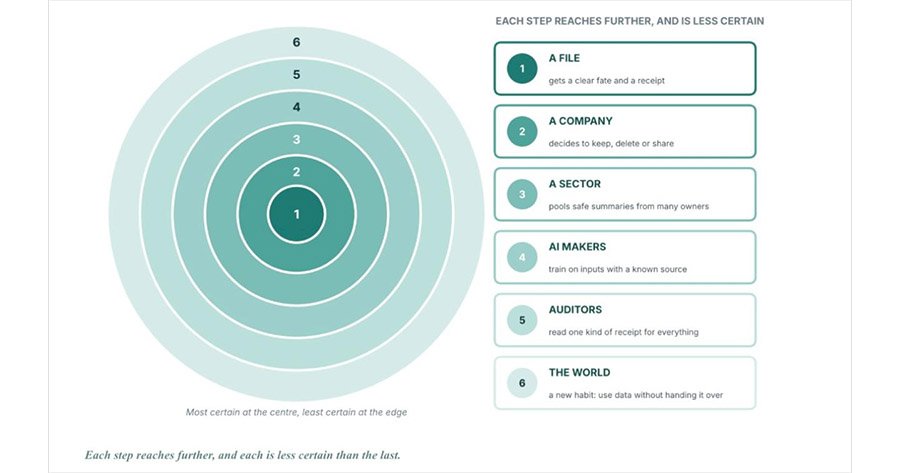
Each step reaches further, and each is less certain than the last.
STEP ONE: A FILE
A stored file stops drifting. It gets a clear fate: keep, destroy, or turn into a band for safe reuse. It gets a receipt that names who or what decided. Where a case is unclear or under a legal hold, a person decides. This first step is the most certain, as the filings describe it.
STEP TWO: A COMPANY
With a fate for each file, a company can treat keeping, deleting and sharing as decisions with evidence behind them. DDME, Dark Data Monetisation Without Exposure, could let it share a band while no file leaves. Demand, law and price decide whether sharing pays, and a small pilot can find out.
STEP THREE: A SECTOR
Summaries from many owners could be pooled, so a whole field sees patterns that no single owner can see. A hospital group, a utility and a laboratory could each add a band without sharing a single file. Pooled bands still face the privacy checks and a minimum group size before they travel anywhere.
STEP FOUR: AI MAKERS
Builders chasing the Singularity need clean inputs with a known source. BDTS, Band-Derived Training Signals, takes bands only, and is built to turn away any band without its HAC proof. Each signal carries its source and the approval behind it. Training keeps its own controls, and this step gives builders inputs they can trace.
STEP FIVE: AUDITORS
Today, live decisions and stored files leave evidence in different forms. One family of receipts could give auditors one clear language for both. A regulator could ask the same question of a decision made this morning and of a file kept for years, and read both answers in the same way, side by side.
STEP SIX: THE WORLD
The outermost step is adoption. If using data without handing it over proves workable, the method could spread from archives to live systems and eventually across whole sectors. This is the widest scenario, but also uncertain, because it depends on many owners, buyers and regulators choosing to adopt the same simple method.
A SIMPLE SCENARIO
A power company holds years of meter readings. They show when each home uses electricity, so they are private. Each reading is marked keep, delete or turn into a band, with a receipt. A band is a usage range for a whole district, so no home shows. The original is wiped. Researchers use the pooled bands.
WHO FEELS IT FIRST
Records teams would feel step one first and most clearly. Finance and legal would follow at step two. Researchers and model makers would feel steps three and four as more owners join. Regulators would feel step five once receipts are trusted. Step six belongs to everyone, and to no single group in particular.
WHAT HELPS IT SPREAD
Ripples travel further when receipts earn trust, when a field agrees common limits, when privacy tests hold under real attack, and when buyers see a signal worth paying for. Each of these can be proved in a pilot, one at a time, and each proof makes the next step easier to take.
CLEARLY EXPLAINED
What happens when the two meet?
They share one grammar: zero-to-one positions, bands and one sealed receipt format. Meeting means a shared language, not a merger. Each invention stays on its own filing and keeps working alone, as before.
Where does Singularity fit?
At step four, as one possible user of clean, permitted inputs. Nothing in the design needs it. The inventions serve the AI already in use, and offer a traceable way to supply data to any future AI system.
Will it earn money?
It could make a governed output possible. Payment depends on demand and on agreement between owner and buyer, and no filing fixes a price. A small pilot would show whether the sums work before scaling.
CLOSING NOTE
A stone does not choose how far its ripples travel. Neither does a patent. The water decides, and here the water is every record kept and every decision made.
LIVE www.0to1doctrine.com
This can be tested, live, via API, governed against ungoverned, side by side.
THE INVENTOR
Systems theorist, inventor, and serial entrepreneur Vatsal Soin holds grants in the US, Japan, India and more; filings span six continents; latest grant, AI footwear, August 2026. Inventions: footwear, apparel fit, Sharable Size Cards, digital twins, robotics, global governed data, archive triage, quantum-resilient cryptography, AI governance. SIM–RMIT and NTU alumnus. Every prior invention was a step; 0→1 is the destination.
SELECTED REFERENCES
Granted: US Patent 12,446,652 B2 • Japan Patent 7560909 • India Patents 454081 and 599317. Filed: PCT/IN2025/051943 • US 19/489,595 • India 202511115781 • Australia AU2022450649 • India 202611113867 (23 September 2026) • PCT/IN2026/052042 (1 October 2026).
DISCLAIMER
Informational only. Not certified. No endorsement implied. Not investment advice. Examples are illustrative, not field results. Vatsal Soin • © 2026 All Rights Reserved.