CD Web Desk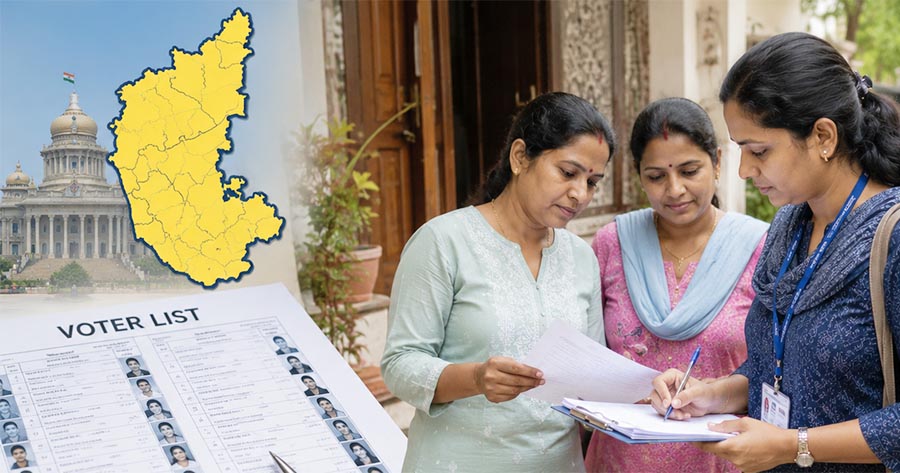
A total of 10.8 million names—around 19.5 per cent of the total electorate—have been excluded from Karnataka’s draft electoral roll as part of the nationwide Special Intensive Revision (SIR) exercise.
The figure represents the second-highest proportion of deletions among the major states, after Telangana, where 21.6 per cent of voters were excluded at the draft stage.
On Monday, August 24, the Election Commission of India (ECI) published Karnataka’s draft electoral roll with 44.6 million electors, around 10.8 million fewer than the 55.4 million names on the electoral roll before the SIR exercise.
Addressing a press conference in Bengaluru, Karnataka Chief Electoral Officer (CEO) V Anbukkumar said the state had 55,432,314 electors in the pre-SIR electoral roll as of June 16, 2026. Of these, 44,635,975 electors were included in the draft roll after submitting their enumeration forms.
Of those included, 22,159,240 are male, 22,473,864 are female and 2,871 fall under the ‘other’ category, he said.
Following the enumeration phase, which was conducted from June 30 to August 17, a total of 10,796,339 electors—or 19.5 per cent—were excluded after Booth Level Officers (BLOs) classified them as Absent, Shifted, Dead, Duplicate or Others (ASDDO).
Under the first phase of the SIR exercise, enumeration forms were distributed to electors. Those who completed and submitted the forms were included in the draft electoral roll. Those left out can now seek inclusion during the claims and objections period.
The second phase also involves verification of electors whose details could not be linked to the 2002 electoral roll or whose enumeration forms contained discrepancies.
According to Anbukkumar, around 2.3 million voters were found to be absent from the 2002 electoral roll, while another two million had discrepancies in their records. Notices will be issued to 4,381,335 electors, or 9.82 per cent of those in the draft roll, whose forms contain discrepancies.
The second phase of the SIR began on August 24 and will continue until September 23.
What if your name is missing?
If you were included in the earlier electoral roll but your name is missing from the draft roll, you can submit a claim for inclusion during the claims and objections period.
This can be done using Form 6. Electors who were marked as absent or shifted during the enumeration exercise can also use Form 6 to seek inclusion at their current address, provided they are not enrolled elsewhere in India.
People who could not submit their enumeration form during the house-to-house enumeration phase can also apply for inclusion during this period.
Those who will turn 18 on or before October 1, 2026, can also apply for inclusion using Form 6. Applicants must be Indian citizens, ordinarily resident at the address where they seek registration, not enrolled elsewhere in India and must submit the required documents.
Form 6 can be submitted physically to an Electoral Registration Officer (ERO), Assistant Electoral Registration Officer (AERO) or Booth Level Officer (BLO), or online through the ECINET app and the Election Commission’s voter services portal.
Which form should you use?
The form depends on what needs to be changed:
Form 6: For inclusion of a name in the electoral roll, including people whose names are missing from the draft roll, those who missed enumeration and eligible first-time voters.
Form 6A: For registration as an overseas elector.
Form 7: To object to the inclusion of a name or seek deletion of a name that should not be on the electoral roll, such as that of a deceased or permanently shifted elector.
Form 8: For corrections to existing entries, shifting of residence, replacement of an EPIC and marking an elector as a person with disability.
Form 8 can be used to correct entries such as name, gender, date of birth or age and address. An elector can request up to four changes through a single Form 8 application.
What if you receive a notice?
A separate notice and verification process will run from August 24 to October 22.
The ERO will issue notices to electors whose previous SIR electoral roll details submitted through the enumeration form could not be mapped to the database, or where the mapping contains a logical discrepancy.
The notice will mention the reason for the discrepancy and provide details of the concerned officer, hearing venue and date. BLOs will deliver the notices through house-to-house visits.
A notice may be received by a family member or, if no family member is available, a neighbour. However, only the elector concerned can appear for the hearing.
A voter who receives a notice must appear before the ERO or AERO even if they submit documents online. A QR code on the notice will allow the elector to upload the required documents.
The BLO will make two attempts to serve the notice. If the elector fails to attend the hearing, the ERO/AERO can reschedule it once.
What documents should you keep ready?
The documents required will depend on the elector’s circumstances and the reason for the notice. The Election Commission has provided an indicative, non-exhaustive list of documents that may be submitted.
Where required, separate self-attested documents have to be submitted for the elector, father and mother.
These include:
Identity card or Pension Payment Order issued to a Central or State government or PSU employee or pensioner
Government, local authority, bank, post office, LIC or PSU identity card, certificate or document issued in India before July 1, 1987
Birth certificate issued by the competent authority
Passport
Matriculation or educational certificate issued by a recognised board or university
Permanent residence certificate issued by the competent State authority
Forest Rights Certificate
OBC, SC, ST or other caste certificate issued by the competent authority
National Register of Citizens, wherever it exists
Government-maintained family register under any statutory or administrative regulation
Government land or house allotment certificate
Aadhaar, subject to the Election Commission’s directions issued on September 9, 2025
How to submit documents after receiving a notice
The ERO issues notices where an elector’s previous SIR electoral roll details either could not be mapped (‘No Mapping’) or do not match the database (‘Discrepancy in Mapping’).
The documents required will also depend on when and where the elector was born.
Those born in India before July 1, 1987 must provide any one document establishing their date or place of birth.
Those born in India between July 1, 1987 and December 2, 2004 must provide documents establishing their own date or place of birth as well as that of either their father or mother.
Those born in India after December 2, 2004 must provide documents relating to themselves, their father and their mother. If a parent is not an Indian citizen, a copy of that parent’s valid passport and visa held at the time of the elector’s birth may also be required.
Those born outside India must provide proof of birth registration issued by the Indian mission abroad.
Those who acquired Indian citizenship through registration or naturalisation must provide their Certificate of Registration of Citizenship.
Anomalies and logical discrepancies
For logical discrepancies, documents may be required to establish the correct relationship or identity. The Election Commission has identified nine specific categories of anomalies that can trigger a notice.
What happens at the hearing?
The ERO will examine the elector’s eligibility and the documents submitted.
An elector whose previous SIR details cannot be linked can either establish the link with the earlier electoral roll or submit documents to establish their eligibility.
During the hearing, the ERO will verify the authenticity of the documents. Where necessary, documents issued after the qualifying date of the previous SIR may be sent to the District Election Officer (DEO) for verification.
If an elector fails to establish eligibility, the ERO must issue a speaking order explaining the reasons for the decision.
Importantly, publication of the draft roll does not give authorities the power to simply delete a voter’s name without following the prescribed process. The Election Commission has reiterated that a name cannot be removed without notice, an opportunity to be heard and a speaking order from the ERO/AERO.
What if your name is already in the draft but the details are wrong?
You do not need to wait for a notice.
If your name appears in the draft roll but there is an error in your name, gender, age, date of birth, address or other details, you can file Form 8 during the claims and objections period.
The same form can be used for shifting residence, replacement of a lost EPIC and marking an elector as a person with disability.
What if someone else’s name has been wrongly included?
A voter can file an objection using Form 7 if a name has been wrongly included in the electoral roll.
This can be used, for instance, where an elector is deceased or has permanently shifted and should no longer be registered at that address.
What happens after claims and objections are filed?
The claims and objections period will run until September 23.
EROs and AEROs will examine the applications, verify supporting documents and conduct hearings wherever required.
Details of claims and objections received through Forms 9, 10, 11, 11A and 11B will be published on the CEO Karnataka website and shared with recognised political parties on a weekly basis.
The notice and disposal process will continue until October 22.
Appeal
If an elector’s claim is rejected, or if they are aggrieved by an ERO’s decision, they have a legal right to appeal.
The first appeal can be filed before the District Magistrate or Deputy Commissioner within 15 days of the ERO’s final order under the Representation of the People Act, 1950.
If still dissatisfied, a second appeal can be filed before the Chief Electoral Officer within 30 days of the District Magistrate’s order.
Even after the claims and objections period ends, people whose claims for inclusion are rejected can apply again using Form 6, according to election authorities.
When will the final electoral roll be published?
The final electoral roll is scheduled to be published on October 27, 2026, with October 1, 2026 as the qualifying date.
Key dates
August 24: Draft electoral roll published; claims and objections begin
August 24–September 23: Period for filing claims and objections
August 24–October 22: Notice, verification and disposal process
October 27: Final electoral roll published
Bengaluru sees particularly sharp decline
The impact of the draft roll is particularly significant in Bengaluru, where the number of electors has fallen sharply following the enumeration exercise.
Across the Greater Bengaluru Authority area, 46.88 lakh electors have been classified under the ASDDO categories, accounting for about 45.13 per cent of the 1.04 crore electors recorded on June 16.
The draft roll contains about 56.9 lakh electors, compared with around 1.03 crore in the previous roll.
Among Assembly constituencies, the highest proportion of electors classified under ASDDO was recorded in Bommanahalli at 54.83 per cent, followed by BTM Layout at 51.61 per cent and Vijayanagar at 51.16 per cent. Yelahanka recorded the lowest proportion at 36.02 per cent.
The ASDDO classification, however, should not be interpreted as a final deletion. Electors affected by the classification have an opportunity to file claims and submit documents during the current phase.
For voters, the immediate priority is therefore simple: check the draft electoral roll, confirm that your name is included and, if it is missing or your details are incorrect, take action before September 23.