CD Web Desk
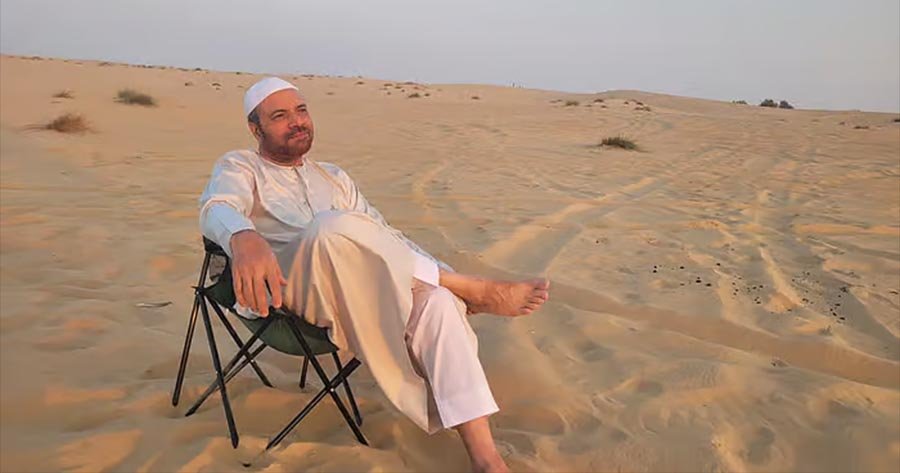
Dubai: When Abidh CK first arrived in Dubai as a 16-year-old in November 1976, he had just Dh10 in his pocket and little idea of what the future held. He had planned to work for two or three years, save some money and return home. Instead, Dubai became his home for the next five decades. Now, after building a family, a career and a lifetime of memories in the UAE, Abidh is preparing to leave on November 10, 2026 — exactly 50 years after the day he first set foot in the country.
Looking back at his journey, Abidh says the UAE has given him far more than he could have imagined when he arrived as a teenager.
“I came with Dh10 in my pocket. Now I am leaving feeling like I was blessed. I built a whole life here. My two daughters are married, and I have six grandchildren. This country has been nothing but generous to me,” he said.
His journey to Dubai began with an invitation from his uncle, who was already living in the UAE and had sent him a visa. After bidding farewell to his family, Abidh travelled by train to Bombay, from where he boarded a flight to Dubai.
He had Rs 2,000 tucked into his trouser pocket and exchanged a portion of it for Dh10 at the Bombay airport. Before boarding, he sent his uncle a telegram informing him of his arrival. However, the message did not reach its destination in time.
“When I arrived at the airport, my uncle wasn’t there,” he recalled.
With no one to receive him, the young Abidh hired a taxi to Rolla in Sharjah. As fate would have it, his uncle had received the telegram by then and was on his way to pick him up. The two eventually met when the taxi stopped near his uncle.
From a salesman to a settled life
Abidh began working the very next day as a salesman at the Sharjah branch of a textile shop. He was not entirely new to the profession, having worked in Mangaluru at the age of 15. He had also learnt typewriting before moving to the UAE.
Communicating with customers from different backgrounds meant learning new languages. He gradually picked up Persian, Arabic, Hindi and other languages by observing signboards and reading names displayed on shops.
“I used to look at name boards and learn languages,” he said.
His early days in Sharjah offered a glimpse of a city undergoing rapid transformation. Several buildings were still under construction, and he wondered how long he would remain there.
“I wondered whether I would stay long enough to see the buildings being completed. I was hoping to stay for just two or three years, make some money and then return home,” he recalled.
He lived with his uncle in a villa and received a monthly salary of Dh700. He sent Dh250 to his family in India, which was equivalent to Rs 500 at the time, and saved the remaining amount.
Whenever his uncle travelled to India, Abidh would send his accumulated savings through him to his father, a ship’s captain who had travelled across the world. His father was renovating their family home and was delighted to receive the money.
However, tragedy struck when his father passed away during one of his uncle’s visits to India.
“I wasn’t able to see him after I came to Dubai, but I am glad I could give him some happiness with the money I earned,” Abidh said.
Communication was slow in those days, and he learnt about his father’s death only two days after it happened, when a telegram arrived.
Fridays, shared taxis and old Dubai
Life in Dubai during the late 1970s was very different from what it is today. Friday was the weekly holiday, although Abidh still worked during the morning and had the evenings free.
He would often take a shared taxi to Dubai from Sharjah, paying Dh2 for the journey, to meet relatives. The city was then largely confined to areas such as Deira, Qusais and Bur Dubai, with stretches of desert separating it from Abu Dhabi.
As the city gradually developed, entertainment options also increased. Cinemas began opening, including one in Nasser Square, where Abidh occasionally watched films with friends.
Meeting fellow Malayalis was another important part of his social life.
“I used to frequent Kader Hotel and meet fellow Malayalis. The best place to be on Thursday night was Naif Road. There would be sales, and a lot of Indians used to come. It was very festive,” he recalled.
Around three years after arriving in the UAE, he was transferred to the Dubai branch of the textile business in Murshid Bazaar, marking another chapter in his professional journey.
Family life and a daughter named Buraida
Abidh married Sahira when he was 22. Three years later, he travelled to Saudi Arabia for Hajj by bus along with his mother.
It was during this pilgrimage that he received news of the birth of his first daughter. He was in Buraidah when the phone call arrived.
“I was in Buraidah when the call came to tell me. So, I named her Buraida,” he said.
His wife moved to the UAE in 1986. Their second daughter, Fahima, was born in 1988. Initially, Sahira visited the UAE before gradually settling there with her family.
Over the years, the couple raised their daughters in the UAE, and Abidh’s family grew to include six grandchildren.
A passion for technology
Beyond his business, Abidh also developed an interest in emerging technology. When the internet began gaining popularity, he created a website, keralauae.com, with the aim of making useful information easily accessible to Malayalis living in the UAE.
“At the time, there was no Google. I wanted to make it easier for people like me to get everything in one place,” he said.
The website brought together links to Malayalam newspapers, railway and airline booking portals, matrimonial websites and other services frequently used by expatriates.
His interest in technology has also allowed him to witness the dramatic changes in the way businesses operate.
Recalling the earlier days, he said customers would visit shops, browse through products and complete their purchases in person. Today, much of that interaction has moved online, with transactions taking place through WhatsApp and other digital platforms.
“Now we have entire transactions happening on WhatsApp and online. Sometimes, AI responds before we even get to it, and customers finalise deals without a human having to intervene. I am fascinated by how far technology has come. Customers don’t even need to visit in person,” he said.
He has also seen a significant change in the process of moving to the UAE. While securing employment and entering the country were once more difficult, the availability of different visa options has made the process more accessible.
“Earlier, it was difficult to come here. If you didn’t have a job, you had to leave. Now it has become much more open, with flexible visa options. The UAE has become everyone’s dream destination,” he said.
A farewell after five decades
After spending almost his entire adult life in the UAE, Abidh decided last year that he would return to India on the exact date he had arrived five decades earlier.
As November 10, 2026, approaches, he is preparing to close a chapter that began with just Dh10, a visa from his uncle and the hopes of a 16-year-old.
Asked what he would miss most about Dubai, his answer was immediate.
“Probably the peace and security,” he said.
For Abidh, leaving the UAE is not merely the end of a long expatriate journey. It is a farewell to the country where he grew up, built his career, raised his family and spent 50 remarkable years.