CD Web Desk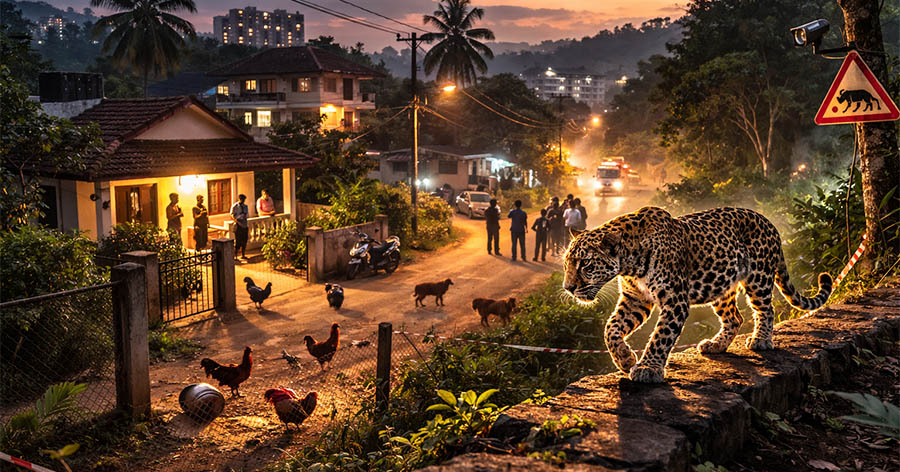
Mangaluru/Udupi, Feb 27: Frequent leopard sightings across Dakshina Kannada and Udupi districts have triggered anxiety among residents, with forest officials capturing 48 leopards in recent months.
Once largely confined to forest interiors, leopards are now increasingly entering residential neighbourhoods, lifting poultry and preying on stray dogs. Reports of their movement have emerged from Mangaluru, Sullia, Moodbidri, Beltangady, Bantwal, Ullal, Kundapur, Karkala and Byndoor. In the past week, sightings in Shaktinagar and Maroli within Mangaluru city limits have kept residents cautious, particularly during night hours.
Forest officials attribute part of the increase in movement to the November–February breeding season, when leopards tend to travel longer distances. A leopard can cover up to 22 kilometres in a day. Karkala Range Forest Officer P. Sridhar said the animals are often drawn to areas where poultry and meat waste are easily accessible. He appealed to the public not to dump such waste in open spaces, as it attracts predators closer to human habitation.
Wildlife veterinarian Dr Yashaswi Naravi explained that leopards generally avoid human contact and attack only when threatened. He advised residents in vulnerable areas to limit night-time movement or remain highly vigilant. “Leopards have a right to exist. However, rapid human expansion into forested and semi-forested areas is increasing direct interaction,” he said.
Experts cite multiple factors behind the rise in reported encounters. Expanding residential layouts on hill slopes and semi-forest land have reduced natural habitats. Greater night-time mobility, aided by improved road connectivity and vehicle access, has also increased the likelihood of sightings.
Technology has further amplified reports. The widespread use of smartphones allows residents to quickly capture and circulate videos, while CCTV cameras installed in homes and streets are recording movements that previously went unnoticed.
Agricultural changes are another contributing factor. The spread of rubber and other commercial plantations provides dense cover, enabling leopards to move undetected near villages. Additionally, a growing population of peacocks and stray dogs offers an abundant prey base along town outskirts.
Although there is no official confirmation of a dramatic rise in the leopard population, capture statistics indicate heightened activity. In Dakshina Kannada district, forest officials installed 62 cages, capturing 15 leopards, with five fatalities recorded. In Udupi district, 55 cages were placed, resulting in the capture of 33 leopards and two fatalities.
The Forest Department has urged citizens to promptly report sightings and avoid confronting the animals, stressing that trained personnel are equipped to handle such situations safely.