CD Web Desk
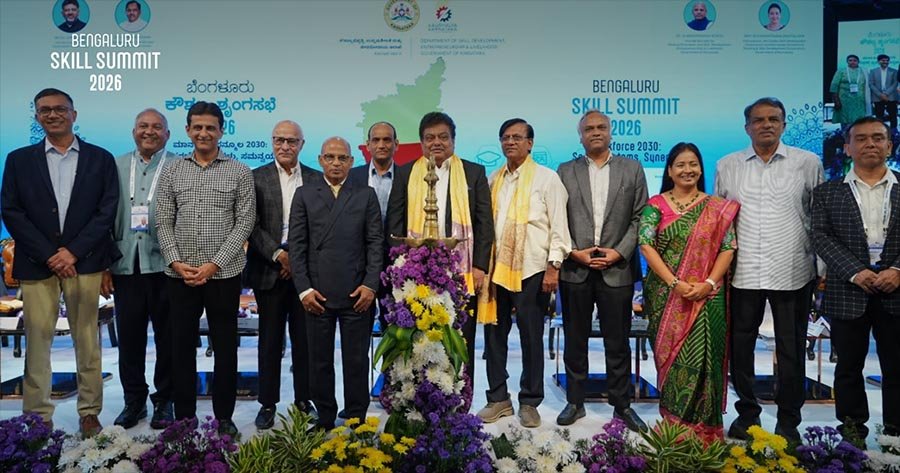
Bengaluru, Nov 5: Artificial intelligence, emerging career opportunities, industry-led training and international employment were among the key themes at the three-day Bengaluru Skill Summit 2026, which brought together around 9,500 participants from government, industry, academia and the international skills community.
The second edition of the summit, held from November 3 to 5, focused on preparing Karnataka’s workforce for the changing employment landscape and the demands of the future economy. The event also saw the launch of a digital employment platform for young jobseekers and a national competition aimed at using labour market data to improve skill development.
Organised by the Department of Skill Development, Entrepreneurship and Livelihood, Government of Karnataka, the summit was hosted by the Karnataka Skill Development Corporation (KSDC) in association with the Karnataka Skill Development Authority (KSDA). The Karnataka Digital Economy Mission (KDEM) was the Knowledge Partner, while Japan was the Country Partner.
Themed ‘Workforce 2030: Scale, Systems, Synergy’, the summit explored four broad areas: emerging skills, including artificial intelligence, green jobs and Industry 4.0; inclusive skill development for women, youth, informal workers and gig economy participants; innovation in training and education; and global employment opportunities for skilled professionals.
The programme featured ministerial discussions, keynote addresses, industry interactions, panel discussions, an exhibition and sessions highlighting new approaches to workforce development.
Yuva Udyoga Sethu launched
One of the major announcements on November 4 was the launch of Yuva Udyoga Sethu, a digital employment platform designed to connect young jobseekers in Karnataka with potential employers.
Chief Minister D K Shivakumar launched the platform, which aims to bridge the gap between skilled candidates and employment opportunities while strengthening the connection between jobseekers and industry.
The second day also saw the inauguration of the Expo Zone by Medical Education and Skill Development, Entrepreneurship and Livelihood Minister Dr Sharanprakash R Patil. The exhibition provided companies, training institutions and organisations an opportunity to showcase their technologies, training programmes and contributions to the state’s skill development ecosystem.
Another key event was the Skillathon, a national ideas competition on Labour Market Intelligence for Karnataka. It invited individuals, startups, teams and organisations from across the country to explore how publicly available government data could be used to identify employment trends, emerging sectors and skill gaps.
Participants were encouraged to map job opportunities, analyse labour market information, validate emerging trends and identify ways to integrate information from different sources through a secure digital platform.
The initiative aims to provide data-driven inputs for Karnataka’s skill development priorities and contribute to the proposed Karnataka Skills Intelligence System (KSISU).
InUnity – Innovation for Community, from Mangaluru, emerged as the winner of the Skillathon.
138 Karnataka Skill Olympics winners felicitated
The summit also recognised 138 medal winners of the Karnataka Skill Olympics 2025–26, organised by KSDC to identify and nurture grassroots talent across more than 50 skill categories.
The winners comprised 59 gold, 45 silver and 34 bronze medallists. The competition provides young achievers with a platform to demonstrate their vocational abilities and progress towards national and international skill competitions.
The awards were presented by Dr Sharanprakash R Patil and Karnataka Skill Development Corporation and Karnataka Vocational Training and Skill Development Corporation Chairperson Shivakantamma (Kanta) Naik. Senior officials, including Principal Secretary Subodh Yadav and KSDC Managing Director Dr Ravi M Tirlapur, were also associated with the ceremony.
A ministerial panel discussion titled ‘Workforce 2030: Karnataka’s Roadmap from Policy to Execution’ featured Dr Sharanprakash R Patil and IT and BT Minister Priyank Kharge. The discussion was moderated by Dr Gayathri Vasudevan, Chief Impact Officer, Sambhav Foundation.
The Innovation Stage also witnessed the launch of Nuvepro’s publication, ‘The State of Task Intelligence 2026’. Launched by Dr Ravi M Tirlapur, the publication examines how organisations can understand workplace tasks, roles and workflows to make informed decisions on workforce requirements, skills and AI-enabled operations.
Another session featured Alina Alam, founder and CEO of Mitti Café, who spoke about the economic and social value of employing persons with disabilities. Her address, titled ‘The Smart Economics of Human Potential: Why Inclusion Is Not Charity, but Good Business’, highlighted how inclusive workplaces can contribute to innovation, productivity and wider economic participation.
AI and international employment in focus
The November 5 programme focused on emerging career opportunities, industry requirements, artificial intelligence and international workforce mobility.
The day’s proceedings began with a keynote address by Debashree Mukherjee, Secretary, Ministry of Skill Development and Entrepreneurship, Government of India.
Speaking about the need to guide young people towards suitable careers, she stressed that students must be made aware of the different educational and employment pathways available to them.
“We have to show children their pathways, where to go, how to go, and what are the opportunities in their different pathways. Our biggest failure, we are failing our children, because we are not able to show them what is the pathway,” she said.
A panel discussion titled ‘The Rise of Hands-On Careers: New Opportunities in Skilled Employment’ examined changing opportunities in technical and vocational professions across sectors such as aerospace, advanced manufacturing, infrastructure, energy and logistics.
Other sessions explored approaches adopted by leading skill development ecosystems across India and the importance of internationally recognised qualifications, global standards and language skills in securing overseas employment.
A separate discussion on ‘The Care Economy: Preparing Talent for Global Opportunities’ focused on preparing professionals for growing international demand in healthcare, eldercare and related services.
Artificial intelligence and its impact on employment featured prominently in a fireside chat involving Vivek Raghavan and Ankush Sabharwal, moderated by Sanjeev Kumar Gupta, CEO of KDEM.
The speakers discussed how AI could enhance human capabilities rather than simply replace jobs. They also highlighted the importance of industry-specific training, collaboration between educational institutions and companies, multilingual AI technologies and expanding access to emerging skills beyond Bengaluru.
“The most valuable worker is not the one who is competing with AI, but the one who is working alongside AI,” Gupta said.
Creativity, traditional skills and global careers
The afternoon sessions examined the role of creativity, traditional knowledge and specialised skills in the evolving employment landscape.
Biren Ghose, founder and CEO of Astra Studios, delivered a keynote titled ‘From Workforce to Imagination Force’, highlighting the importance of creativity and original intellectual property in an AI-driven economy.
A panel discussion titled ‘Skill Champions: Beyond Medals – Inspiring Through Passion, Perseverance and Performance’ featured Karnataka’s WorldSkills medal winners. Among those who shared their experiences were Smriti Nambiar, who won a silver medal and Best of Nation Award in Bakery, and Abhishek Shignalli, recipient of a Medallion for Excellence in Robot Systems Integration.
Another discussion explored the potential of traditional skills to create new business opportunities. Featuring Arati Hiremath, founder of Aartikrafts, and sculptor Dr Arun Yogiraj, the session examined how traditional knowledge could be supported through training, entrepreneurship and better market access.
The programme also included a special address by ISRO astronaut and Indian Air Force Air Commodore Prasanth Balakrishnan Nair, recipient of the Kirti Chakra, on developing an astronaut mindset for nation-building.
Focus on rural AI skills and entrepreneurship
The Innovation Stage featured a special address by Madan Padaki, founder of JānAI and member of the Karnataka government’s Vision Group for Skills Development.
His session, ‘From Rural AI Skills to Local Economic Opportunities’, examined how artificial intelligence could help young people in rural and peri-urban communities identify local challenges, develop solutions and create employment and entrepreneurial opportunities.
“There is infinite potential in every one of you. Only if you believe. The moment you start believing, you can do anything. Our thought was, it is not that Gen AI that is required for India, but JānAI. How do you make AI work for the people,” he said.
Other discussions on the Innovation Stage addressed collaboration between educational institutions and industry, AI-based learning, Industry 5.0, digital education and the need to prepare graduates for changing workplace requirements.
Sessions also examined how classroom experiences could help young people develop critical thinking, communication, collaboration and problem-solving skills.
Kaushalya Karnataka Awards presented
The final day also featured the Kaushalya Karnataka Awards, which recognised contributions to vocational training and skill development across the state.
The awards covered several categories, including best-performing government, aided and private ITIs, best ITI principals, junior training officers and trainees, and outstanding GTTC and KGTTI centres and trainers.
Recognition was also given to successful GTTC alumni, entrepreneurs, industrialists, self-help groups under the National Rural Livelihood Mission, Rural Self Employment Training Institutes, institutions participating in skill competitions and companies across large enterprise, mid-market and growth enterprise categories.
The awards were presented by Dr Sharanprakash R Patil and Shivakantamma (Kanta) Naik.
Strengthening Karnataka’s workforce ecosystem
The three-day summit provided a platform for government, industry, academia and international stakeholders to discuss ways to strengthen Karnataka’s skill development ecosystem and respond to changing workforce requirements.
Industry-led training, lifelong learning, inclusive employment, emerging technologies, international workforce mobility and recognition of vocational skills were among the major areas discussed.
The summit’s focus on scale, systems and synergy reflected the need to expand access to quality skill training, strengthen institutional frameworks and improve coordination between government, educational institutions and industry.
The Bengaluru Skill Summit 2026 was organised by the Department of Skill Development, Entrepreneurship and Livelihood, Government of Karnataka, and hosted by KSDC in association with KSDA. KDEM was the Knowledge Partner, Japan was the Country Partner, and Trescon managed