CD Web Desk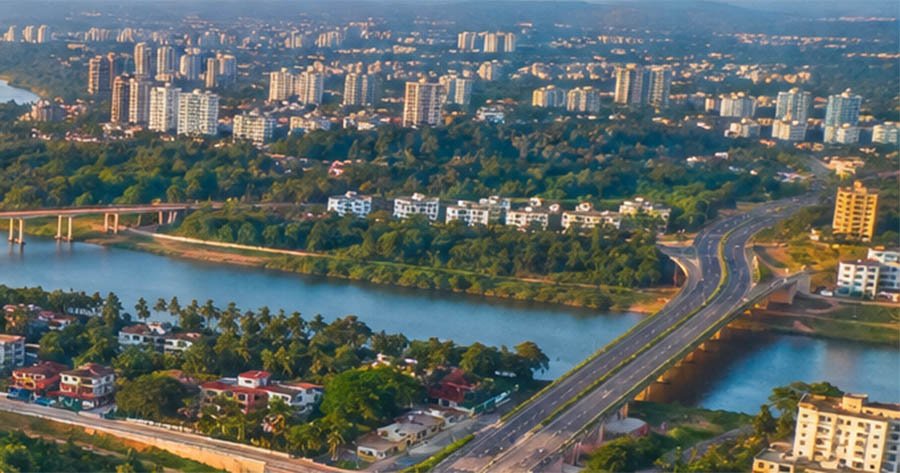
Mangaluru: Mangaluru may need to look beyond its traditional urban boundaries to accommodate its future growth, with the Surathkal–Baikampady–Mulki corridor emerging as a key area for planned expansion.
Rather than allowing the city to grow predominantly in one direction, the Mangaluru Urban Development Authority (Muda) is looking at a broader development strategy that could open up new residential and infrastructure corridors towards the north.
The vision includes better roads and connectivity, affordable housing and residential layouts on the outskirts, improved infrastructure, and measures to ease the growing pressure on the city’s roads.
The idea, according to newly appointed Muda chairperson Santhosh Kumar Shetty, is to make Muda more than an authority that develops layouts and distributes sites. It should play a larger role in shaping the city’s overall growth.
“Rather than growing in just one direction, Mangaluru city needs to expand towards Surathkal, Baikampady and Mulki. Efforts will be made to provide the necessary roads and infrastructure for this,” Shetty said at his maiden news conference on Monday.
Planning a larger Mangaluru
Mangaluru’s rising land prices and increasing traffic congestion have made it increasingly difficult to accommodate future growth within the existing urban core.
Shetty said Muda would therefore focus on creating the infrastructure necessary to support development in emerging areas north of the city.
The expansion would not be limited to residential development. Better roads and connectivity would be essential to ensure that new growth centres are integrated with Mangaluru rather than developing as isolated pockets.
To address the city’s worsening traffic situation, Muda is also considering plans for flyovers and underpasses at suitable locations, he said.
The approach reflects a larger need for Mangaluru to plan its expansion before congestion, unplanned construction and high land prices make future development more difficult.
Affordable housing on the outskirts
The proposed expansion could also provide an opportunity to address one of the city’s most pressing problems — the rising cost of land.
With land prices within Mangaluru’s city limits becoming increasingly unaffordable, middle-class and low-income families are finding it difficult to purchase sites and build homes.
Shetty said Muda would work on affordable site and housing schemes on the outskirts, particularly along the Surathkal-to-Mulki stretch.
The objective would be to create residential options that are within the financial reach of middle-class families while simultaneously encouraging planned urban growth outside the congested city centre.
Master Plan remains the priority
Shetty said implementing the Master Plan would be his immediate priority, describing it as the foundation for the planned development of Mangaluru.
The Master Plan proposal was submitted to the government in January, and the clarifications sought by the government have already been furnished, he said.
“Minor hurdles in this regard will be discussed with Minister U T Khader and Chief Minister D K Shivakumar, and it will be implemented soon after obtaining the government’s final approval,” Shetty said.
A clear and updated Master Plan, he suggested, would provide the framework needed to guide the city’s expansion and infrastructure development in the years ahead.
Smaller parks, revived lakes
The authority is also looking at improving Mangaluru’s public spaces and natural assets.
Lakes within Muda’s jurisdiction will be identified, with plans to accelerate their development and rejuvenation, Shetty said.
At the same time, Muda plans to create smaller neighbourhood parks rather than relying only on large parks such as Kadri Park.
Given the scarcity and high cost of large parcels of land within the city, available 25-cent and 50-cent plots in residential areas could be developed into small parks. Muda may also consider acquiring private land for the purpose, he said.
The strategy could help bring accessible green spaces closer to residential neighbourhoods without requiring the large tracts of land needed for major city parks.
Making Muda easier for citizens
Shetty also wants to change the way people interact with the authority.
Muda’s procedures and regulations are often perceived as complicated, he said, leading many people to depend on engineers, brokers and middlemen to get their work done.
“The public does not have the patience to come directly and get their work done because the rules and processes are complex,” Shetty said.
He said the authority would examine its procedures and simplify rules after discussions with elected representatives, MLAs and officials.
The aim, he said, is to create an environment where citizens can approach Muda directly instead of having to depend on intermediaries.
From site allocation to city building
At the heart of Shetty’s agenda is a broader interpretation of Muda’s role.
The authority, he said, should not restrict itself to developing layouts and allocating sites. It must become an active participant in building the infrastructure that will determine how Mangaluru grows.
That means looking beyond the existing city, identifying new growth corridors and ensuring that roads, housing, public spaces and other basic infrastructure develop alongside them.
For Mangaluru, the proposed shift towards Surathkal, Baikampady and Mulki could represent more than an expansion of the city’s physical footprint. If backed by proper planning and infrastructure, it could offer a way to distribute growth, ease pressure on the existing urban core and make housing more accessible.
And with his assumption of charge as Muda chairperson, Shetty now faces the task of turning that wider vision for Mangaluru into a workable plan on the ground.