CD Web Desk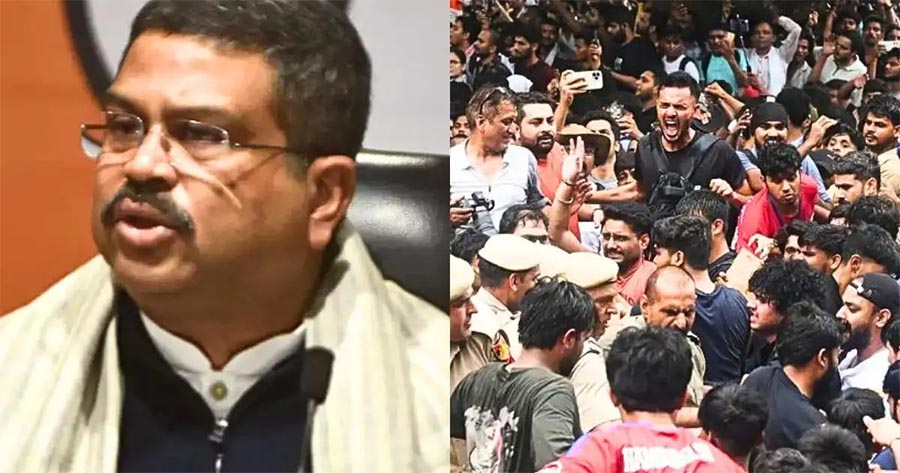
New Delhi: Education Minister Dharmendra Pradhan’s resignation is a rare one. So rare, in fact, that to find a parallel, one has to rewind the clock all the way to 2018, when MJ Akbar stepped down from his post as Union Minister of State for External Affairs.
Pradhan resigned on Saturday, marking a major victory for the Cockroach Janta Party-led protests against paper leaks, with Jantar Mantar in Delhi as its epicentre. Despite the government assuring that it would accede to the protesters’ other demands, including compensation to the families of students who died by suicide after the NEET paper leak and no legal action against those who took part in the march to Parliament earlier this week, the agitators refused to budge on the education minister’s resignation.
The CJP also made the resignation a precondition for the next round of talks, which was supposed to be held today.
After stepping down, Pradhan said he took full responsibility of the NEET paper leak and “never turned away from the situation”, but “individuals holding responsible positions attempted to create obstacles and mislead students”.
“Considering the situation at Jantar Mantar and across the country-with the aim of preventing anti-national forces from exploiting it, preserving national unity, ensuring that not a single Indian student’s future gets entangled in legal complexities, and allowing our children to devote their time to studies and focus on building their careers – I have submitted my resignation to the Honourable Prime Minister,” the 57-year-old wrote in a letter that he posted on X.
Opposition leaders have long accused the Central government of “arrogance” and alleged ministers don’t step down even after several controversies. This is a trend, they claim, that has persisted since Prime Minister Narendra Modi came to power in 2014.
The last and only other time something similar – yet very different in terms of the kind of allegations levelled – had happened was in 2018, when MJ Akbar resigned.
Akbar, who was the junior minister of state for external affairs since 2016, was accused of sexual harassment by multiple women amid a growing #MeToo movement in the country. Most of these women had worked or interacted with him when he was the editor of several leading newspapers.
Top sources in the government had said at the time that the decision to step down was Akbar’s and he would remain in the BJP. “This will not set a precedent,” the sources had said.
Before he resigned, Akbar had also dismissed calls for doing so, stating, “Accusations without evidence have become a viral fever.”