CD Web Desk
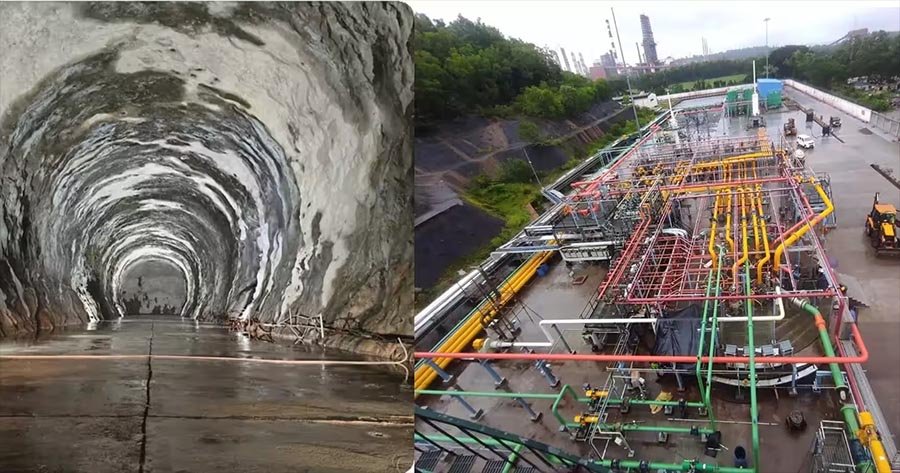
Mangaluru, Nov 13: Prime Minister Narendra Modi on Friday dedicated India’s largest underground Liquefied Petroleum Gas (LPG) storage cavern, located at Bala in Mangaluru, to the nation. The Rs 854-crore facility, developed to strengthen the country’s energy security, has a storage capacity of 80,000 metric tonnes.
The facility is India’s second underground LPG storage cavern and is expected to strengthen the country’s strategic LPG reserves, improve supply management and reduce vulnerability to disruptions in international energy supplies.
Developed by Megha Engineering and Infrastructures Limited (MEIL) for Hindustan Petroleum Corporation Limited (HPCL), the project involves extensive underground infrastructure, including two major tunnels measuring approximately 1,220 metres and 225 metres in length. The construction also required excavation of an access tunnel extending more than a kilometre, with the underground infrastructure reaching depths of around 128 metres below sea level.
An important component of the project is a 9.4-km LPG pipeline connecting New Mangalore Port to the main terminal. The pipeline will facilitate the transportation of imported LPG from the port to the storage facility, improving handling and distribution efficiency.
Rs 854-crore project completed after extensive testing
Construction of the underground LPG storage facility began in 2019. The project was undertaken by MEIL for HPCL at an investment of approximately Rs 854 crore.
On June 6, 2025, MEIL announced the successful completion of the project after carrying out the required tests. The company subsequently released a detailed video showcasing the facility on October 31, 2025.
The underground infrastructure comprises two principal storage caverns, identified as S1 and S2, along with an extensive network of access and connecting tunnels. Earlier technical details of the project indicated that the two storage caverns are situated at depths of approximately 220 metres and 225 metres, respectively.
The facility also incorporates upper and lower water curtain systems measuring 578.2 metres and 804.31 metres, respectively, along with connecting tunnels spanning 486.2 metres. A vertical shaft extending approximately 164 metres forms another important part of the underground infrastructure.
The water curtain arrangement is designed to maintain the necessary underground conditions for the safe storage of LPG.
Strengthening India’s energy security
The Mangaluru facility is expected to play an important role in strengthening India’s ability to manage fluctuations and disruptions in LPG supplies.
Underground storage caverns offer an alternative to conventional above-ground storage facilities and enable large quantities of petroleum products to be stored within suitable geological formations.
With a capacity of 80,000 metric tonnes, the Mangaluru cavern is larger than the underground LPG storage facility at Visakhapatnam, which has a capacity of 60,000 tonnes.
Mangaluru already has significant strategic petroleum storage infrastructure. The country’s strategic crude oil reserves include an underground facility at Padur with a capacity of 2.5 lakh metric tonnes and another at nearby Permude with a capacity of 1.5 lakh metric tonnes.
The addition of the LPG cavern further strengthens Mangaluru’s position as an important petroleum storage and distribution centre in the country.