CD Web Desk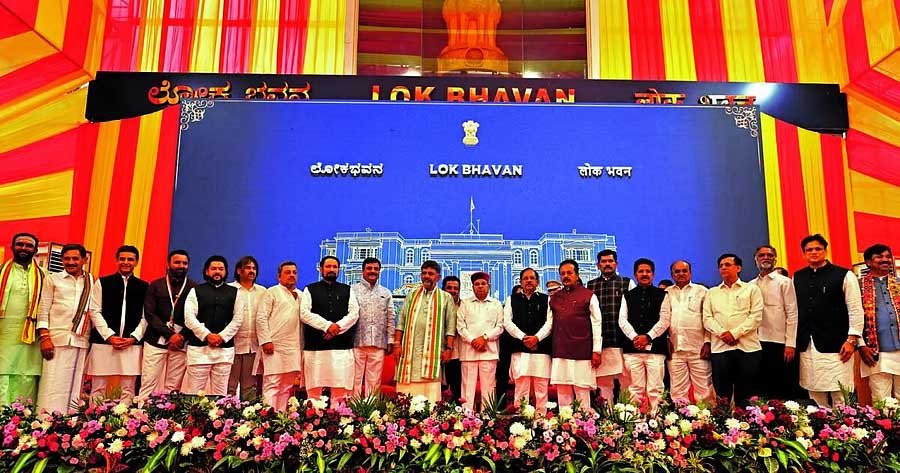
Bengaluru: The Congress government’s latest cabinet expansion appears to be a carefully crafted political exercise aimed at strengthening its social coalition ahead of the 2028 Karnataka Assembly elections. While reinforcing its traditional AHINDA support base—an acronym for minorities, backward classes, Scheduled Castes (SCs) and Scheduled Tribes (STs)—the party has also retained significant representation for the politically influential Lingayat and Vokkaliga communities.
Of the 19 legislators inducted into the cabinet on Monday, 12 belong to the AHINDA social bloc. With the expansion, 20 of the state’s 33 ministers now come from these communities, underscoring the Congress leadership’s continued emphasis on broadening its support among historically underrepresented groups.
The party has also attempted to ensure representation across several sub-castes. Haveri MLA Rudrappa Lamani’s induction provides representation to the Banjara/Lambani community, an important Scheduled Caste subgroup in Karnataka. The inclusion of C. Puttarangashetty from the Uppara community and Ajay Dharam Singh from the Rajput community further expands the cabinet’s representation among Other Backward Classes (OBCs).
In a move seen as addressing concerns within the SC (Left)/Madiga community over the implementation of internal reservation, the Congress inducted first-time MLA K.S. Basavanthappa from Mayakonda. He is currently the only first-time legislator in the state cabinet.
Despite the increased focus on AHINDA communities, the cabinet continues to reflect the political influence of Karnataka’s two dominant communities. The government now has seven Lingayat ministers and six Vokkaliga ministers, including Chief Minister D.K. Shivakumar, ensuring both communities retain a strong presence in the administration and among key portfolios.
Political observers believe the Congress hopes Shivakumar’s leadership will help consolidate support among Vokkaligas, while the party continues efforts to make inroads into the Lingayat community, traditionally regarded as the Bharatiya Janata Party’s strongest social base.
According to the socio-educational survey conducted by the H. Kantharaj-led Backward Classes Commission—which was later set aside by the Siddaramaiah government in June 2025—the Lingayat population was estimated at 66.35 lakh (11%) and the Vokkaliga population at 61.58 lakh (10.29%). Critics have argued that allocating 13 cabinet positions to these two communities amounts to disproportionate representation when compared with their estimated share of the state’s population.
The cabinet expansion also reflects regional balancing, though disparities remain. South Karnataka, comprising 15 districts, accounts for 19 ministers, while North Karnataka’s 13 districts have 13 ministers. The coastal region, consisting of three districts, is represented by only one minister, U.T. Khader.
Bengaluru continues to enjoy the highest representation in the cabinet with six ministers—K.J. George, Ramalinga Reddy, Krishna Byre Gowda, Byrathi Suresh, Zameer Ahmed Khan and Rizwan Arshad—highlighting the capital city’s continuing political importance within the Congress government.