CD Web Desk
Each is a standalone Metainvention. The 0→1 Doctrine is designed to put global standards on one scale from 0 to 1 and checks an AI decision before it runs: Authorized Intelligence. Band-Based Archive Triage (BBAT) sorts dark data (redundant, obsolete and trivial, or ROT) by labels and seals each step, so dark data could cut costs, be monetised and train AI. Together: a more comprehensive system.
LIVE www.0to1doctrine.com
THE TWO INVENTIONS AT A GLANCE
The first is a translator and checkpoint for AI. Every field measures differently: safety in one unit, finance in another, privacy in a third. The 0→1 Doctrine puts those measures on one shared scale from 0 to 1, then checks a proposed AI action against the approved limit before it runs.
The second is a sorter for stored data. Most organisations keep old files nobody dares delete. Band-Based Archive Triage (BBAT) reads only each record’s labels, never its content, and decides whether to retain, purge or promote it. Neither needs the other.
INVENTION ONE • THE PROBLEM IT SOLVES
For generations, systems were built around averages, not actual needs, so supply and demand drifted apart. A big reason is that every field measures in its own way. Safety, privacy, finance, health and trade each use different units and scales. Before they can be compared, someone must convert one into another, and different people convert differently. AI has the same problem. It can compare them safely only when their definitions and rules are common and clear.
INVENTION ONE • LIMITS BECOME BANDS
Nobody needs to invent the limits. They begin with suppliers, who declare what their products and services can do, and rise through industry norms to laws and statutory needs where those apply. The Doctrine translates each one into a band, an interval on the 0-to-1 scale, and each band declares whether higher is better or worse. A shared scale makes measures comparable, not identical, so definitions, sources, reference ranges and decision conditions travel with every band.
INVENTION ONE • WHO SETS THE LIMIT
Authority starts with the supplier’s own declaration and rises as needs require: buyers, deployment administrators, industry groups, regulators and shared councils. Each rule is recorded with its source and version, so a decision traces back to who wrote it.
INVENTION ONE • MATCH, GATE, RECEIPT
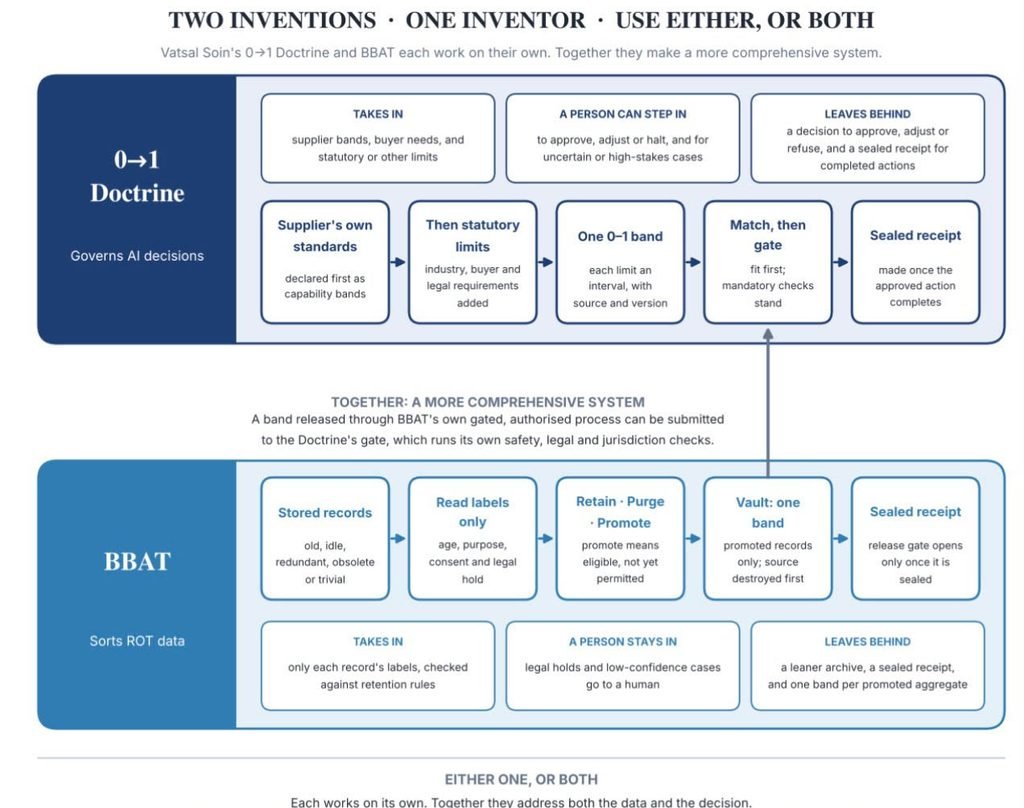
The Doctrine first checks whether what is needed fits what is offered. Then it checks the mandatory safety and legal rules; a good fit never overrides a failed rule. Unclear or high-stakes cases can go to a person. Only then may the action run. Once it is done, a sealed receipt records what was checked and decided. It shows the checks that were run, not that the data was true.
INVENTION ONE • WHERE VALUE COULD BEGIN
A hospital rule and a bank limit could be read by one engine. Decisions made on one shared language could be more consistent and easier to trace across systems. That may reduce rework and the cost of oversight.
INVENTION TWO • THE PROBLEM IT SOLVES
Most archives hold redundant, obsolete and trivial data, known as ROT or dark data. It stays because nobody can prove it safe to delete. Storage, backup and security bills return every year, and the pile slows every system that searches it. Idle data is a quiet cost line few have ever priced, and deleting it blindly risks losing records a law or a customer still needs.
INVENTION TWO • LABELS, NOT CONTENT
BBAT reads only a record’s labels, such as age, purpose, consent and legal hold, then decides: retain, purge or promote. Because only labels are read, the decision can be made without opening the content itself. Purge applies only where the verified rules require no retention, and never while a legal hold or doubt remains. Promote makes a record eligible for a separate, authorised use; by itself it never permits publishing, sharing or training. A legal hold always goes to a person first.
INVENTION TWO • FROM RECORD TO BAND
For promoted records, a sealed hardware vault, called a Trusted Execution Environment, derives one bounded band. As designed, the source is destroyed within a declared scope before anything leaves, and a hardware-controlled gate stays shut until a sealed receipt exists. What travels outward is a range, not a record, with the order of steps on receipt. Destruction covers the declared scope, not copies held elsewhere.
INVENTION TWO • WHERE VALUE COULD BEGIN
Savings could come first: less to store, back up and secure. Income could follow where buyers want a permitted band. Bands from promoted records could also supply training signals for AI, where authorised. Trust could grow where receipts shorten audits. Markets set prices, and every gain needs measuring.
USED SINGLY OR TOGETHER
Choose either invention, or both. The Doctrine can guard AI actions without BBAT, and BBAT can sort archives without the Doctrine. Used together they make a more comprehensive system: a band released through BBAT’s own gated process can be submitted to the Doctrine’s gate, which runs its own checks. A bank, for instance, could purge old logs, hold the legal ones for a person, and offer one approved band, with sealed receipts at the gated steps. The diagram shows both paths and where they meet.
WHY SUPERINTELLIGENCE NEEDS IT
AI will soon make more decisions than people can check. So the rules have to be built in from the start, not added later. Each rule is written once, in a form AI can read. The AI checks the rule before it acts, and a record is saved afterwards. Without shared rules, people can only review decisions after they are made. With them, AI stays inside the limits people set.
THE NUMBERS: ONE EXAMPLE EACH
0→1 Doctrine: A supplier says a machine runs safely between 0.40 and 0.70. A buyer needs 0.50 to 0.60. The bands overlap, so they fit. A legal ceiling of 0.55 then narrows the fit to 0.50 to 0.55, and that mandatory limit still applies.
BBAT: A rule says a record scoring below 0.30 needs no retention, and one scoring 0.80 or more is eligible for reuse. A record scoring 0.20 is purged, unless a legal hold or doubt sends it to a person. A record scoring 0.85 is promoted. A record scoring 0.50 is retained. Nobody opens the files to decide this.
CLOSING NOTE
Every measure once spoke alone. Give them a shared tongue, and idle data may wake, markets may listen, AI may be made to ask first.
LIVE www.0to1doctrine.com
This can be tested, live, via API, governed against ungoverned, side by side.
THE INVENTOR
Systems theorist, inventor and entrepreneur Vatsal Soin holds granted patents in the US, Japan, India and more; filings span six continents. His August 2026 grant covers AI footwear with Sharable Size Card (SSC). His inventions span AI apparel with Global Biometric Size Card (GBSC), digital twins, robotics, global data, quantum resilience and governance. SIM–RMIT and NTU alumnus. Every invention was a step; 0→1 is the destination.
SELECTED REFERENCES
Granted: US Patent 12,446,652 B2 • Japan Patent 7560909 • India Patents 454081 and 599317. Filed: PCT/IN2025/051943 • US 19/489,595 • India 202511115781 • Australia AU2022450649 • India 202611113867 (23 September 2026) • PCT/IN2026/052042 (1 October 2026).
DISCLAIMER
Informational only. Not certified. No endorsement implied. Not investment advice. Examples are illustrative, not field results. Vatsal Soin • © 2026 All Rights Reserved.