
 CD Web Desk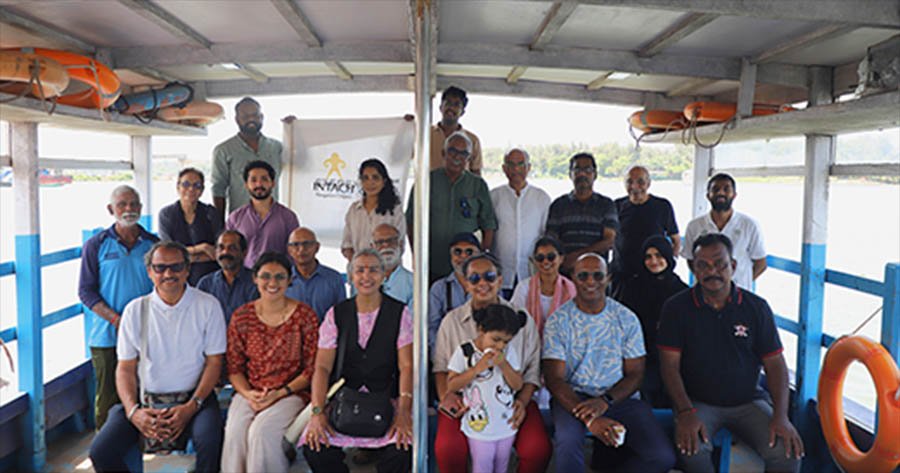
The Gurupura River was once more than a waterway for Mangaluru. It was a route for boats, a place where children learned to swim, a source of livelihood for fishing communities and a defining part of the region’s history.
Some of those memories surfaced last Sunday as the Mangaluru chapter of the Indian National Trust for Art and Cultural Heritage (INTACH) organised ‘A Morning by the River’ to mark World Rivers Day.
Beginning at the Sultan Bathery ferry point, the one-and-a-half-hour boat journey brought together nature lovers, artists and citizens for a closer look at the river, its banks and the ecological and cultural traditions that have developed around it.
But the programme was also an opportunity to remember something that is gradually disappearing from local memory: the ‘Palke’, temporary islands that once formed in the Gurupura during the monsoon.
When the river created its own islands
According to social activist Yatish Baikampady, natural debris carried downstream during the monsoon would accumulate at certain points in the river, gradually creating temporary islands known locally as Palke.
These formations were not merely curiosities in the river. They became breeding grounds for fish and, for traditional fishing communities, an important seasonal source of livelihood.
When rough seas prevented fishermen from going out, the fish around these temporary islands provided an alternative source of income.
Over time, however, the phenomenon became increasingly rare.
Baikampady attributed the disappearance of the temporary islands and the traditional knowledge surrounding them to dams and other interventions that have altered the river’s natural processes.
With the islands disappearing, a piece of knowledge about how local communities understood and lived with the river has also begun to fade.
A river at the heart of Mangaluru’s history
INTACH Mangaluru chapter convener Subhas Chandra Basu recalled the central role played by the Gurupura River in the development of Mangaluru.
Ports, forts and water transport grew around the region’s waterways, making the river an important part of its historical and economic landscape.
Yet, Basu expressed concern over the changing relationship between the city and the river, particularly the growing use of the waterway as a dumping ground for waste.
The contrast is striking: a river that once helped shape the city’s growth is increasingly being treated as a receptacle for what the city discards.
When living with the river was part of life
For chartered accountant Giridhar Kamath, the memories are more personal.
He recalled a time when the river was an integral part of everyday life, when children swam and bathed in its waters and communities were accustomed to living alongside its seasonal changes.
People, he said, had traditionally understood how to cope with floods and the behaviour of the river. Many of the flooding problems witnessed today, he suggested, are connected to human interventions that have altered natural systems.
The observations reflected a broader theme that emerged during the programme: the loss of traditional knowledge does not necessarily happen all at once. It can disappear quietly as the practices, landscapes and natural features that sustained that knowledge themselves vanish.
Memories carried by the river
As the boat moved along the Gurupura, participants shared memories of boat journeys, swimming lessons and childhood experiences connected to the river.
For some, the journey was a chance to revisit familiar landscapes from a different perspective. For others, it offered an opportunity to understand the river not simply as a geographical feature, but as part of Mangaluru’s social and cultural history.
The discussion also turned to the need to protect river ecosystems and preserve the knowledge and lifestyles that evolved around them.
The Gurupura’s story, participants suggested, is therefore not only about environmental degradation. It is also about what happens when a community loses its intimate understanding of a landscape.
A river worth remembering
‘A Morning by the River’ ended with the felicitation of Yatish Baikampady, Giridhar Kamath and artist Kishore.
But the programme’s larger message went beyond the event itself.
Rivers are often remembered through maps, bridges, ports and engineering projects. Yet their deeper histories are also preserved in the memories of fishermen, boatmen, children who learned to swim in their waters and communities that understood the seasonal rhythms of the river.
The disappearing Palke of the Gurupura are one such memory.
Once created naturally by the river, they supported fish, fishermen and a body of traditional knowledge. Their disappearance offers a reminder that when the natural character of a river changes, the human stories built around it can disappear too.
For Mangaluru, remembering the Gurupura may therefore mean remembering not just a river, but a way of life that once flowed with it.





Thank you for the memorable story of Phalguni or Gurupura River The river is still essential for the City of Mangaluru along with its sister the Nethravathi This write up should reach our elected Reps, and Chambers of Commerce who influence the developments in the city often without ensuring ecological sustainability abd health and welfare of all not only of influential lobbies
very nice article,i enjoyed it.