CD Web Desk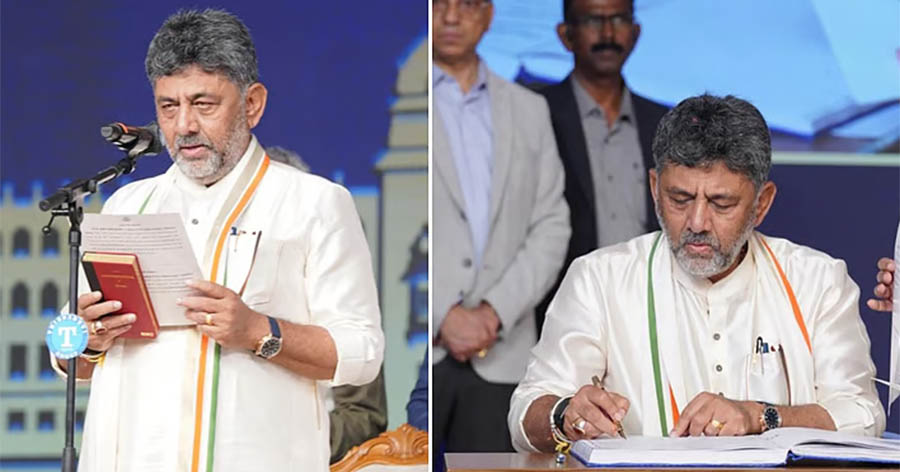
Bengaluru: D.K. Shivakumar, the 64-year-old Congress strongman from Kanakapura, was sworn in as Karnataka’s Chief Minister on Wednesday, marking the beginning of a new political chapter in the state and the culmination of a decades-long journey to the top office.
Governor Thaawarchand Gehlot administered the oath of office and secrecy at Lok Bhavan in Bengaluru, formally handing over the reins of the state to a leader widely regarded as one of the Congress party’s most influential figures in southern India.
For nearly three decades, Shivakumar built his reputation as the Congress’s go-to troubleshooter in Karnataka — a leader known for his organisational skills, political resilience and ability to navigate crises. From safeguarding the party during defections to steering crucial electoral campaigns, he emerged as one of the Congress’s most dependable strategists.
On Wednesday, that long political journey reached its defining moment.
Popularly known as “DKS”, Shivakumar assumes office days after being elected leader of the Congress Legislature Party following consultations between the state leadership and the party high command in New Delhi. His elevation comes after years of speculation, political negotiations and a prolonged leadership contest with veteran Congress leader Siddaramaiah, who stepped down last week.
The swearing-in ceremony also reflected the Congress’s effort to balance continuity and renewal.
Senior leader G. Parameshwara took oath as Deputy Chief Minister, while the first batch of ministers included K.H. Muniyappa, K.J. George, M.B. Patil, Ramalinga Reddy, Satish Jarkiholi, Krishna Byre Gowda, Priyank Kharge, U.T. Khader, Eshwar Khandre, Yathindra Siddaramaiah, Byrathi Suresh and Sharan Prakash Patil.
The cabinet line-up combines experienced administrators, influential regional leaders and emerging political faces, signalling the party’s attempt to maintain internal balance while ensuring broad social and regional representation.
Even as the ceremony unfolded, discussions continued over the final composition of the ministry. With the Karnataka cabinet permitted to have 34 members, including the Chief Minister, further expansion and portfolio allocation remain subjects of intense political consultation.
Speaking ahead of the ceremony, Shivakumar dismissed speculation over ministerial appointments, saying the final list would be decided in consultation with the Congress leadership in New Delhi.
The event itself was more restrained than originally envisioned. While the Congress had considered holding a grand public ceremony on the steps of Vidhana Soudha, concerns over traffic and logistics prompted a shift to the Glass House at Lok Bhavan.
The gathering nevertheless carried symbolic significance. Students from Shivakumar’s native village of Doddaalahalli in Kanakapura attended alongside representatives of farmers’ organisations, labour groups, civic workers, women’s self-help groups and pro-Kannada organisations.
Outside the venue, Congress supporters lined the streets around Vidhana Soudha and Lok Bhavan, waving party flags as giant LED screens broadcast the proceedings. Security arrangements were extensive, with access restricted to invited guests.
Soon after taking oath, Shivakumar was scheduled to chair his first cabinet meeting before interacting with party office-bearers and organisational leaders at the Congress’s Bharat Jodo Bhavan.
The challenges awaiting the new Chief Minister are considerable. Beyond completing cabinet formation, he must manage competing aspirations within the ruling party, maintain political momentum and deliver on governance promises in a state that remains central to the Congress’s national strategy.
For the moment, however, the spotlight belongs to a leader whose political career has been defined by persistence, patience and survival.
After years of waiting, negotiating and weathering political storms, D.K. Shivakumar has finally reached the summit of Karnataka politics.